
¡Hola, mis amigos! Mariànnà Sanchèz here, reporting live from the vibrant heart of Ecuador, where the air hums with the promise of innovation and the scent of fresh coffee. You know, sometimes I feel like we are living in a real-life science fiction novel, where every day brings a new, mind-bending development. And right now, the biggest story everyone is talking about, from the bustling markets of Guayaquil to the serene peaks of the Andes, is the seismic shift happening in the music industry, all thanks to our brilliant, sometimes bewildering, friend: artificial intelligence.
For months, we have watched with a mix of awe and apprehension as AI-generated music has moved from experimental novelty to genuine chart-topper. It is not just a few quirky tracks anymore, no. We are talking about songs crafted entirely by algorithms, mimicking human voices and instruments with uncanny precision, now racking up millions of streams on platforms like Spotify and Apple Music. This is not just a trend; it is a revolution, and it is sending shockwaves through the very foundations of how we create, consume, and value music.
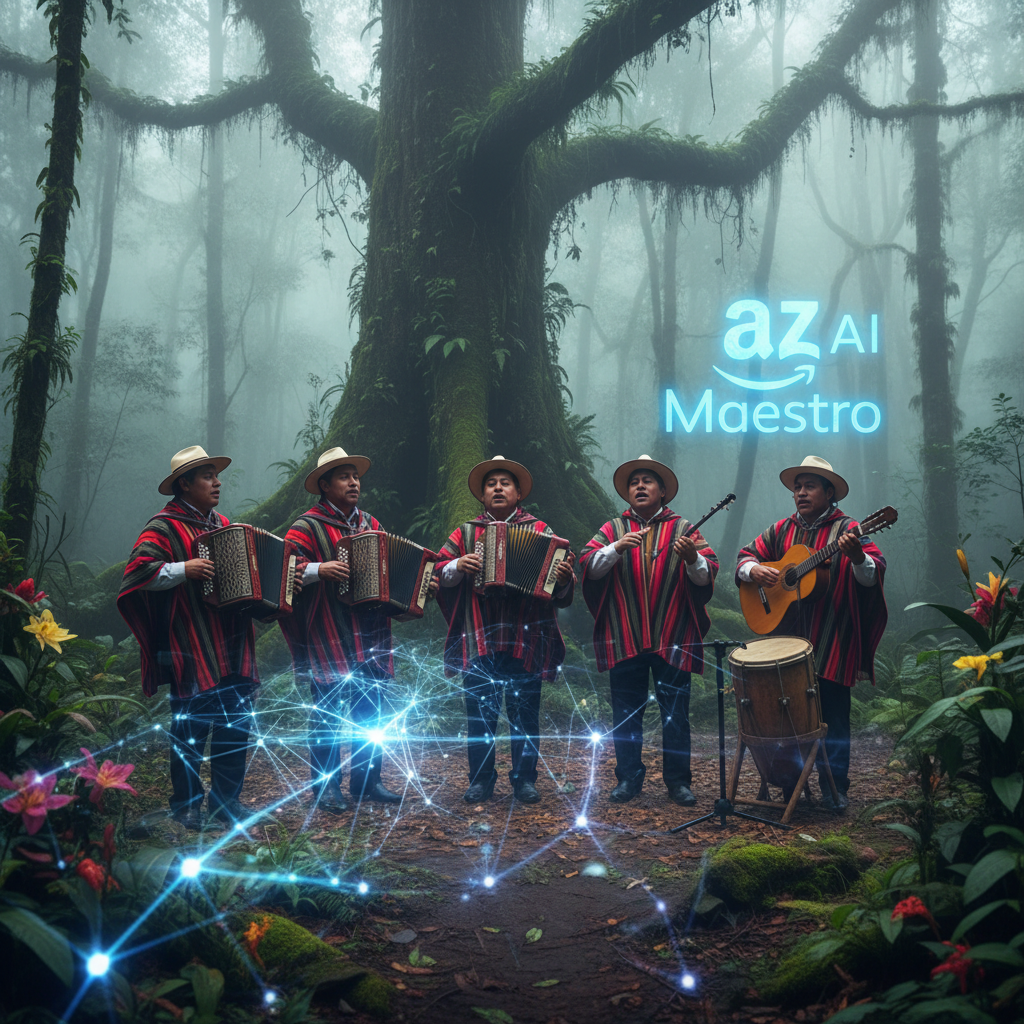
The recent buzz around Amazon's new 'Maestro AI' platform has truly ignited this conversation. This sophisticated tool, unveiled just last month, promises to let anyone, from aspiring bedroom producers to seasoned artists, generate full, commercially viable tracks with a few text prompts. Imagine saying, 'Maestro, give me a reggaeton beat with a melancholic flute melody and a female vocalist singing about lost love in Spanish,' and out comes a song that could be a hit! It is astounding, it is terrifying, and it is happening now. As a journalist who adores both technology and the rich tapestry of Ecuadorian culture, I cannot help but wonder: what does this mean for our unique musical heritage, for our 'cumbia cósmica' and 'pasillo' traditions?
This is not a theoretical debate, my friends. We are seeing real-world impact. Just last week, a track titled 'Synthwave Serenade,' credited to an AI collective called 'Neural Harmonics,' reportedly debuted in the top 20 on several global streaming charts. This song, entirely algorithmically composed and performed, bypassed traditional human artists, producers, and even record labels. It is a stark reminder that the future is not just knocking, it is already remixing our playlists. The sheer speed and scale of this shift are breathtaking, leaving many in the human-led music industry reeling.
I spoke with Dr. Elena Vargas, a renowned ethnomusicologist at the Universidad San Francisco de Quito, who shared her concerns. 'The beauty of our music, from the intricate rhythms of the Marimba Esmeraldeña to the soulful lyrics of a Pasillo, lies in its human origin, its connection to our lived experiences, our joys, our sorrows, our history,' Dr. Vargas explained. 'Can an algorithm truly understand the 'duende,' that elusive spirit of artistic expression? Can it feel the pang of nostalgia that inspires a 'pasillo,' or the communal joy of a 'cumbia' dance? I am skeptical.' Her words resonate deeply, because our music is not just sound; it is storytelling, it is identity, it is the very soul of our people.
However, not everyone views this as an existential threat. Some see it as an incredible opportunity, a democratizing force. David Guetta, the legendary DJ and producer, has been an outspoken advocate for AI's potential in music production. He famously used an AI-generated vocal on a track last year, sparking both controversy and curiosity. 'AI is a tool, just like a synthesizer or a drum machine,' Guetta stated in a recent interview with The Verge. 'It allows us to explore new creative avenues, to push boundaries we never thought possible. It is not about replacing human creativity, but augmenting it, giving artists superpowers.' This perspective offers a glimmer of hope, suggesting that AI could be a collaborator, not just a competitor.
Here in Ecuador, we are already seeing some fascinating experiments. This Ecuadorian startup, 'Andesound AI,' is developing algorithms specifically trained on indigenous Ecuadorian music samples, aiming to create new sonic landscapes inspired by our rich traditions. Their goal is not to replace, but to provide new tools for local artists to explore, to fuse ancient sounds with futuristic possibilities. It is an exciting prospect, a true blend of Ecuador's biodiversity meets AI and it's magical [blocked], but in the realm of sound!
Yet, the legal and ethical quagmires are immense. Who owns the copyright to an AI-generated song? The prompt writer? The AI developer? The original artists whose work was used to train the model? These are not easy questions, and governments and legal bodies worldwide are scrambling to catch up. The Recording Industry Association of America (riaa) and other global music organizations are actively lobbying for stricter regulations, demanding transparency and fair compensation for artists whose intellectual property forms the bedrock of these AI models. They argue that without clear guidelines, we risk devaluing human artistry and creating a Wild West where algorithms profit from the uncredited labor of countless musicians.
Consider the economic implications. If AI can produce an endless stream of royalty-free, commercially viable music, what happens to the livelihoods of session musicians, songwriters, and emerging artists? The cost of music production could plummet, making it harder for human artists to compete. This is a particularly poignant concern in countries like Ecuador, where many musicians already struggle to make ends meet, relying on live performances and modest streaming revenues. We cannot let technology inadvertently silence the very voices it claims to amplify.
However, I believe there is a unique opportunity for us, for Ecuador, in this unfolding drama. Our music, our culture, our stories are so deeply rooted, so authentic, that they possess a resilience that algorithms might struggle to replicate. The human touch, the raw emotion, the improvisational genius that defines a true Ecuadorian artist, these are qualities that transcend mere data points. Perhaps this 'existential crisis' will force us to cherish and champion our human artists even more, to recognize the irreplaceable value of their unique contributions.
The future of music is not about whether AI will create songs, because it already is. The real question is how we, as a global community, choose to integrate this powerful technology responsibly. Will we allow it to dilute the very essence of human creativity, or will we harness it to unlock new dimensions of artistic expression, while fiercely protecting the rights and livelihoods of our human creators? I remain an optimist, believing that the ingenuity that brought us AI can also guide us to a harmonious coexistence. But it will require thoughtful dialogue, proactive regulation, and a steadfast commitment to preserving the human heart of music. The symphony of the future is being composed right now, and we all have a part to play in ensuring it sings with soul, not just with code. And you know, I have a feeling that the 'cumbia cósmica' will find a way to thrive, no matter what. After all, it is the rhythm of our people. It is the Galápagos of technology, evolving and adapting, always. What an exciting time to be alive! What an exciting time to be in Ecuador! I cannot wait to see what melodies emerge from this fascinating crossroads. Stay tuned, mis amigos, the beat goes on! And you can always find more insights on this evolving landscape at TechCrunch.