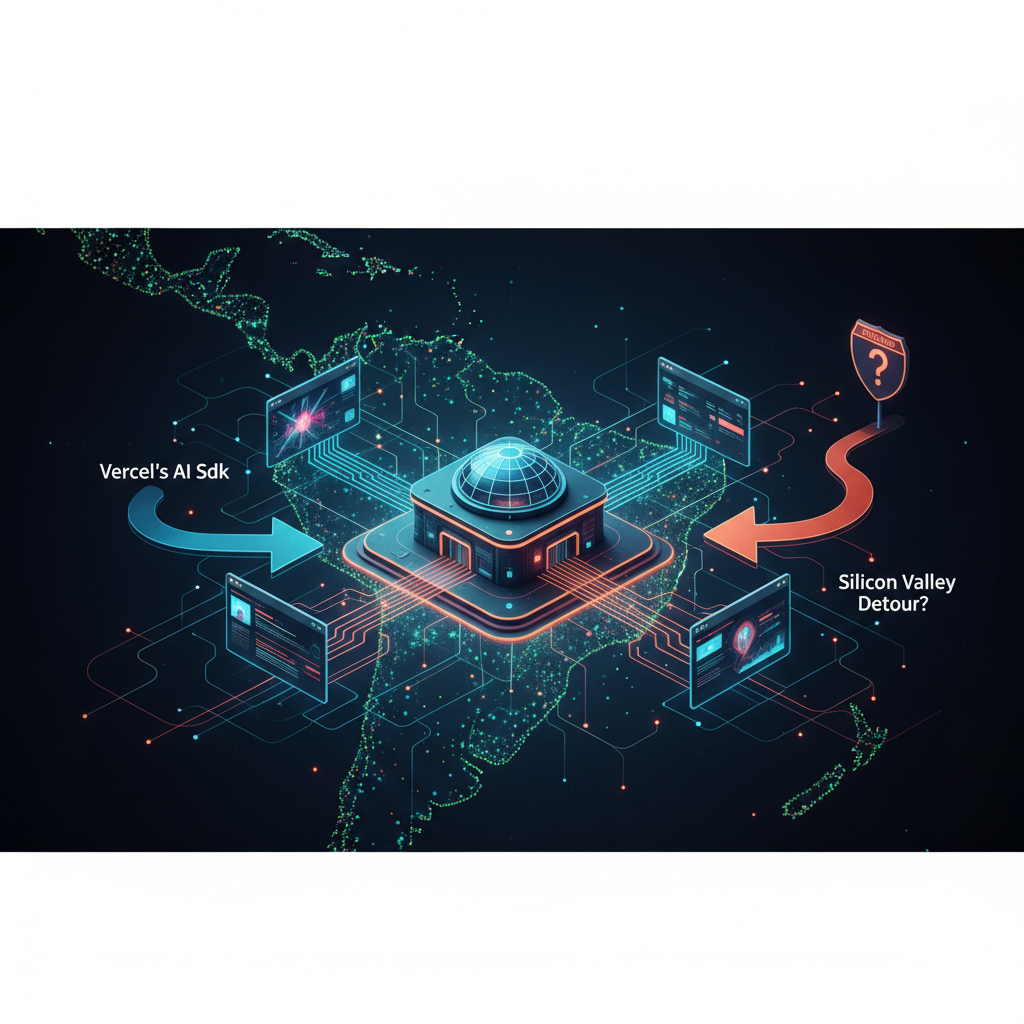

You know, sometimes I look at these tech trends coming out of Silicon Valley, and I think, 'Is this a real movement, or just a new flavor of açai for the same old crowd?' But then something like Vercel's AI SDK comes along, and it makes you pause. The idea that every single website, every digital storefront, every little blog, will soon have an AI layer baked right in, it's a vision that's both thrilling and a little bit terrifying. Is this a fad, a passing samba beat, or are we witnessing the fundamental reshaping of the internet as we know it, a digital 'rodoviária' where every bus stop has a super-intelligent attendant? My gut tells me it's the latter, and the implications for a country like Brazil are enormous.
Let's rewind a bit, shall we? For decades, the internet has been largely a static experience, or at least, a predictable one. You click, you navigate, you read, you buy. Interactivity has evolved, sure, from simple forms to complex single-page applications, but the core interaction model remained largely human-driven. Then came the large language models, the LLMs, and suddenly, the digital world started talking back in ways we never imagined. First, it was chatbots on customer service pages, often clunky and frustrating. But now, with tools like Vercel's AI SDK, the promise is far grander: an intelligent co-pilot, a personalized guide, an instant translator, all embedded directly into the fabric of the site itself.
Vercel, for those who might not be intimately familiar, is a platform known for making web development faster and more efficient, particularly with technologies like Next.js. Their AI SDK is essentially a toolkit that allows developers to easily integrate AI capabilities, powered by models from OpenAI, Anthropic, or even custom ones, directly into their web applications. Think about it: a few lines of code, and suddenly your e-commerce site can offer real-time product recommendations based on a user's conversational query, or your news portal can summarize complex articles on demand, or your government services site can guide citizens through bureaucratic processes in plain Portuguese. It's about making AI not just an add-on, but an intrinsic part of the user experience.
This isn't just about making things 'smarter,' my friends. It's about fundamentally changing how we interact with information and services online. Imagine a small business in the interior of Minas Gerais, selling artisanal cheeses. With an AI layer, their website could answer customer questions about ingredients, suggest wine pairings, or even handle complex shipping inquiries to São Paulo, all without a human in the loop. This level of accessibility and automation, previously reserved for tech giants, is now within reach for everyone. It's a powerful equalizer, if we play our cards right.
Of course, the big players are already all over this. Google, with its Gemini models, and Microsoft, with its Copilot integrations across its ecosystem, are pushing AI into every corner of the web. OpenAI's APIs are the backbone for countless startups leveraging this trend. But Vercel's approach is particularly interesting because it's developer-centric, empowering the builders of the web to infuse AI directly. It's like giving every 'pedreiro' a new, powerful tool to build smarter homes, not just bigger ones.