
Let us be frank. The global AI conversation, for far too long, has been dominated by a handful of titans in Silicon Valley, their pronouncements echoing across the digital landscape like decrees from Mount Olympus. OpenAI, Google, Anthropic, they all want you to believe that the future of artificial intelligence is a meticulously crafted, proprietary black box, accessible only through their carefully controlled APIs and subject to their whims. They speak of safety, of alignment, of responsible AI, and while these are noble pursuits, I see something else entirely: a digital enclosure movement, designed to centralize power and stifle the very innovation they claim to champion.
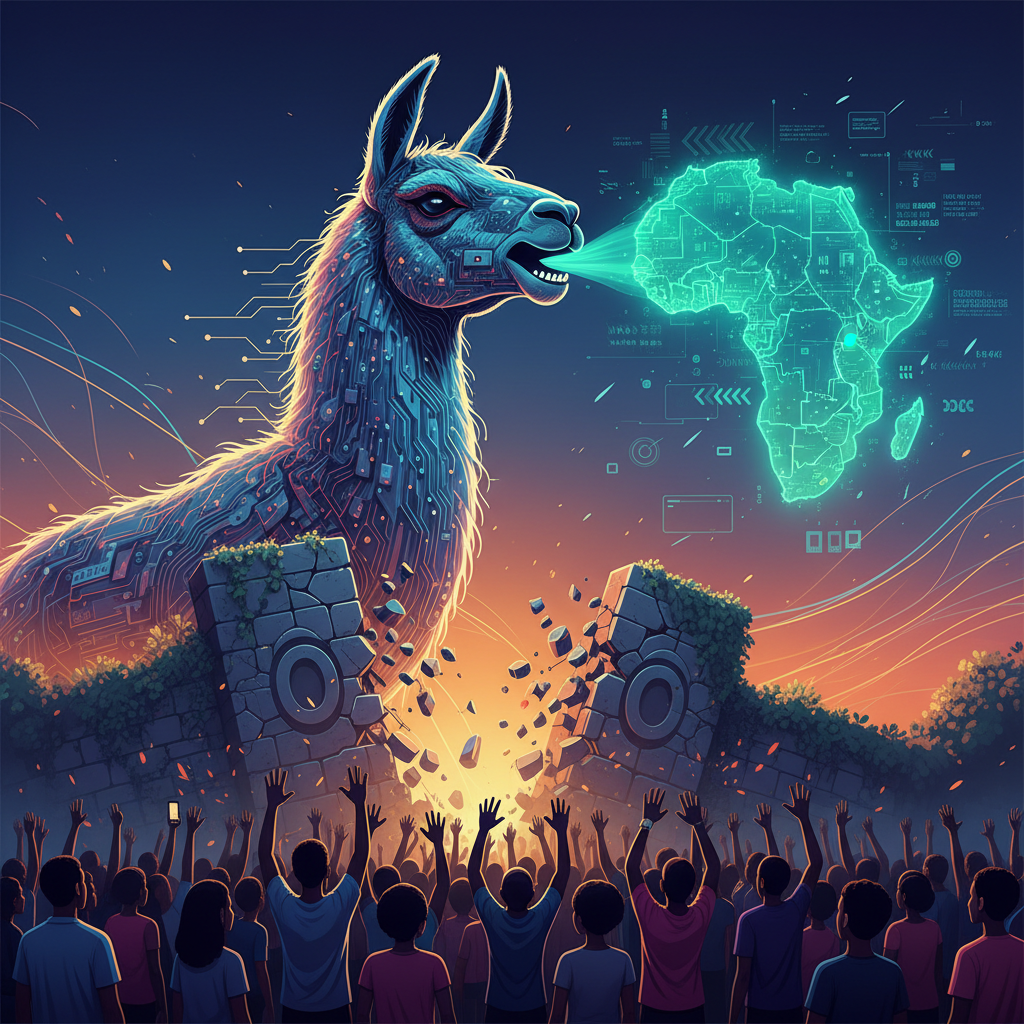
But a new wind is blowing, a powerful Harmattan wind carrying the scent of change and opportunity across our continent. And its name, my friends, is Llama. Meta, under the often-underestimated leadership of Mark Zuckerberg, has done something truly revolutionary by open-sourcing its Llama models. They have effectively handed the keys to the kingdom to developers, researchers, and entrepreneurs worldwide, particularly those of us in emerging markets who have historically been relegated to the sidelines. This is not merely a technical decision; it is a geopolitical one, a strategic masterstroke that will redefine the global AI landscape for decades to come.
Consider the alternative, the walled gardens of OpenAI's GPT and Google's Gemini. Access is often expensive, usage is restricted, and the underlying architecture remains a closely guarded secret. For a startup in Yaba, Lagos, or a research team in Accra, Ghana, building on these closed platforms means constantly dancing to someone else's tune, always vulnerable to policy changes, price hikes, or even outright exclusion. How can we truly innovate, truly build solutions tailored to our unique challenges, when the foundational tools are held hostage by foreign corporations? It is like being given a magnificent car, but not the engine schematics, nor the right to repair it, nor even the freedom to drive it where you please. It is a dependency model, and Africa has had enough of those.
Meta’s Llama, particularly the more recent iterations like Llama 3, changes this equation entirely. By making the model weights, architectures, and even some training methodologies publicly available, Meta has democratized access to cutting-edge AI. This is not just about cost savings, though that is a significant factor for cash-strapped startups. It is about sovereignty, about customization, and about fostering a truly global, diverse ecosystem of AI development. We can fine-tune these models on local languages, on African datasets, to understand our cultures, our proverbs, our specific needs, without asking for permission or paying exorbitant fees. We can build AI that speaks Yoruba, Igbo, Hausa, Swahili, and countless other languages with native fluency, not just as an afterthought translation layer.
I have seen firsthand the energy this has unleashed. Just a few months ago, I was at a hackathon in Abuja, and the sheer ingenuity on display, powered by Llama, was breathtaking. Teams were building AI tutors for rural schools, diagnostic tools for community clinics, and even creative AI assistants for Afrobeats producers, all leveraging the power of an open model. This is the real impact: not just bigger, more complex models, but models that are truly useful, truly accessible, and truly adaptable to the myriad contexts of human experience. As Dr. Timnit Gebru, a leading voice in ethical AI and founder of the Distributed AI Research Institute, has often emphasized, the power dynamics of AI development are critical. Open-source models fundamentally shift that power, empowering local communities and researchers to shape their own technological futures. She has consistently advocated for approaches that foster independent research and development, particularly for marginalized communities, and Meta's move aligns with that vision.
Now, I hear the counterarguments. The purists will argue that open-source models are less controlled, potentially more prone to misuse, or that they lag behind the bleeding edge performance of their closed counterparts. They will point to the immense compute resources required to train models like GPT-4 or Google's latest Gemini iterations, suggesting that only the giants can truly push the boundaries. And yes, there is a kernel of truth in some of these points. Training billion-parameter models is an astronomically expensive endeavor, and safety guardrails are indeed crucial. Nobody is advocating for a free-for-all that ignores ethical considerations.
However, these arguments miss the forest for the trees. The notion that closed models are inherently safer is a fallacy. Safety is a function of design, deployment, and ongoing vigilance, not secrecy. In fact, open-sourcing allows for a far broader community of experts to scrutinize, identify vulnerabilities, and contribute to making models more robust and ethical. It is a collective intelligence approach to safety, rather than a centralized, opaque one. Furthermore, the performance gap is rapidly closing. The open-source community, fueled by global talent and collaborative spirit, is iterating at an astonishing pace. Projects like Mistral AI, a European champion, are demonstrating that smaller, more efficient open models can rival or even surpass the performance of much larger proprietary ones for specific tasks. Their innovations are a testament to the power of open collaboration, a model that Meta has embraced with Llama. As Arthur Mensch, CEO of Mistral AI, has stated,