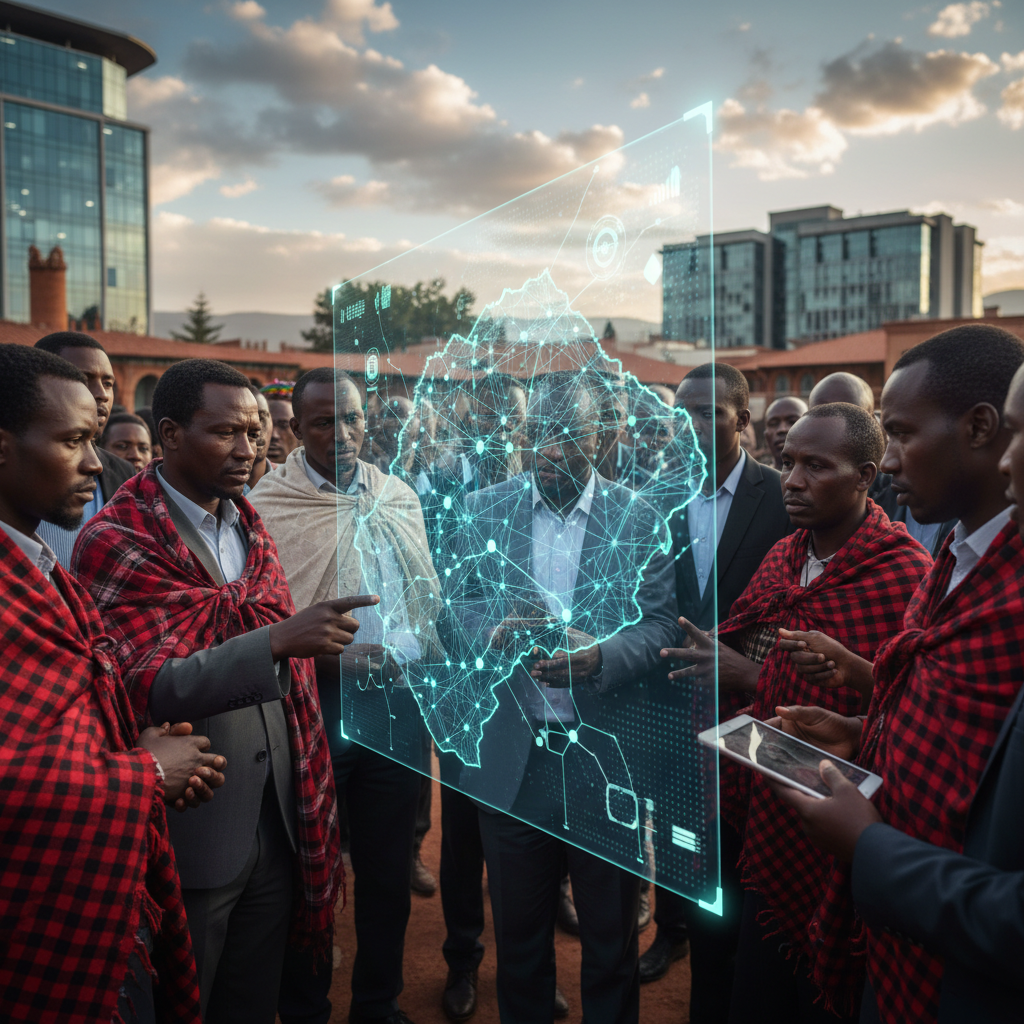

The digital winds of change are sweeping across the globe, carrying with them the promise and peril of artificial intelligence. In the high-altitude kingdom of Lesotho, a nation often overlooked in the grand narratives of technological advancement, the conversation around 'sovereign AI' has begun to echo through the corridors of power. This concept, where nations develop and control their own AI models and infrastructure, is touted as the ultimate safeguard against external influence and a beacon of national self-determination. But as a journalist from these mountains, I have learned to look beyond the glittering promises and ask a fundamental question: what they're not telling you.
The push for sovereign AI is not merely an academic exercise, it is a geopolitical imperative. Major powers like China and the United States have long understood the strategic value of controlling advanced technologies. Now, a growing chorus of nations, from the European Union to emerging economies in Africa, are seeking to carve out their own digital destiny. The stated goal is noble: to protect national data, ensure ethical alignment with local values, and foster economic independence. Yet, the path to achieving this is fraught with challenges, not least of which is the immense capital and expertise required.
For a country like Lesotho, with its modest GDP and nascent tech sector, embarking on such an ambitious journey seems, at first glance, an insurmountable task. Our nation, rich in water but lean in digital infrastructure, has historically relied on external partners for much of its technological backbone. The idea of building our own large language models, our own foundational AI, sounds like a dream spun from the finest mohair, but a dream nonetheless.
However, the narrative is shifting. Smaller nations are not necessarily aiming to compete with OpenAI or Google directly. Instead, they seek to leverage open source models, adapt them with local data, and develop applications tailored to their specific needs. This is where the true intrigue begins. Who are the architects of these initiatives, and more importantly, who stands to gain?
"The notion of sovereign AI for a country like Lesotho is not about building an NVIDIA equivalent from scratch," explained Dr. Puleng Mofokeng, a leading expert in digital policy at the National University of Lesotho. "It is about data sovereignty, about ensuring that our unique linguistic heritage, our agricultural practices, and our public health data are not processed and controlled by algorithms trained exclusively on Western datasets. It is a matter of cultural preservation and national security." Dr. Mofokeng's perspective highlights a crucial point: the value lies not just in the models themselves, but in the data that feeds them and the applications they serve.
Sources close to the Ministry of Communications, Science, Technology, and Innovation confirm that preliminary discussions are underway regarding a national AI strategy. These discussions reportedly involve partnerships with regional bodies and international development agencies. The proposed strategy includes developing a national data repository, investing in AI literacy programs, and exploring the feasibility of a 'Sesotho-first' large language model. The estimated initial investment for such an undertaking, even in its most modest form, is projected to be in the range of 500 million Loti, a substantial sum for our national budget.
But the devil, as always, is in the details. The global AI landscape is dominated by a handful of powerful corporations and nations. Even open source models, while offering greater flexibility, often originate from these same dominant players. The question then becomes: are we truly building sovereignty, or are we merely becoming sophisticated consumers of technology developed elsewhere, albeit with a local veneer? Reuters has extensively covered how even ostensibly 'sovereign' projects often rely heavily on foreign hardware and foundational software.
Consider the case of a neighboring country, which recently announced a major partnership with a European AI firm to develop a national AI platform. On the surface, it appeared to be a triumph of local innovation. Yet, a closer examination of the contract revealed that the intellectual property rights for the core algorithms remained largely with the European partner, and the data processing infrastructure was to be hosted on servers outside the continent. This arrangement, while providing immediate technological access, raised serious questions about long-term control and true data sovereignty. It is a cautionary tale for any nation, including ours, embarking on this path.
"We must be vigilant," cautioned Mr. Thabo Lerotholi, a veteran investigative journalist based in Maseru, who has spent decades exposing corruption. "When large sums of money are involved, and the technology is complex, opportunities for rent-seeking and undue influence multiply. We need transparent procurement processes, clear ownership structures, and robust oversight. Otherwise, 'sovereign AI' could become another avenue for external entities to extract value, leaving us with the bill and little true control." His words resonate deeply in a country where the promise of development has, at times, been overshadowed by the reality of exploitation.
The allure of sovereign AI is undeniable. Imagine AI models trained on Basotho history, culture, and language, capable of assisting in education, healthcare, and agricultural planning in ways that foreign models simply cannot. Imagine a national AI system that predicts drought patterns specific to the Maloti Mountains, or helps diagnose diseases prevalent in our communities, using data collected and owned by Basotho for Basotho. This is the vision that inspires.
However, the practicalities are sobering. The talent pool in Lesotho, while growing, is small. Attracting and retaining top AI engineers and researchers requires competitive salaries and advanced infrastructure. The cost of high-performance computing, essential for training large models, is astronomical. A single high-end NVIDIA GPU, a critical component for AI development, can cost more than the average annual income in Lesotho. Scaling this up to national infrastructure is a monumental financial undertaking. MIT Technology Review often details the immense resource requirements for cutting-edge AI development.
Furthermore, the ethical considerations are profound. Who defines the