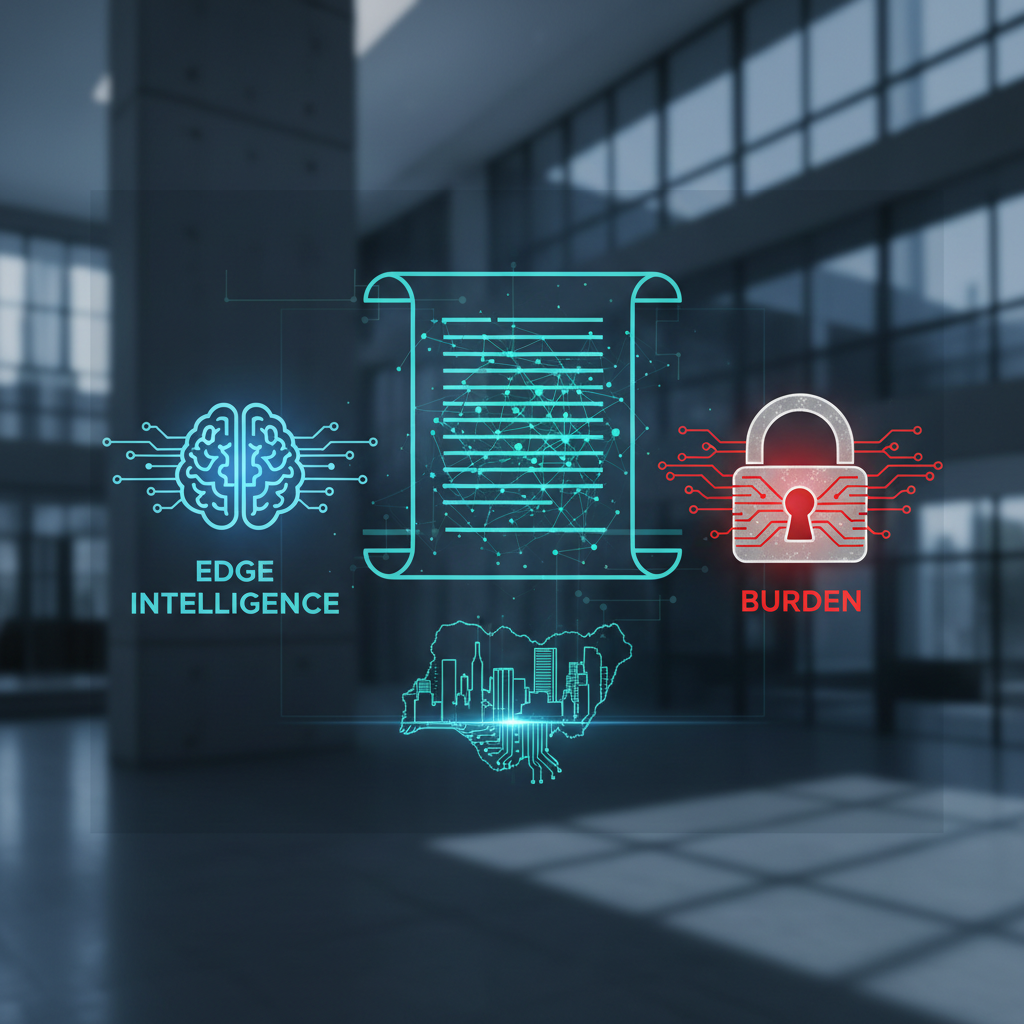

The digital drums are beating a new rhythm across Lagos, and indeed, all of Nigeria. It's a rhythm that speaks of autonomy, of data that stays home, and of intelligence that lives not in distant clouds, but right here, on our devices, in our hands, and in our communities. I am talking about Edge AI and on-device intelligence, and the Nigerian government, through the National Information Technology Development Agency, Nitda, has finally stepped into the arena with a bold, some might say audacious, new policy framework.
This isn't just another bureaucratic pronouncement, my friends. This is a foundational decree, a digital igba nkwu ceremony, if you will, marrying our burgeoning tech ecosystem to a future where AI isn't just consumed, but built, owned, and controlled from within. The 'National Policy on Edge AI and On-Device Intelligence Governance' was unveiled last month, and it aims to set the ground rules for how AI models operate directly on devices like smartphones, smart sensors, and local servers, rather than relying solely on centralized cloud infrastructure. Mark my words, this move is less about immediate compliance and more about a long game, a strategic play for digital self-determination in a world increasingly dominated by foreign tech giants.
Who's Behind This and Why?
The architects of this policy are primarily Nitda, under the watchful eye of the Federal Ministry of Communications, Innovation, and Digital Economy. Their motivation is clear, almost palpable. For years, Nigeria has been a massive consumer of technology, a digital marketplace for innovations born in Silicon Valley, Beijing, and Berlin. Our data, our digital lives, often traverse international borders, processed and stored in servers far from our shores. This reliance creates vulnerabilities, raises privacy concerns, and, crucially, limits our capacity for innovation and economic growth.
“We cannot build a truly sovereign digital economy if the intelligence powering our daily lives resides entirely outside our control,” stated Dr. Isa Pantami, former Minister and a key proponent of digital transformation, in a recent private briefing. “This policy is about empowering Nigerian developers, securing Nigerian data, and ensuring that the benefits of AI are localized, not expatriated.” The government sees Edge AI as a pathway to greater data privacy and security, reduced latency for critical applications, and a significant boost to local content development and job creation. Imagine AI-powered agricultural sensors providing real-time insights to farmers in rural Kano without needing constant internet access, or smart traffic systems in Abuja optimizing flow even when the network is patchy. These are the visions driving this policy.
What It Means in Practice
In practical terms, the policy mandates a tiered approach to Edge AI deployment. It categorizes AI systems based on their risk profile, similar to what we see in Europe's AI Act, but with a distinctly Nigerian flavor. High-risk Edge AI systems, those impacting critical infrastructure, healthcare, or national security, will face stringent regulatory oversight, requiring local data processing, robust security protocols, and verifiable ethical frameworks. Medium and low-risk systems will have more flexibility, but still need to adhere to data protection laws like the Nigeria Data Protection Act, Ndpa, and ensure transparency in their operations. Furthermore, the policy encourages the development of open-source Edge AI frameworks and hardware, aiming to reduce dependence on proprietary foreign solutions. This includes incentives for local manufacturing of AI-enabled devices and the establishment of local AI research and development hubs.
Consider the implications for our burgeoning fintech sector. Mobile money agents, for instance, could leverage on-device AI for fraud detection or personalized financial advice, even in areas with unreliable connectivity. This could unlock financial services for millions more Nigerians. The policy is also a clarion call for local talent. “We are not just talking about importing models; we are talking about training our own models on our own data, for our own unique challenges,” explained Professor Ndubuisi Ekekwe, a prominent voice in African innovation, during a panel discussion at the Lagos Tech Fest. “This requires a new generation of AI engineers, data scientists, and ethicists, all right here at home.”
Industry Reaction: A Mix of Excitement and Apprehension
The industry's response has been, predictably, a mixed bag of optimism and apprehension. Local startups, particularly those in the hardware and embedded systems space, are cautiously optimistic. “This is the push we needed,” said Tunde Ajayi, CEO of a Lagos-based startup developing AI solutions for smart cities. “For too long, we've been building for the cloud. Now, the government is signaling that on-device intelligence is not just viable, but preferred. It opens up massive opportunities for localized solutions that are genuinely relevant to our context.” He sees a future where Nigeria will lead this revolution, tailoring AI to our unique challenges.
However, larger, established tech companies, especially those with significant cloud infrastructure investments, are expressing concerns about the potential for increased compliance costs and fragmentation of the market. A representative from a major telecommunications provider, who preferred not to be named due to ongoing discussions with Nitda, voiced his worries. “While the intent is noble, the implementation could be a nightmare. We already operate in a complex regulatory environment. Adding mandates for local processing and specific hardware requirements for Edge AI could stifle innovation, not accelerate it, and potentially increase costs for consumers.” He pointed out that the global trend, according to TechCrunch, still heavily favors cloud-based AI for its scalability and computational power. The concern is that overly strict regulations could isolate Nigeria from global AI advancements, making it harder to attract foreign investment and talent.
Civil Society Perspective: The Privacy Paradox
Civil society organizations, particularly those focused on digital rights and privacy, view the policy with a critical but hopeful eye. They welcome the emphasis on data localization and privacy, seeing it as a potential bulwark against surveillance and misuse of personal information. “When data stays on the device, or at least within national borders, it’s inherently more secure from foreign state actors and commercial exploitation,” noted Adaobi Okoro, a legal analyst with the Digital Rights Foundation of Nigeria. “However, the devil is in the details of enforcement. Will Nitda have the capacity and independence to truly audit these systems? Will there be clear avenues for redress if an on-device AI system infringes on an individual's rights?”
There’s a paradox here. While Edge AI promises enhanced privacy by keeping data local, the very nature of on-device intelligence means AI models are constantly processing personal data, often without explicit user interaction. This raises questions about consent, transparency, and the potential for algorithmic bias to be embedded directly into the devices we carry. According to a recent report by Wired, the ethical implications of ubiquitous Edge AI are still largely unexplored, even in more developed economies. For Nigeria, where digital literacy varies widely, ensuring citizens understand and can control how their on-device AI works will be a monumental task.
Will It Work?
So, will this ambitious policy truly work? Will Nigeria become a leader in Edge AI, or will it become another regulatory hurdle that stifles innovation? My take, and I've seen enough cycles in this space to know a few things, is that its success hinges on several critical factors. First, enforcement must be pragmatic and adaptive. Nitda cannot afford to be rigid; it must collaborate closely with industry to understand the practicalities of implementation. Second, investment in local talent and infrastructure is non-negotiable. We need more than policies; we need world-class AI labs, accessible computing resources, and robust educational programs. The future is already here because it's just not evenly distributed, and we must distribute the knowledge and tools widely across our nation.
Third, and perhaps most importantly, is the commitment to an open and collaborative ecosystem. If the policy inadvertently creates a closed garden, it will fail. Nigeria’s strength lies in its entrepreneurial spirit and its ability to adapt. If this policy fosters an environment where local developers can innovate freely, where data is protected but also leveraged for public good, and where the benefits of AI are shared equitably across our diverse population, then yes, it will work. It won't be easy, and there will be bumps along the way, but the potential for Nigeria to leapfrog into a position of digital leadership through intelligent, localized AI is immense. This is not just about technology; it is about our future, our identity, and our place in the global digital economy. The world is watching. And so am I.