
The morning sun was already beating down on Bree Street in Johannesburg, painting long shadows from the towering office blocks. Inside one of them, Thandi, a bright young analyst at a major financial firm, was staring at her screen. Her task: consolidate market research from a dozen internal documents and external reports, a job that used to take days of sifting through disparate databases. Today, she just typed a query into Glean, the enterprise AI search platform her company adopted last year, and watched as relevant snippets and summarized insights popped up almost instantly. It felt like magic, a true leap forward for productivity. But as I watched her, a question lingered, one that often keeps me up at night: What does this instant gratification do to our minds, to our very way of thinking?
Glean's recent announcement of over $200 million in annual recurring revenue (ARR) is a testament to the insatiable corporate appetite for efficiency. Companies globally, including a growing number here in South Africa, are pouring resources into these sophisticated AI tools, promising to unlock knowledge and streamline operations. The narrative is always one of empowerment: AI handles the mundane, freeing humans for higher-order thinking, creativity, and strategic decision making. And on the surface, it makes perfect sense. Why spend hours searching when an AI can do it in seconds?
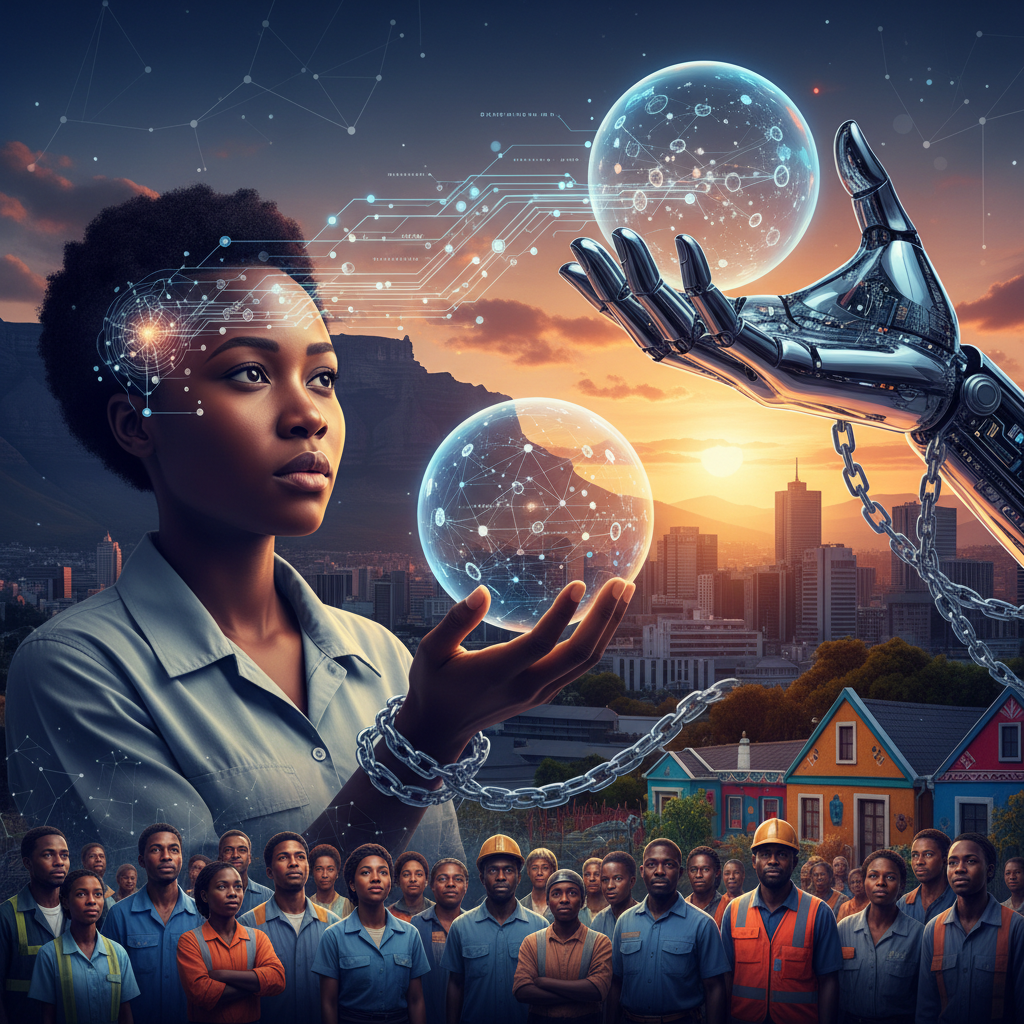
However, the human brain is a muscle. Like any muscle, if you stop exercising it, it atrophies. When AI platforms like Glean perform the heavy lifting of information retrieval and synthesis, what happens to our own cognitive muscles for critical evaluation, pattern recognition, and deep contextual understanding? This isn't just a tech story because it's a justice story, a story about how we shape the minds of our future workforce, especially in a continent striving for intellectual and economic self-determination.
Recent research from the University of Cape Town's Department of Psychology suggests a nuanced picture. Dr. Naledi Mkhize, a cognitive psychologist specializing in human computer interaction, shared her concerns with me. "We're seeing a phenomenon we call 'cognitive offloading,'" she explained, her voice calm but firm. "When AI reliably handles complex information tasks, individuals tend to rely on it more and more, potentially reducing their own capacity for independent problem solving. It's not about making us dumb, but about shifting where the 'work' of cognition happens. The risk is that we lose the ability to discern when the AI is wrong, or when its synthesis misses crucial, nuanced context that a human would pick up."
Let that sink in. The very tools designed to make us more effective could, paradoxically, be making us less discerning. Imagine a doctor relying solely on an AI diagnostic tool without understanding the underlying physiological processes, or an engineer trusting an AI's structural analysis without a deep grasp of physics. The consequences could be dire. In the corporate world, this might manifest as a workforce less capable of independent critical thought, more prone to accepting AI outputs at face value, and ultimately, less innovative. This is particularly concerning for developing economies like ours, where critical thinking and adaptability are paramount for navigating complex challenges and fostering local innovation.
I spoke with Mr. Sipho Dlamini, CEO of a Johannesburg based fintech startup that has integrated Glean into its operations. "For us, it's been a game changer for speed and access to information," he told me, gesturing emphatically. "Our teams can find what they need in moments, not hours. This allows them to focus on developing new products and serving our customers better. We've seen a 30 percent increase in project completion rates since implementation." His enthusiasm is understandable, and the immediate benefits are undeniable. But I pressed him on the long term. "Are you actively training your staff to critically evaluate the AI's output? To challenge it, to understand its limitations?" He paused, considering. "That's an excellent point, Amahlé. We probably need to do more in that area."
Here's the thing nobody's talking about: the psychological contract we're forming with these AI systems. We're outsourcing not just tasks, but potentially parts of our cognitive process. This raises profound questions about agency and intellectual ownership. If an AI synthesizes a report, who truly owns the insights? If a decision is based on AI derived information, who bears the responsibility if it goes awry? These are not abstract philosophical debates; they are practical challenges facing businesses and individuals right now.
Dr. Aisha Khan, a research fellow at the African Institute for AI Ethics, emphasized the need for a balanced approach. "The solution isn't to reject these powerful tools, but to integrate them mindfully," she argued. "We need to cultivate what we call 'AI literacy,' which goes beyond simply knowing how to use the tool. It means understanding its underlying mechanisms, its biases, its limitations, and developing the human skills to complement and critically evaluate its outputs. For African nations, this is an opportunity to leapfrog, but only if we do it with intention and foresight, ensuring our human capital remains robust."
This mindful integration means investing in training that teaches employees not just how to use Glean or similar platforms from Google or Microsoft, but how to think alongside them. It means fostering environments where challenging AI outputs is encouraged, not seen as inefficiency. It means recognizing that true intelligence, the kind that drives innovation and societal progress, is a uniquely human endeavor, enhanced but not replaced by machines. The Ubuntu philosophy, 'I am because we are,' reminds us that our strength lies in our collective humanity and interconnectedness. Technology should serve to amplify this, not diminish our individual cognitive contributions.
As Glean and other enterprise AI solutions continue their rapid expansion, reaching into more offices across our continent, the onus is on us, the users, the leaders, and the educators, to ensure we are not trading short term productivity gains for long term cognitive decline. We must demand transparency, advocate for robust AI literacy programs, and consciously cultivate the critical thinking skills that define us as humans. The future of work, and indeed the future of our minds, depends on it. For more insights into the ethical implications of AI, you can explore resources like MIT Technology Review or Wired's AI section. We must ensure that as technology advances, our humanity advances with it, not despite it.