The sun rises here in Tahiti, painting the sky with hues that no artist could truly replicate, not even with the most advanced digital tools. Yet, as the world embraces generative artificial intelligence, I find myself thinking about how these new technologies, like Adobe Firefly, are beginning to weave themselves into the very fabric of our creative expression, even in a place as steeped in tradition as French Polynesia.
For generations, our stories have been told through intricate tifaifai quilts, powerful tatau tattoos, and vibrant pareu designs. These are not just images; they are narratives, genealogies, and spiritual connections passed down through the hands of our ancestors. So, when tools like Adobe Firefly burst onto the scene, promising to generate images from simple text prompts, it naturally brings a mix of wonder and apprehension to our shores. It makes us ask: what does this mean for the hands that have always created?
Adobe Firefly, for those unfamiliar, is Adobe's suite of generative AI models, integrated directly into popular creative applications like Photoshop and Illustrator. It allows designers to quickly generate images, alter existing ones, or create text effects with remarkable ease. It's a powerful tool, one that has been widely adopted by the global creative industry, seeing millions of users experiment with its capabilities since its initial launch. The company has been clear about its commitment to ethical AI, training Firefly on licensed content and public domain images, a move that has helped it gain trust among artists concerned about intellectual property, a critical issue for many creators worldwide. According to The Verge, Adobe has positioned Firefly as a co-pilot, an assistant to human creativity, rather than a replacement.
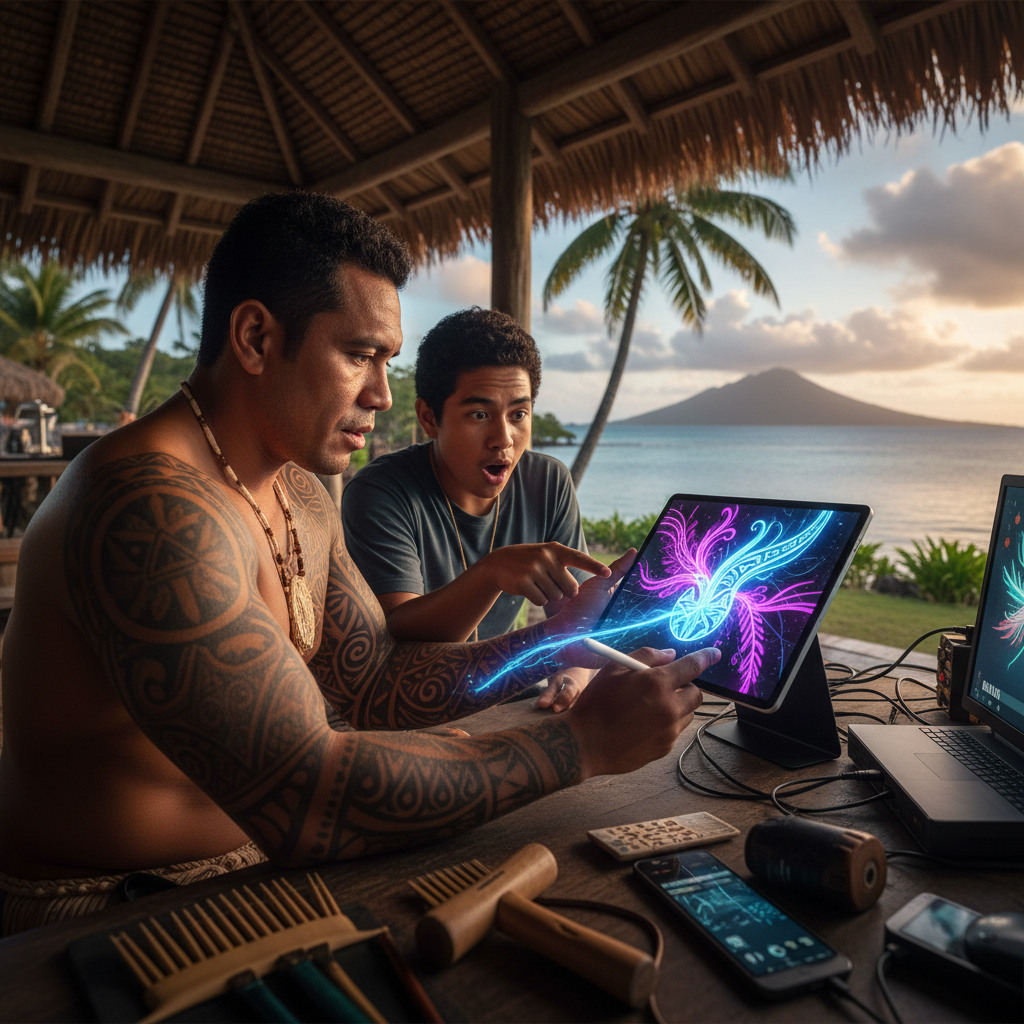
Here in French Polynesia, the conversation around generative AI is perhaps more nuanced. Our artists, particularly those working in traditional forms, are guardians of cultural heritage. The idea of an algorithm generating a tatau pattern, for example, raises questions about authenticity, spiritual significance, and the deep personal journey involved in receiving such a mark. "Our art is not just about aesthetics; it is about identity, about our connection to the land and the ocean," explains Teiki, a renowned tatau artist from Moorea, his needles poised over a client's arm. "An AI can create a pretty picture, yes, but can it understand the mana? Can it feel the ancestors' whispers in the design?" His words echo a sentiment shared by many here, a respect for the intangible spirit that infuses our creative works.
Yet, the practicality and potential of Firefly are hard to ignore. For local graphic designers, small business owners, and tourism operators, it offers unprecedented efficiency. Imagine a small guesthouse owner in Bora Bora needing quick, high-quality promotional images. Instead of hiring a photographer or spending hours on stock photo sites, they can use Firefly to generate stunning visuals of a fare (bungalow) against a sunset, or a va'a (outrigger canoe) gliding across a turquoise lagoon. This democratizes access to professional-grade visuals, a significant advantage for businesses in remote locations where resources might be limited. "For my small shop selling handmade pareu, Firefly has been a game-changer," says Hinano, a young entrepreneur in Papeete. "I can quickly mock up new designs, visualize them on different models, and even create marketing materials without needing a huge budget. It helps me compete, and it frees up my time to focus on the actual craft of making." This is a story about paradise and pixels, where ancient motifs meet generative AI.
The global creative industry has certainly embraced generative AI with open arms. Major brands are using tools like Firefly for rapid prototyping, concept generation, and personalized marketing campaigns. A recent report by Reuters highlighted how companies are leveraging AI to reduce production costs and speed up content creation. Adobe itself reported significant engagement with Firefly, with users generating billions of images and text effects. This widespread adoption signals a fundamental shift in how creative work is done, moving towards a more collaborative model between human and machine.
However, the ethical considerations remain paramount. The debate around fair compensation for artists whose work contributes to AI training data is ongoing. While Adobe has taken steps to address this, the broader industry is still grappling with how to ensure creators are fairly recognized and rewarded. Here in the Pacific, technology takes a different form; it must serve the community and uphold our values. This means ensuring that AI tools do not inadvertently appropriate cultural designs or dilute the significance of traditional art forms. Discussions are beginning within local cultural institutions, like the Maison de la Culture in Tahiti, about developing guidelines for the responsible use of generative AI when it comes to indigenous art.
Dr. Manutea, a cultural anthropologist at the University of French Polynesia, offers a thoughtful perspective. "We must not fear technology, but rather guide its integration," he advised during a recent symposium on digital heritage. "Generative AI can be a powerful tool for education, for archiving, and even for inspiring new interpretations of our traditions, provided we maintain human oversight and respect for the source material. It could help us share our culture with the world in new ways, but the core narrative must always remain ours." His vision is one where AI becomes a bridge, not a barrier, to cultural understanding.
Looking ahead, the integration of generative AI like Firefly into our creative ecosystem will undoubtedly deepen. We might see artists using AI to quickly generate variations of a traditional pattern, then meticulously hand-finishing the final piece, infusing it with their unique touch and mana. Or perhaps, AI could help preserve fading art forms by generating digital archives and educational tools that make them accessible to younger generations. The ocean connects us and so does AI, bridging distances and ideas.
Ultimately, the story of Adobe Firefly and generative AI in French Polynesia is not just about technology; it is about people. It is about how we, as islanders with a rich heritage, choose to interact with these powerful new tools. It is about finding a balance between honoring the past and embracing a future where pixels and traditions can, perhaps, dance together in harmony, creating new expressions that are both deeply rooted and boldly innovative. The canvas is vast, and the possibilities, like our ocean, are boundless. We are writing this story, one prompt, one brushstroke, one tatau at a time. The journey of integrating these tools into our unique cultural context is just beginning, and it promises to be as vibrant and complex as the patterns of a finely woven tapa. We must ensure that as the digital tide rises, it lifts all our canoes, carrying our traditions forward, not washing them away.