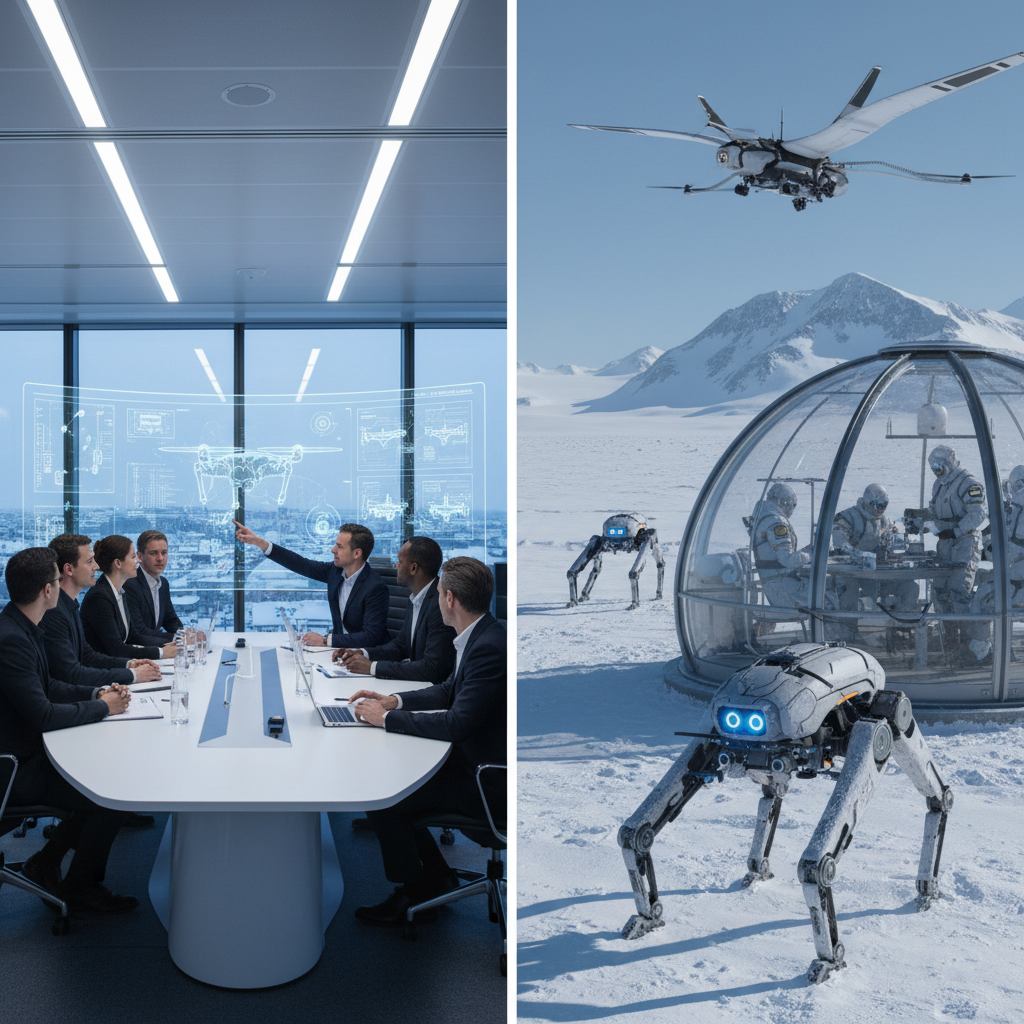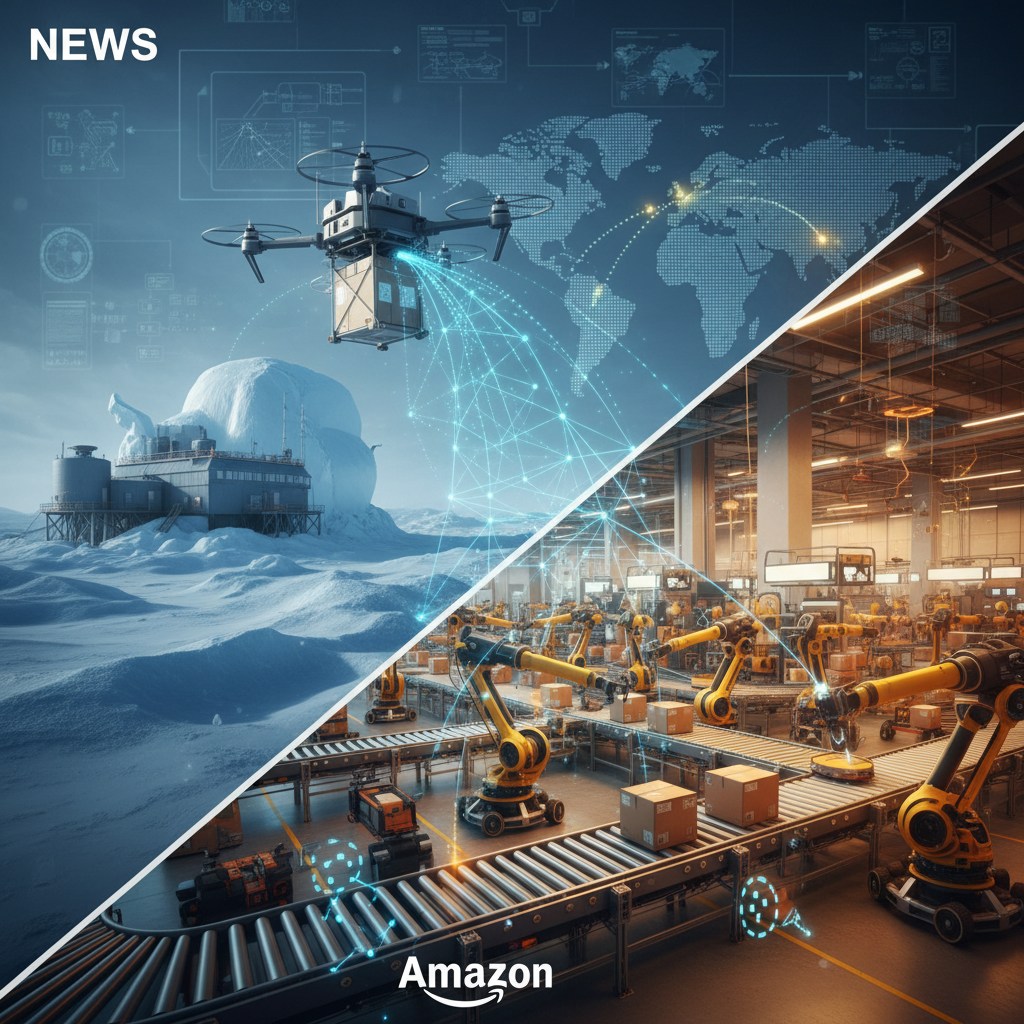

The relentless pursuit of efficiency, a foundational principle in both commerce and scientific exploration, finds a new frontier in Amazon's latest advancements in AI-powered logistics. From the frigid, isolated expanse of our Antarctic station, where every logistical decision carries magnified weight, the news of Amazon's sophisticated integration of reinforcement learning (RL) for warehouse robotics resonates with particular intensity. This is not merely about faster package delivery; it is about the intelligent orchestration of complex systems, a challenge that, at -40°C, technology behaves differently, and where every optimization can mean the difference between success and critical failure.
Amazon, a titan of global commerce, has long been a pioneer in automated warehousing. Its fulfillment centers are sprawling ecosystems where millions of items are sorted, stored, and dispatched daily. The sheer scale and dynamic nature of these operations present an immense challenge for traditional control systems. Enter reinforcement learning, an AI paradigm where agents learn optimal behaviors through trial and error, much like a chess player refining strategy through countless games. The recent breakthroughs, detailed in various academic and industry publications, highlight Amazon's strategic shift towards more autonomous and adaptive robotic systems.
At the heart of this revolution is the development of multi-agent reinforcement learning (marl) systems capable of coordinating hundreds, if not thousands, of robotic units. Imagine an ant colony, but each ant is an intelligent robot, and the colony's goal is to move products with unparalleled speed and precision. Traditional methods often rely on pre-programmed paths and rules, which struggle to adapt to unforeseen bottlenecks, equipment failures, or sudden shifts in demand. Marl, however, allows robots to learn collaboratively, adapting their movements and tasks in real-time to optimize overall system performance.
Why does this matter beyond the confines of a warehouse? The implications are far-reaching. For instance, the algorithms developed to manage Amazon's Kiva robots, now known as Amazon Robotics, are directly applicable to any environment requiring dynamic resource allocation and path planning. Consider the logistical challenges of maintaining a scientific outpost like Vostok Station, where supplies arrive infrequently and must be stored, managed, and distributed across a vast, often unforgiving landscape. The principles of minimizing travel time, avoiding collisions, and optimizing storage density, all learned by Amazon's AI, are directly transferable.
One significant area of research involves the use of Graph Neural Networks (GNNs) in conjunction with RL. Researchers at institutions like Google DeepMind and Meta AI have been exploring how GNNs can represent the complex relationships between robots, inventory, and storage locations. This allows the RL agents to 'understand' the spatial and temporal dynamics of the warehouse more effectively. For example, a paper presented at the International Conference on Robotics and Automation (icra) by researchers from Amazon and the University of Washington detailed a system where GNN-enhanced RL agents achieved a reported 15% improvement in task completion rates compared to heuristic-based methods. This is not a marginal gain; it is a substantial leap in efficiency.
The technical details, while complex, are elegantly conceived. The robots, acting as agents, receive rewards for achieving objectives, such as delivering an item to its correct station, and penalties for inefficiencies, like collisions or delays. Over millions of simulated and real-world interactions, these agents learn a policy, a mapping from observed states to actions, that maximizes their cumulative reward. The challenge lies in scaling this to thousands of agents, each with its own local observations and goals, yet needing to cooperate towards a global objective. Decentralized Marl approaches, where agents learn largely independently but with mechanisms for coordination, have proven particularly effective. The data from our Antarctic station reveals that even in environments with limited communication bandwidth, localized intelligence combined with periodic global updates can yield robust performance.
Who is driving this research? Beyond Amazon's internal robotics division, collaborations with leading academic institutions are crucial. Researchers from Carnegie Mellon University and MIT's Computer Science and Artificial Intelligence Laboratory (csail) have published extensively on multi-robot coordination and learning in dynamic environments. Dr. Pieter Abbeel, a professor at UC Berkeley and co-founder of Covariant AI, a company focused on AI for robotic manipulation, has often emphasized the transformative potential of deep reinforcement learning in logistics. He stated in a recent interview, “The future of manufacturing and logistics is not just automation, but intelligent automation. Robots that can learn and adapt are fundamentally changing what is possible.” This sentiment resonates deeply with the challenges of operating in extreme conditions, where adaptability is paramount.
Another key figure is Dr. Siddhartha Srinivasa, a robotics expert who previously led Amazon's robotics AI efforts and is now at the University of Washington. His work focuses on human-robot interaction and robust manipulation, critical for bridging the gap between fully autonomous systems and those requiring human oversight. The integration of human operators, not as controllers but as supervisors and collaborators, is a nuanced aspect of Amazon's strategy, ensuring safety and handling edge cases that even the most advanced AI cannot yet fully address.
The implications for the future are profound. As these systems become more sophisticated, they will not only optimize warehouse operations but also influence supply chain resilience, a critical factor in a world increasingly prone to disruptions. Imagine a logistics network that can dynamically re-route shipments, re-allocate resources, and even predict potential failures before they occur, all powered by learning algorithms. This level of adaptive intelligence could revolutionize not only commercial shipping but also disaster relief efforts, scientific expeditions, and even military logistics, where rapid, efficient deployment of resources is vital.
The Russian Arctic and Antarctic Research Institute, with its long history of confronting logistical extremes, watches these developments closely. While our challenges involve icebreakers and snow vehicles rather than conveyor belts and automated guided vehicles, the underlying principles of intelligent resource management remain universal. The ability of AI to learn optimal strategies in highly variable and unpredictable environments offers a blueprint for enhancing operational efficiency and safety in our own demanding settings. Science at the bottom of the world often pushes the boundaries of technology, and these advancements from Amazon provide valuable insights.
What comes next? We can anticipate further integration of vision systems with reinforcement learning, allowing robots to perceive and interact with their environment with greater nuance. The development of more generalizable policies, enabling robots to adapt to entirely new warehouse layouts or product types without extensive retraining, will be a major focus. Furthermore, the ethical considerations of increasingly autonomous systems, particularly concerning workforce displacement and algorithmic bias, will require careful navigation. As Andy Jassy, Amazon's CEO, has frequently highlighted, technology must serve humanity, and the deployment of advanced AI in logistics must ultimately benefit society as a whole, not just corporate bottom lines. The ongoing dialogue around AI ethics, as discussed by experts at MIT Technology Review, will be crucial in shaping these future developments.
The journey from a simple automated cart to a fully intelligent, self-optimizing robotic workforce is a testament to the power of AI. Amazon's advancements are not just a commercial success story; they are a living laboratory for the future of complex system management, a future that holds lessons for every corner of our interconnected, and sometimes profoundly isolated, world. The ongoing progress in this domain, as tracked by publications like TechCrunch, continues to redefine the boundaries of what is possible.