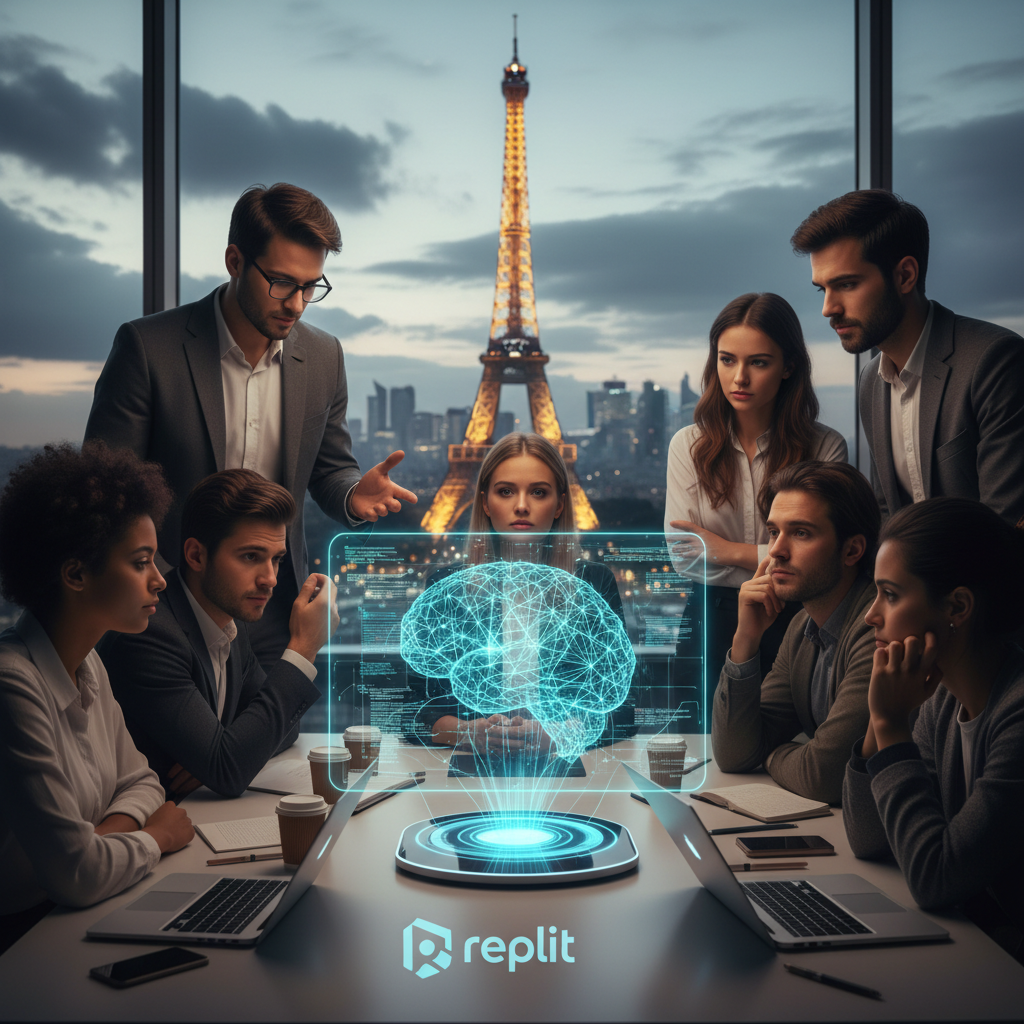

Mon Dieu, the arrogance of Big Tech. Just when you thought you had a handle on the latest AI craze, another American startup emerges from the digital ether, declaring itself the harbinger of a new era. This time, it is Replit, a platform many of us remember as a humble online coding environment, a digital sandbox for nascent programmers. Now, suddenly, it has rebranded itself, or rather, re-engineered its entire identity, into an 'AI-powered software development platform.'
One cannot help but observe this pivot with a certain Gallic skepticism. Replit, founded by Amjad Masad, has always been about making coding accessible. It was a place where students, hobbyists, and even professionals could quickly prototype, collaborate, and learn. A noble pursuit, certainly. But the siren song of AI, with its promise of exponential growth and untold riches, seems to have lured Replit away from its democratic roots and into the increasingly crowded, and frankly, often uninspired, arena of enterprise AI tools.
Their recent announcements, heavily promoted across tech media, speak of 'Ghostwriter,' an AI pair programmer, and a suite of tools designed to automate large swathes of the development lifecycle. They claim to be building a 'super-app for developers,' an all-encompassing environment where AI assists from ideation to deployment. Sounds impressive on paper, does it not? The sort of grand, sweeping vision that Silicon Valley adores, promising to 'disrupt' and 'revolutionize' everything in its path. But what does this truly mean for the actual craft of programming, for the human element that has always been at the heart of creation?
For us in Europe, particularly in France, this narrative feels a little too familiar. It is the same old tune, played on a slightly different instrument. The American way is not the American way and that's the point. We are constantly barraged with solutions to problems we did not know we had, all designed and dictated by a handful of companies across the Atlantic. Replit’s move, while perhaps strategically sound for its investors, raises questions about the future of developer autonomy and the potential for a monoculture in software creation.
Consider the implications. If AI becomes the primary driver of code generation, what happens to the nuanced understanding, the creative problem-solving, the sheer artistry that distinguishes a good developer from a mere code monkey? Will developers become mere editors, tweaking AI-generated suggestions, rather than architects of elegant solutions? This is not a Luddite fear, but a genuine concern for the intellectual integrity of the profession. As Professor Cécile Armand, a prominent AI ethicist at Sorbonne Université, recently remarked, “We must be vigilant that AI tools augment human creativity, not diminish it. The risk is not just job displacement, but the erosion of critical thinking and the unique human touch in complex problem-solving.”
Replit’s valuation, reportedly in the realm of $1 billion after its last funding round, underscores the immense investor appetite for anything labeled 'AI.' This is the gold rush of our times, and every company, it seems, feels compelled to stake a claim. They are not alone, of course. Microsoft has its Copilot, Google has its Gemini-powered coding assistants, and countless startups are vying for a piece of the pie. The market is saturated, yet the narrative persists that AI is the only path forward, the only way to remain relevant.
But France says non to Silicon Valley's vision when it comes to uncritical adoption. Our approach to technology has always been more circumspect, more focused on human impact and ethical considerations. We have seen the consequences of unbridled technological enthusiasm, from data privacy breaches to the propagation of algorithmic bias. The European Union's AI Act, for all its complexities, is a testament to this more cautious, human-centric philosophy, aiming to regulate AI based on its risk level, rather than simply embracing it as an unqualified good. Reuters has covered extensively the ongoing discussions and implementations of these regulations, highlighting Europe's distinct stance.
Replit's shift is not just about adding AI features; it is about fundamentally altering the developer workflow. They envision a world where AI agents can autonomously fix bugs, refactor code, and even generate entire applications from natural language prompts. While the efficiency gains could be significant, the potential for opaque, black-box systems to dominate critical infrastructure is a genuine concern. Who is accountable when an AI-generated bug in a financial system or a medical device causes harm? These are not trivial questions, and they are often overlooked in the rush to market.
Moreover, the environmental cost of such pervasive AI is rarely discussed. Training and running large language models, the backbone of these AI coding assistants, requires immense computational power and, consequently, vast amounts of energy. As we in Europe strive for greater sustainability, the carbon footprint of these AI-driven development platforms demands scrutiny. Are we simply trading human effort for increased energy consumption, all in the name of 'progress'?
Let us not forget the cultural aspect. Software development, like any creative endeavor, is influenced by culture, language, and local context. A coding assistant trained predominantly on English language code and American development practices may not serve the diverse needs of developers globally. Will it understand the nuances of French regulatory compliance, or the specific design patterns favored in a German engineering firm? This homogenization of tools risks stifling local innovation and reinforcing the dominance of a few cultural perspectives.
Indeed, the concept of digital sovereignty, a cornerstone of European policy, is directly challenged by the increasing reliance on proprietary, AI-powered tools from non-European providers. We have seen how critical infrastructure can be held hostage by foreign technologies. This is why initiatives like Mistral AI, a French champion, are so vital, demonstrating that Europe can build its own powerful AI models, tailored to its values and needs. TechCrunch frequently reports on the competitive landscape, showing how European startups are carving out their own niches.
Replit's journey from a collaborative coding platform to an AI-first development environment is a microcosm of the broader shifts in the tech industry. It represents the relentless pursuit of automation, the belief that every human task can and should be optimized by artificial intelligence. But this pursuit, while offering undeniable efficiencies, must be balanced with a critical eye towards its long-term consequences. We must ask: what do we gain, and what do we lose? What kind of developer do we want to cultivate, and what kind of digital future do we truly desire?
Perhaps it is time to slow down, to engage in a more profound reflection, rather than simply chasing the next shiny object presented by Silicon Valley. The future of software development, like the future of society, should not be dictated by algorithms alone, but by human values, diverse perspectives, and a healthy dose of skepticism. After all, a truly intelligent system should serve humanity, not dictate its evolution. And for that, we need more than just clever code; we need wisdom, foresight, and the courage to say 'non' when necessary.