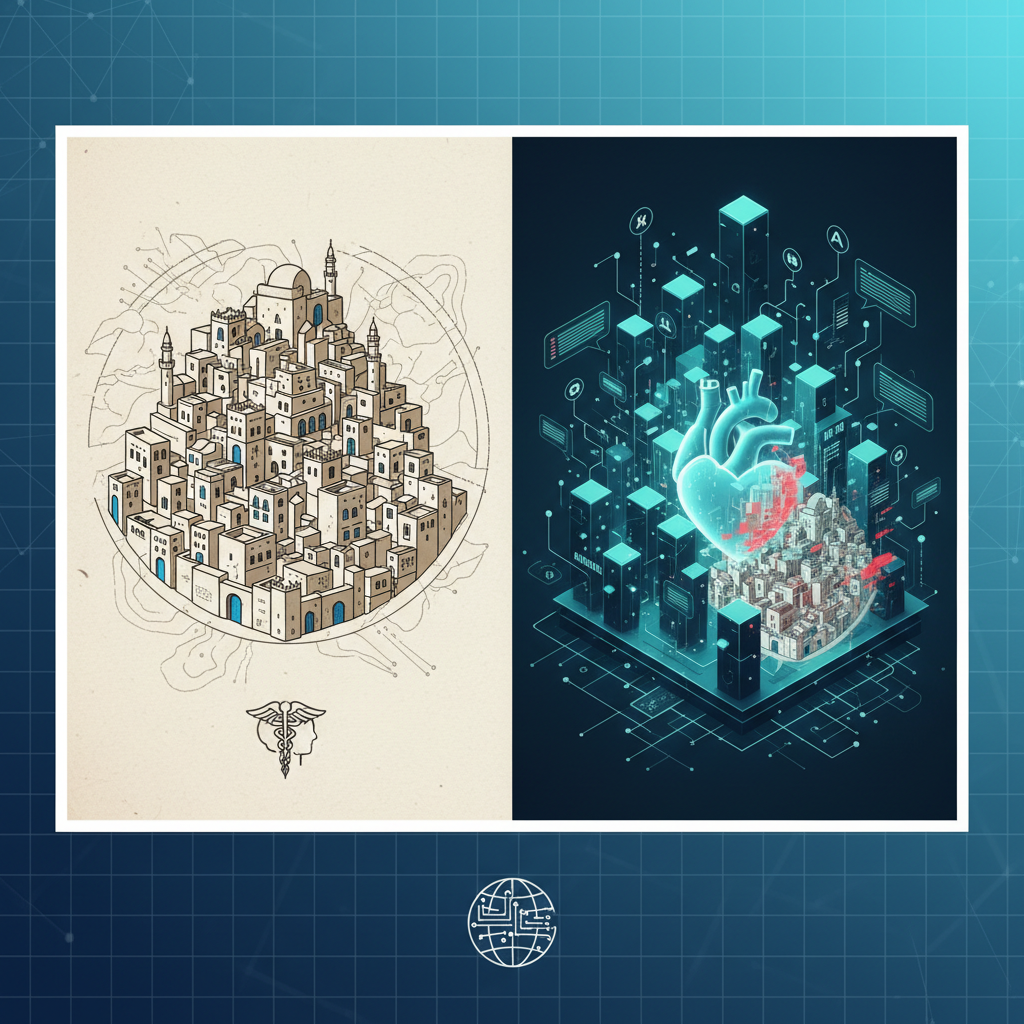
The rhythmic pulse of a city, much like the intricate patterns woven into a traditional Algerian carpet, is a tapestry of countless individual threads: human movement, economic activity, resource consumption, and infrastructure. For decades, urban planners have grappled with the monumental task of optimizing these complex systems, often relying on historical data and predictive models that, while useful, frequently fall short of capturing the dynamic, organic nature of urban life. Yet, a recent breakthrough in artificial intelligence, spearheaded by the 'Urban Intelligence Lab' at Carnegie Mellon University in collaboration with researchers from the Houari Boumediene University of Science and Technology in Algiers, promises to fundamentally alter this landscape. It offers a new lens through which to view and manage our burgeoning megacities.
This groundbreaking research, detailed in a paper titled 'Deep Generative Models for Spatiotemporal Urban Dynamics and Infrastructure Resilience,' introduces a novel AI framework that moves beyond mere prediction. Instead, it aims to generate optimal urban configurations and infrastructure responses in real-time, adapting to unforeseen events and evolving societal needs. Imagine a city that not only anticipates traffic congestion but dynamically re-routes public transport and adjusts traffic light timings across an entire metropolitan area, all while considering air quality and energy consumption. This is the future this research envisions.
Why This Breakthrough Matters: A New Paradigm for Urban Living
For too long, urban planning has been a reactive discipline, often playing catch-up with the rapid pace of urbanization. In cities like Algiers, where historical districts like the Casbah coexist with modern developments, the challenges are particularly acute. The intricate, often informal, networks of the old city defy conventional modeling, while new areas struggle with infrastructure strain. This new AI framework, however, offers a proactive, generative approach. It is not simply predicting what will happen; it is designing what should happen, based on a holistic understanding of urban systems.
"The traditional methods, while foundational, are like trying to predict the flow of the Oued M'zab by only looking at its surface," explains Dr. Fatima Zahra Boukhalfa, a lead researcher from Houari Boumediene University. "This AI, conversely, delves into the subterranean currents, understanding the underlying geological structures and water sources that truly dictate its path. It's a paradigm shift from observation to intelligent design." Her words resonate deeply, reminding us of the profound, often hidden, complexities that define our urban environments.
From a technical standpoint, the implications are vast. This is not merely about optimizing a single variable, such as traffic flow. The framework integrates a multitude of data streams: anonymized mobility data, environmental sensor readings, energy consumption patterns, public utility performance, and even socio-economic indicators. It then employs a sophisticated blend of graph neural networks and diffusion models to synthesize this information, creating a dynamic digital twin of the city. This digital twin can then be used to simulate interventions, predict their cascading effects, and ultimately propose optimal strategies for infrastructure development, resource allocation, and emergency response.
The Technical Details: Unpacking the Algorithmic Architecture
Let me walk you through the architecture that makes this possible. At its core, the research leverages what are known as Spatiotemporal Graph Diffusion Models (stgdm). Unlike conventional predictive models that operate on Euclidean data, urban environments are inherently non-Euclidean; connections between points are not just about physical distance but also about network topology, social interactions, and infrastructure dependencies. Graph neural networks (GNNs) are perfectly suited for this, as they can process data structured as graphs, representing cities as nodes (e.g., districts, intersections, buildings) and edges (e.g., roads, utility lines, social ties).
The 'generative' aspect comes from the integration of diffusion models, a class of deep learning models that have recently shown remarkable success in generating highly realistic images and other complex data. In this context, the diffusion model learns to reverse a gradual 'noising' process applied to optimal urban states. By learning to denoise, it effectively learns the distribution of desirable urban configurations. When given a current, suboptimal urban state, it can then 'denoise' it into an improved, more resilient, or more efficient state. The mathematics behind this is elegant, drawing parallels to statistical physics, where systems naturally evolve towards states of lower energy or higher entropy. Here, the 'energy' is a measure of urban inefficiency or vulnerability, and the AI guides the city towards a more optimal, lower-energy state.
The Stgdm framework also incorporates a novel attention mechanism that allows the model to weigh the importance of different spatiotemporal features. For instance, during a heatwave, the model might prioritize green infrastructure and public cooling centers, while during peak commute hours, it focuses on public transportation optimization. This dynamic weighting is crucial for real-world applicability, where priorities shift constantly.
The Architects of Tomorrow's Cities: Who is Behind This Research?
The primary research was conducted by the Urban Intelligence Lab at Carnegie Mellon University, led by Professor Anya Sharma, a pioneer in computational urbanism. Their collaborators from Houari Boumediene University of Science and Technology (usthb) in Algiers played a critical role in providing real-world urban data from North African cities and contributing expertise in complex systems modeling, drawing from a rich tradition of mathematical thought in the region. Key contributors include Dr. Boukhalfa and Dr. Youssef Benali, who focused on the ethical integration of local socio-cultural factors into the algorithmic design.
"Our collaboration with Usthb was indispensable," states Professor Sharma during a recent virtual press conference. "Their deep understanding of the unique dynamics of North African cities, particularly the interplay between historical preservation and modern development, allowed us to refine our models to be truly globally applicable, not just optimized for Western urban paradigms." This sentiment underscores the critical need for diverse perspectives in AI research, especially when addressing issues with profound societal impact.
Funding for this multi-year project came from a consortium of international bodies, including the United Nations Human Settlements Programme (UN-Habitat) and a significant grant from the Algerian Ministry of Higher Education and Scientific Research, demonstrating a commitment to leveraging advanced technology for national development.
Implications and Next Steps: Building Smarter, More Equitable Futures
The immediate implications of this research are profound. For megacities grappling with rapid population growth, climate change impacts, and aging infrastructure, this offers a powerful tool for proactive planning. Imagine using this framework to design resilient coastal defenses for Algiers, predict and mitigate the impact of flash floods in urban wadis, or optimize energy grids to prevent blackouts during peak demand. The potential for enhancing urban resilience and sustainability is immense.
However, the path forward is not without its challenges. Data privacy and ethical governance are paramount. The collection and analysis of vast amounts of urban data, even if anonymized, raise legitimate concerns. "We must ensure that these powerful tools serve all citizens, not just a privileged few, and that they do not perpetuate or amplify existing inequalities," cautions Dr. Benali, emphasizing the need for robust ethical AI frameworks and public engagement. This is a critical point, particularly in regions where data governance structures are still evolving. The temptation to simply apply a 'smart city' solution without considering its social fabric can lead to unintended consequences, as we have seen in other global initiatives.
Furthermore, the integration of such complex AI systems into existing bureaucratic structures will require significant investment in human capital and policy reform. Urban planners, policymakers, and engineers will need to be trained in these new methodologies. Pilot projects are already underway in several cities, including a phased implementation in a new eco-district near Oran, Algeria, focusing on optimizing public transport and waste management systems. These real-world deployments will be crucial for refining the models and demonstrating their practical value.
Looking ahead, the research team plans to explore the integration of citizen feedback mechanisms directly into the AI's learning loop, creating a truly participatory urban planning process. This would allow residents to provide real-time input on their experiences, further refining the AI's understanding of urban well-being. The vision is not of an AI dictating urban life, but rather an AI serving as an intelligent assistant, empowering communities to build cities that are more responsive, resilient, and reflective of their inhabitants' aspirations.
As we stand at the precipice of this new era of urban intelligence, the question is not whether AI will reshape our cities, but how we will ensure it does so wisely, equitably, and with a deep respect for the unique cultural and historical narratives that define each urban landscape. The journey from the ancient alleyways of the Casbah to the algorithmic heart of a smart city is long, but with responsible innovation, it promises a brighter future for all. For more on the ethical considerations of AI in urban development, one might consult MIT Technology Review. For broader industry trends in AI, TechCrunch offers valuable insights. The academic papers themselves are often found on platforms like arXiv.