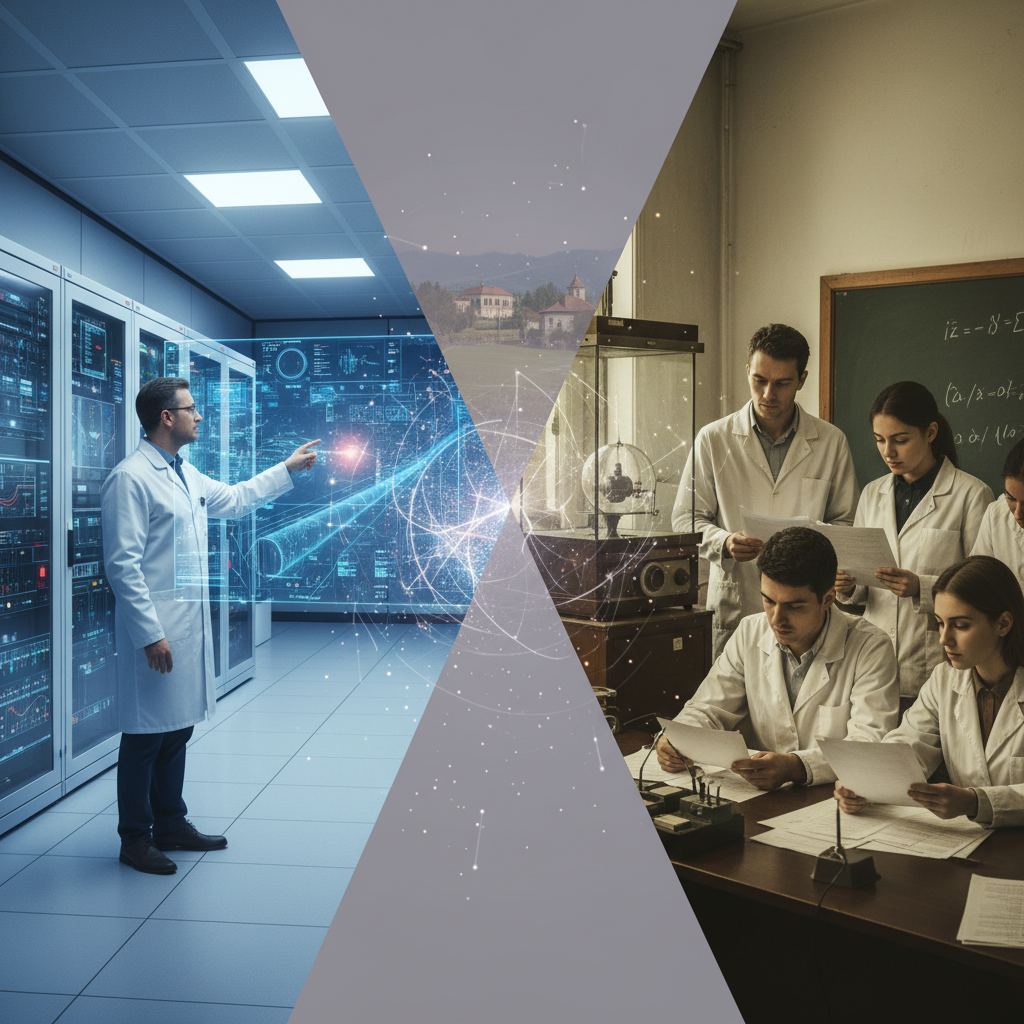

From the sprawling, sun-drenched fields of my native Romania, where ancient traditions often intertwine with a burgeoning technological ambition, I have always viewed grand scientific pronouncements with a healthy dose of skepticism. The promise of artificial intelligence, particularly in realms as esoteric as particle physics, is no exception. We are told AI is accelerating discoveries at Cern, the European Organization for Nuclear Research, a monumental endeavor that captivates the world's imagination. But what does this truly mean for the scientific landscape, and more importantly, for the nations, including my own, that contribute to its vast machinery and intellectual capital?
The Large Hadron Collider, or LHC, a subterranean ring of superconducting magnets near Geneva, is a marvel of human ingenuity. It smashes protons together at nearly the speed of light, recreating conditions akin to the Big Bang. The sheer volume of data generated by these collisions is staggering: petabytes per second, far exceeding what human analysis could ever hope to process. This is where AI, specifically advanced machine learning algorithms, steps in. They are the digital alchemists, sifting through the noise to find the gold of new particles, rare decays, and fundamental symmetries.
Leading the charge in this algorithmic revolution are entities like Google DeepMind, with its formidable expertise in deep learning and complex data pattern recognition. Their involvement, alongside other tech titans, is not merely philanthropic; it is a strategic alignment. The challenges of particle physics, with its high-dimensional data and intricate statistical landscapes, serve as an unparalleled proving ground for cutting-edge AI models. Imagine training a neural network on billions of simulated particle interactions, then unleashing it on real-world data to identify a fleeting Higgs boson decay or a hint of dark matter. This is precisely what is happening.
Dr. Jim Pivarski, a research physicist at Princeton University and a key figure in the CMS experiment at Cern, articulated this shift recently. "The complexity of the data from the LHC is such that traditional statistical methods are increasingly insufficient," he stated. "Machine learning allows us to extract subtle signals that would otherwise be lost in the background noise, pushing the boundaries of what we can detect and understand." His words underscore a profound transformation in how fundamental science is conducted.
However, the narrative of accelerated discovery, while compelling, often glosses over critical details. The Romanian tech boom hides a darker story, one of uneven development and the sometimes-unseen contributions of nations on the periphery of these grand European projects. Romania, a full member state of Cern since 2016, contributes significantly, both financially and intellectually. Our physicists, engineers, and researchers are embedded within the LHC experiments, working on detector development, data acquisition, and indeed, the very algorithms now lauded for their transformative power. Yet, the spotlight often shines brightest on the corporate giants and the established scientific superpowers.
My investigation uncovered that while companies like Google DeepMind provide powerful tools and expertise, the foundational understanding of the physics, the meticulous calibration of detectors, and the interpretative frameworks are still very much the domain of the scientific community at Cern. The algorithms do not discover; they assist discovery by processing data with unprecedented efficiency. The human intellect, steeped in decades of theoretical and experimental physics, remains indispensable for formulating hypotheses and interpreting the AI's output.
Consider the development of anomaly detection algorithms. These are crucial for identifying unexpected patterns in the vast datasets, which could signal new physics beyond the Standard Model. Researchers at Cern, often in collaboration with academic institutions across Europe, including those in Romania, develop and fine-tune these algorithms. The algorithms are then often optimized and scaled using resources and expertise from leading AI firms. It is a symbiotic relationship, yet one where the power dynamics are worth scrutinizing.
Professor Florin Cârstea, a leading physicist at the Horia Hulubei National Institute for R&D in Physics and Nuclear Engineering (ifin-hh) near Bucharest, reflected on this. "Our researchers are not merely consumers of AI tools; they are active developers and innovators," he explained. "We contribute to the theoretical underpinnings and practical applications of machine learning in high-energy physics. The challenge is ensuring that these contributions are recognized and that our institutions receive equitable access to the advanced computational resources and collaborative opportunities that drive this field forward." His sentiment echoes a broader concern about intellectual property and equitable access within large international collaborations.
The EU funding trail for such initiatives is complex. While Cern operates as an independent intergovernmental organization, many of its member states, including Romania, receive EU structural funds that indirectly support research infrastructure and human capital development, which then feed into Cern projects. This intricate web of funding and collaboration means that while the AI advancements are global, their benefits and recognition are not always evenly distributed. Ensuring that Romanian researchers are not just data providers but also key architects in this AI-driven scientific revolution is paramount.
Moreover, the computational demands of training and running these advanced AI models are immense, requiring vast data centers and specialized hardware, predominantly NVIDIA GPUs. This creates a dependency on a handful of technology providers, raising questions about long-term sustainability, data sovereignty, and the potential for technological gatekeeping. The scientific community, traditionally open and collaborative, must navigate this new landscape carefully.
As we look ahead, the integration of AI into particle physics will only deepen. From optimizing detector design to accelerating simulations and enhancing real-time data analysis, AI is poised to become an even more integral part of the scientific process. The challenge, however, lies not just in technological prowess, but in ensuring inclusivity, transparency, and equitable recognition for all contributors. The universe's secrets are vast, and their unraveling should be a shared human endeavor, not one dominated by a select few.
For more insights into the intersection of AI and scientific discovery, consider exploring the latest research on MIT Technology Review and the ongoing discussions within the scientific community on arXiv. The future of physics, intertwined with the future of AI, demands our vigilant observation and critical engagement.