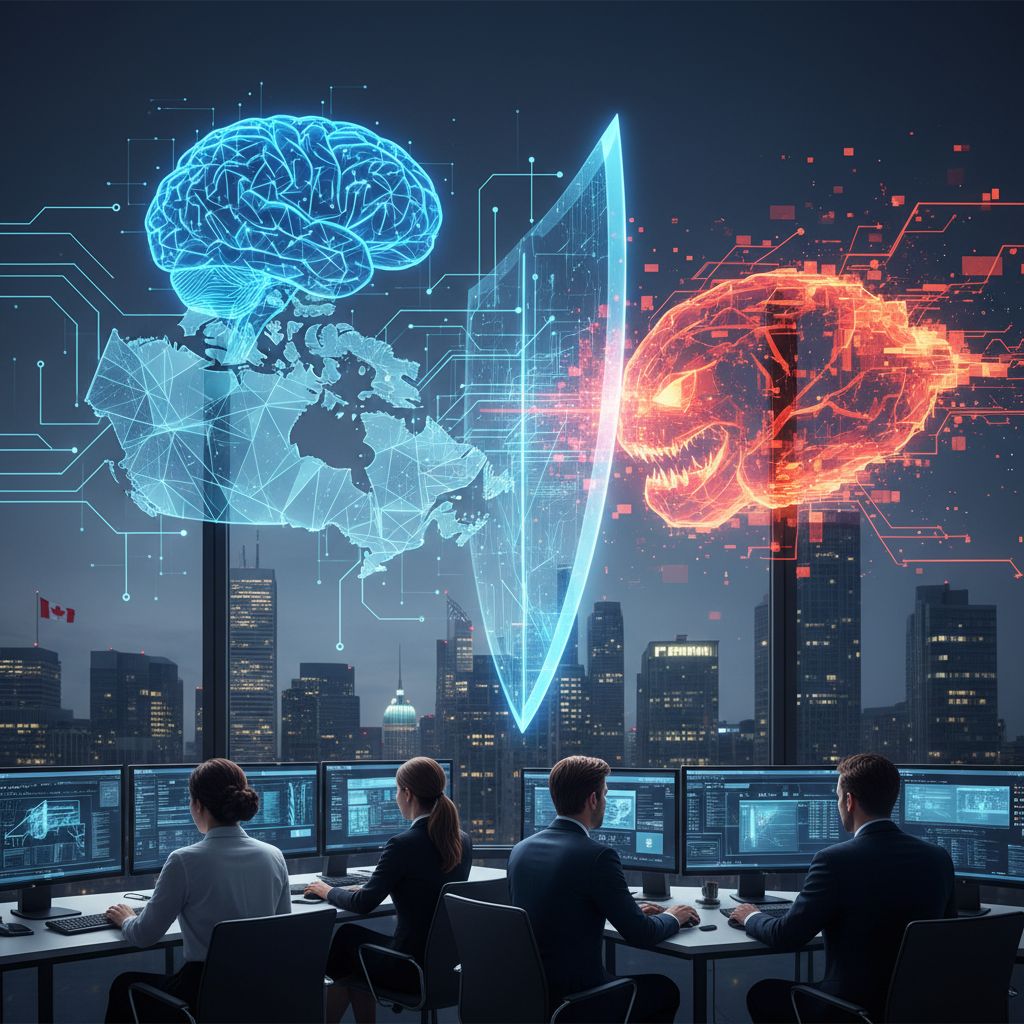

The digital landscape, particularly for Canadian enterprises, is a relentless battleground. From sophisticated ransomware attacks targeting critical infrastructure to persistent state-sponsored espionage, the sheer volume and velocity of cyber threats have long outstripped human capacity for detection and response. Enter artificial intelligence, heralded by many as the panacea for this escalating crisis. But as a journalist who questions everything, particularly the more grandiose claims emerging from Silicon Valley, I find it imperative to ask: does this actually work, or is it merely sophisticated marketing? Let's separate the marketing from the reality, delving into the technical intricacies of AI-powered real-time threat detection across enterprise networks.
The Technical Challenge: A Needle in a Haystack, on Fire
The core problem is not merely identifying malicious activity, but doing so instantaneously within a deluge of legitimate network traffic. Traditional signature-based intrusion detection systems (IDS) are inherently reactive, effective only against known threats. Heuristic and rule-based systems fare slightly better, but are prone to high false positive rates and struggle with novel attack vectors. The modern enterprise network, often a hybrid cloud environment spanning multiple geographies, generates petabytes of telemetry daily: firewall logs, endpoint detection and response (EDR) data, network flow records (NetFlow, Ipfix), DNS queries, and identity management events. The challenge is to process this heterogeneous, high-volume, high-velocity data stream, identify anomalies indicative of compromise, and do so with minimal latency and maximal accuracy. This is not a trivial undertaking; it demands a robust, scalable, and intelligent analytical framework.
Architecture Overview: A Multi-Layered Defense
A truly effective AI-driven cybersecurity architecture for real-time threat detection is not a monolithic application, but rather a distributed system composed of several interconnected components. Think of it as a digital early warning system, akin to NORAD's layered defense, but for data packets. At its foundation is a robust data ingestion layer, capable of collecting diverse logs and network telemetry from endpoints, network devices, cloud environments, and identity providers. Technologies like Apache Kafka or Google Cloud Pub/Sub are critical here, providing high-throughput, fault-tolerant message queuing. This raw data then flows into a real-time stream processing layer, often leveraging Apache Flink or Spark Streaming, where initial filtering, normalization, and enrichment occur. This preprocessing is vital for transforming disparate data formats into a unified schema suitable for AI analysis.
Following this, the core AI detection engine operates. This engine is typically composed of multiple specialized models, each trained for specific threat types or data sources. Finally, an orchestration and response layer integrates with existing Security Information and Event Management (siem) systems, Security Orchestration, Automation, and Response (soar) platforms, and incident response workflows, ensuring that detected threats trigger appropriate automated or human-led actions.
Key Algorithms and Approaches: Beyond Simple Anomaly Detection
While 'anomaly detection' is often used as a catch-all, the reality is far more nuanced. Effective AI cybersecurity employs a suite of machine learning techniques:
-
Supervised Learning for Known Threats: For classifying known malware families, phishing attempts, or specific attack patterns, supervised models like Support Vector Machines (SVMs), Random Forests, or deep neural networks (e.g., Convolutional Neural Networks for network traffic patterns, Recurrent Neural Networks for sequential log data) are highly effective. These models require large, labeled datasets of malicious and benign activities, which can be a significant hurdle for novel threats.
-
Unsupervised Learning for Novel Anomalies: This is where AI truly shines in detecting zero-day exploits or insider threats. Techniques such as Isolation Forests, One-Class SVMs, Autoencoders, or Generative Adversarial Networks (GANs) are employed to learn a 'normal' baseline of network and user behavior. Deviations from this baseline, exceeding a certain statistical threshold, are flagged as anomalies. For instance, an autoencoder might be trained on typical user login patterns; an attempt from an unusual geographic location or at an odd hour would result in a high reconstruction error, indicating an anomaly.
Conceptual Example: Autoencoder for User Behavior Anomaly Detection
 # Simplified conceptual pseudocode
 Input: User_Login_Features (e.g., login_time_of_day, source_ip_country, device_type)

# Training Phase
 model = Autoencoder(input_dim=len(User_Login_Features), encoding_dim=smaller_dimension)
 model.compile(optimizer='adam', loss='mse')
 model.fit(normal_user_data, normal_user_data, epochs=N, batch_size=M)

# Detection Phase
 reconstruction_error = model.predict(new_user_login_data) - new_user_login_data
 if mean(reconstruction_error) > Threshold:
 flag_as_anomaly()
 # Simplified conceptual pseudocode
 Input: User_Login_Features (e.g., login_time_of_day, source_ip_country, device_type)

# Training Phase
 model = Autoencoder(input_dim=len(User_Login_Features), encoding_dim=smaller_dimension)
 model.compile(optimizer='adam', loss='mse')
 model.fit(normal_user_data, normal_user_data, epochs=N, batch_size=M)

# Detection Phase
 reconstruction_error = model.predict(new_user_login_data) - new_user_login_data
 if mean(reconstruction_error) > Threshold:
 flag_as_anomaly()
-
Reinforcement Learning for Adaptive Defense: While less mature in widespread deployment, reinforcement learning holds promise for creating adaptive defense systems. An agent could learn optimal response strategies by interacting with a simulated network environment, receiving rewards for mitigating threats and penalties for false positives or missed detections. This could lead to dynamic firewall rule adjustments or automated isolation of compromised assets.
-
Graph Neural Networks (GNNs) for Relationship Analysis: Modern attacks often involve complex relationships between users, devices, and resources. GNNs are particularly adept at modeling these relationships and identifying suspicious patterns that might be missed by analyzing individual events. For example, a GNN could detect a rapid propagation of access across seemingly unrelated systems, indicative of lateral movement within a network.
Implementation Considerations: The Canadian Approach Deserves More Scrutiny
Deploying such a system within a Canadian enterprise, whether a financial institution in Toronto or a resource company in Alberta, presents unique challenges. Data residency laws and privacy regulations, such as those governed by Pipeda, dictate where and how data can be processed and stored. This often necessitates on-premise or Canadian-sovereign cloud deployments, influencing technology choices and vendor partnerships. The Canadian approach deserves more scrutiny when considering cloud-native AI solutions, as not all global providers offer the necessary data sovereignty guarantees.
Performance is paramount. Real-time means milliseconds, not minutes. This requires efficient data structures, optimized algorithms, and often, specialized hardware like NVIDIA GPUs for accelerating deep learning inference. Scalability must be baked in from the start, as network traffic can fluctuate dramatically.
False positives are another critical concern. A system that constantly flags benign activity will quickly be ignored, eroding trust and wasting valuable analyst time. Model interpretability is also crucial; security analysts need to understand why a particular alert was triggered to effectively investigate and respond. Black-box models, while powerful, can hinder this process.
Benchmarks and Comparisons: A Moving Target
Comparing AI cybersecurity solutions is challenging because the threat landscape is constantly evolving. Traditional metrics like true positive rate (TPR) and false positive rate (FPR) are a starting point, but real-world performance also depends on the diversity of the training data, the ability to adapt to new attack techniques, and the system's integration capabilities. Many vendors claim superior AI capabilities, but independent benchmarks are scarce. Organizations often rely on proof-of-concept deployments and internal testing against simulated attacks to evaluate efficacy. The data suggests a different conclusion than the marketing often portrays; no single AI solution is a silver bullet, and a layered defense remains essential.
Code-Level Insights: Frameworks and Libraries
Developers and data scientists building these systems often leverage a common set of tools:
- Machine Learning Frameworks: TensorFlow, PyTorch, and scikit-learn are staples for model development.
- Data Processing: Apache Kafka for messaging, Apache Flink or Spark Streaming for real-time processing.
- Graph Processing: Apache Flink Gelly, NetworkX, or PyTorch Geometric for GNN implementations.
- Cloud Platforms: AWS SageMaker, Google AI Platform, Azure Machine Learning for managed ML workflows and scalable infrastructure. Many Canadian companies are also exploring domestic cloud providers to address data sovereignty.
- Libraries for specific tasks:
pandasfor data manipulation,numpyfor numerical operations,matplotlibandseabornfor visualization, andtsharkorscapyfor network packet analysis.
Real-World Use Cases: From Banks to Utilities
- Financial Services: Major Canadian banks, such as RBC and TD, are reportedly investing heavily in AI to detect fraudulent transactions and identify sophisticated phishing campaigns targeting their vast customer bases. Their systems often integrate AI models with existing fraud detection engines to analyze transaction metadata, login patterns, and user behavior anomalies in real time.
- Critical Infrastructure: Utilities, including Hydro-Québec and Ontario Power Generation, are deploying AI to monitor operational technology (OT) networks for unusual command sequences or unauthorized access attempts that could disrupt essential services. These systems often operate in air-gapped or highly segmented networks, requiring specialized data collection and processing methods.
- Government Agencies: Various federal departments in Ottawa utilize AI for threat intelligence analysis, correlating indicators of compromise (IOCs) from diverse sources and predicting potential attack vectors. This often involves natural language processing (NLP) to analyze threat reports and open-source intelligence.
- Telecommunications: Companies like Bell Canada and Telus employ AI to detect network intrusions, identify denial-of-service (DoS) attacks, and secure their extensive infrastructure against evolving threats, leveraging the massive volumes of network flow data they generate.
Gotchas and Pitfalls: The Uncomfortable Truth
The path to effective AI cybersecurity is fraught with challenges. Data quality is paramount; 'garbage in, garbage out' applies acutely here. Biased or incomplete training data can lead to models that either miss critical threats or generate an overwhelming number of false positives. Adversarial AI, where attackers intentionally craft inputs to fool detection models, is a growing concern. Model drift, where the effectiveness of a model degrades over time as threat patterns evolve, necessitates continuous retraining and validation. Furthermore, the talent gap in Canada for data scientists with deep cybersecurity expertise remains a bottleneck, limiting the ability of many organizations to build and maintain these sophisticated systems internally.
Resources for Going Deeper
For those looking to delve further into the technical underpinnings, several resources are invaluable. Academic papers published on arXiv or in journals like Nature Machine Intelligence offer cutting-edge research. Industry reports from organizations like Gartner and Forrester provide market analysis, while platforms such as TechCrunch offer insights into startup innovations. Practical implementation guidance can often be found in open-source projects and developer blogs. Understanding the theoretical foundations and practical applications is key to navigating this complex domain.
Ultimately, AI offers powerful tools to augment human cybersecurity capabilities, not replace them. Its promise for real-time threat detection is significant, but it demands meticulous engineering, continuous adaptation, and a healthy dose of skepticism regarding vendor claims. For Canadian enterprises, a thoughtful, data-driven approach, mindful of local regulatory environments and talent constraints, will be the true determinant of success.