AI's New Playbook: Revolutionizing HBCU Sports Analytics and Athlete Development
AI is transforming sports analytics at Historically Black Colleges and Universities (HBCUs) across the USA, offering unprecedented insights into athlete performance and development, and addressing historical resource disparities.
Click play to listen to this article read aloud using text-to-speech.
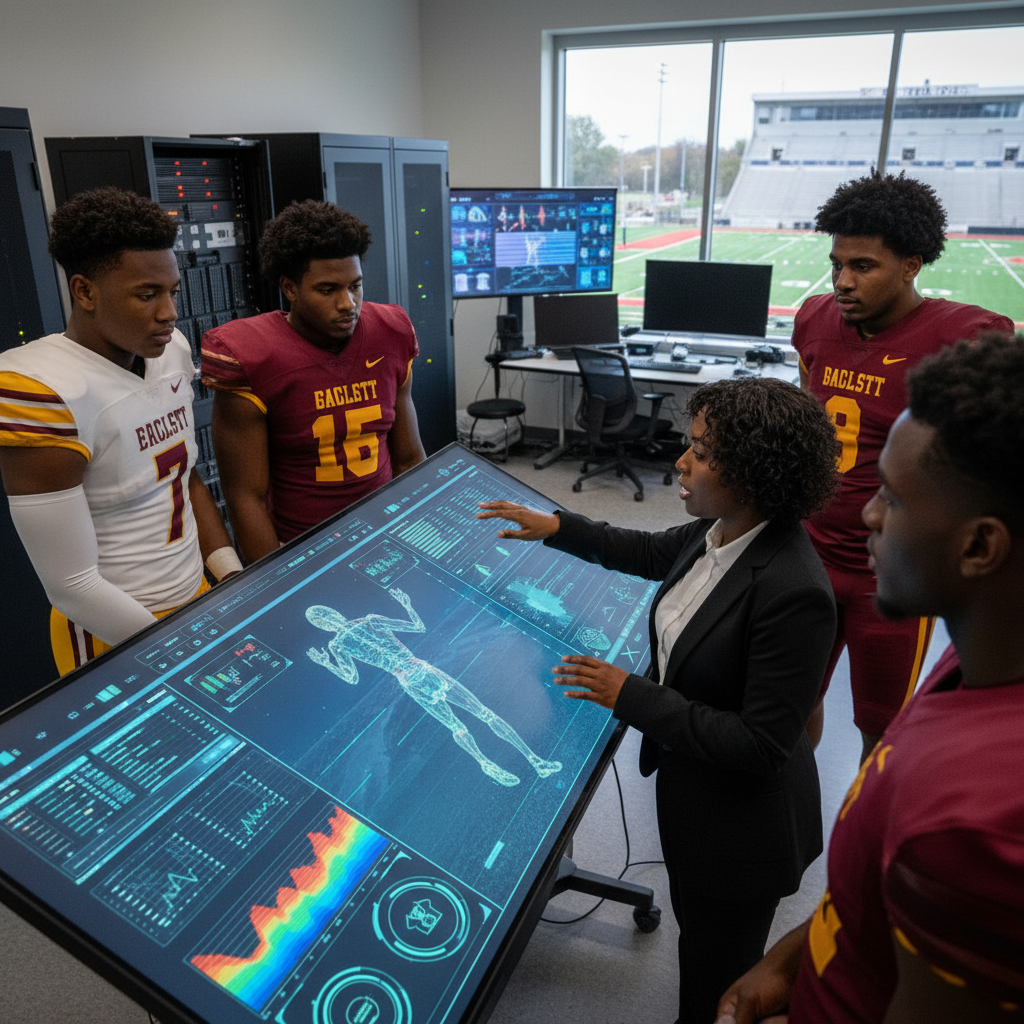
BALTIMORE, MD – April 22, 2026 – The roar of the crowd, the precision of a pass, the explosive power of a dunk – these moments are now being dissected and enhanced by artificial intelligence, even within the hallowed halls of Historically Black Colleges and Universities (HBCUs). While the broader sports world has embraced AI for years, its integration into HBCU athletics marks a significant, and culturally resonant, shift.
For too long, HBCU athletic programs, despite their rich legacy of producing world-class talent, have often operated with fewer resources than their Power Five counterparts. This disparity, a lingering echo of systemic inequities, is now being challenged by accessible AI technologies that level the playing field in critical areas like athlete performance analysis and injury prevention.
Dr. Imani Nkosi, Director of Sports Technology at Howard University, highlights this paradigm shift. “We’re not just talking about fancy statistics anymore,” Dr. Nkosi explains, her voice resonating with passion during a recent panel at the Black Tech Futures Conference in Atlanta. “AI-driven platforms, like 'Gridiron Guru' for football or 'Hoops IQ' for basketball, are providing our coaches with granular data on player fatigue, biomechanical efficiencies, and even predictive analytics for potential injuries. This isn't just about winning games; it’s about safeguarding our athletes’ long-term health and maximizing their potential, something our communities have always prioritized.”
These platforms, often cloud-based and subscription-model, are becoming increasingly affordable, making them viable for institutions with tighter budgets. For example, North Carolina A&T State University’s track and field program recently implemented an AI system that analyzes sprint mechanics from video footage, providing instant feedback to athletes and coaches. “Before, a coach might catch a few things with the naked eye,” says Coach Marcus 'MJ' Jones, a former Olympian and head track coach at A&T. “Now, the AI identifies micro-adjustments in stride length or foot strike that can shave off hundredths of a second – the difference between a personal best and a national record. It’s a game-changer for our student-athletes, many of whom are first-generation college students striving for professional careers.”
The impact extends beyond the field or court. AI is also being leveraged for recruitment, identifying promising young talent from underserved communities who might otherwise be overlooked. Algorithms can analyze high school game footage, cross-referencing performance metrics with academic records and even social media presence to build comprehensive athlete profiles.
However, the integration isn't without its considerations. Data privacy, algorithmic bias, and ensuring equitable access to these technologies remain critical discussions within the HBCU sports community. “We must ensure these tools are used ethically and responsibly,” cautions Reverend Dr. Elijah Vance, a prominent voice on technology ethics from Morehouse College. “The data must serve the athlete, not exploit them. And we must actively work to prevent any biases in the algorithms that could disproportionately affect young Black men and women.”
As AI continues to evolve, its presence in HBCU sports promises not only to elevate athletic performance but also to underscore the enduring resilience and innovative spirit of these vital institutions, proving that with strategic application, technology can indeed be a powerful tool for equity and advancement.
Related Articles
AI's Gaelic Game-Changer: How Tech is Leveling the Field for Irish Women in Sport
 Siobhàn O'Briénn
AI in Northern Health: Bridging Gaps for Indigenous Communities in Canada
 Ingridè Bjornssòn
AI Diagnóstico: Mexico's Bet on AI for Public Health in Rural Areas
 Alejandroó Riveràs
AI Scores Big for Tanzanian Women's Football: Twiga Stars Eyeing Digital Edge
 Zawadì Mutembò