
AI's Healing Touch: Revolutionizing Maternal Healthcare in Nigeria's Rural Communities
Artificial Intelligence is poised to transform maternal health in Nigeria, particularly in underserved rural areas, by improving diagnostics and access to care. Experts believe this digital 'healing touch' can significantly reduce maternal mortality rates.
Click play to listen to this article read aloud using text-to-speech.
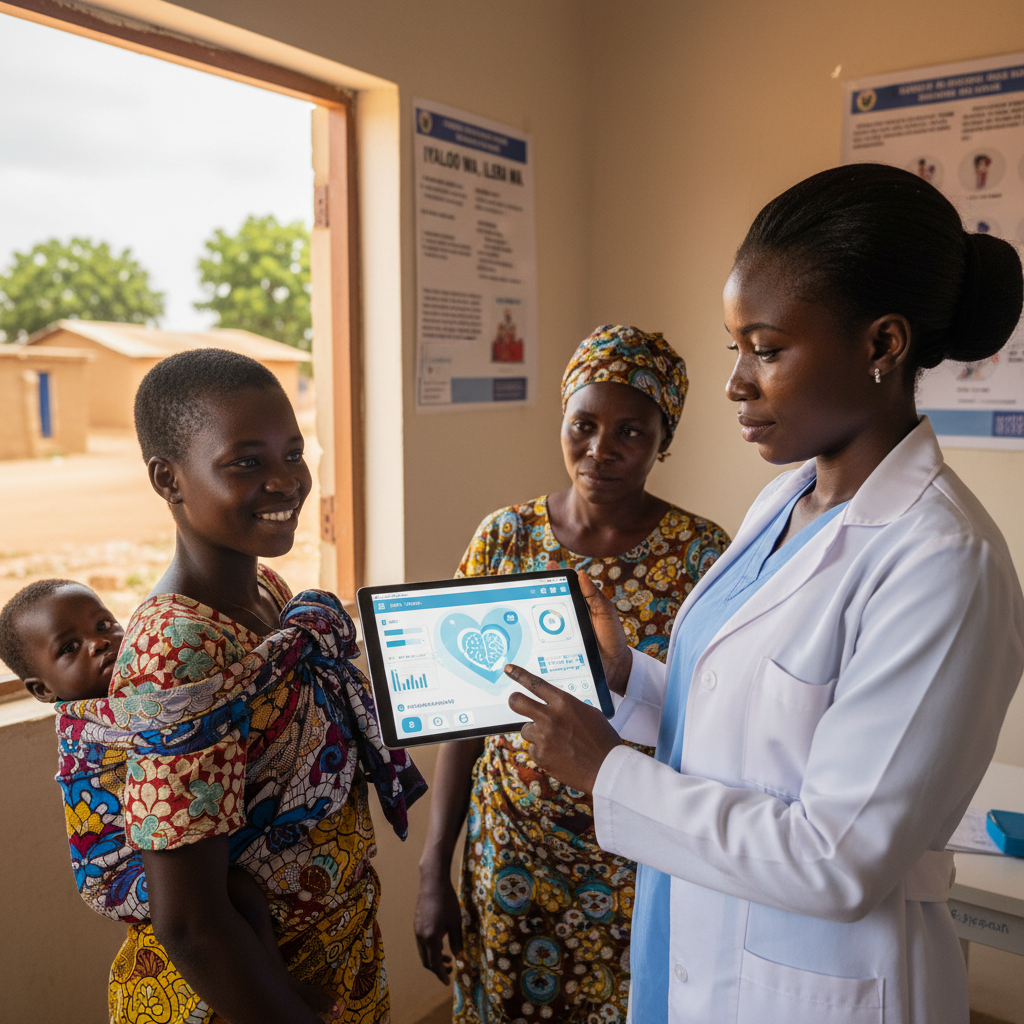
LAGOS, Nigeria – The rhythmic beat of progress echoes through Nigeria's healthcare landscape as Artificial Intelligence (AI) emerges as a powerful ally in the fight against maternal mortality, a persistent challenge in many parts of our beloved nation. For too long, ìyá àbísíkà (pregnant women) in remote communities have faced daunting odds, from delayed diagnoses to limited access to specialist care. But a new dawn is breaking, powered by intelligent machines.
According to the National Bureau of Statistics, Nigeria's maternal mortality ratio remains unacceptably high, with disproportionate figures stemming from rural areas where healthcare infrastructure is often sparse. This is where AI offers a beacon of hope. Initiatives like the 'Project Àlàáfíà' (Health Project), spearheaded by the Nigerian Federal Ministry of Health in collaboration with local tech hubs, are deploying AI-powered diagnostic tools and telemedicine platforms.
Dr. Adeola Olagbaju, a prominent public health physician and advocate for women's health, based at the University College Hospital, Ibadan, emphasizes the transformative potential. "Imagine an AI algorithm that can analyze ultrasound scans in real-time, identifying potential complications like pre-eclampsia or fetal distress even in the absence of a specialist doctor," Dr. Olagbaju explained during a recent health tech summit in Abuja. "This is not science fiction; it's becoming our reality. It empowers community health workers, our àgbẹ̀dọ́wọ́ (helpers), to make more informed decisions and facilitate timely referrals to secondary care facilities."
One such innovation gaining traction is the AI-driven mobile application, 'MamaCare AI,' developed by a Lagos-based startup, 'Tech for Àlàáfíà.' The app, currently in pilot phases in Ogun and Kaduna states, uses machine learning to interpret basic health data collected by community health extension workers (CHEWs). It can flag high-risk pregnancies, predict potential complications based on historical data, and even provide culturally sensitive health advice in local languages, including Yoruba.
Mrs. Folashade Adewale, a CHEW from a village near Abeokuta, shared her experience. "Before, we relied on our experience and basic training. Now, with MamaCare AI, it feels like having a specialist consultant in our pocket. It helps us know when to act fast, when to tell a woman, 'Mama, ó yẹ kí o lọ sí ilé ìwòsàn lẹsẹkẹsẹ (you must go to the hospital immediately)." This immediate feedback loop can be life-saving, bridging the critical gap between primary and tertiary care.
The ethical implications and data privacy concerns are being carefully addressed. The National Information Technology Development Agency (NITDA) is working on robust frameworks to ensure that patient data is secure and used responsibly. "Our goal is to leverage AI for good, to uplift our women and secure the future of our children, without compromising their privacy or dignity," stated Dr. Isa Pantami, Director-General of NITDA, in a press briefing last month.
As Nigeria continues its journey towards digital transformation, the integration of AI into maternal healthcare represents a significant stride. It's a testament to the ingenuity of our people and a promise that every ìyá (mother) in Nigeria, regardless of her location, deserves the best possible chance at a safe pregnancy and delivery. The future of health, it seems, is intelligent, empathetic, and deeply rooted in our communities. Àṣẹ! (So be it!).
Related Articles

Algeria's Football Federation Explores AI for Talent Scouting and Player Development
 Abderrahmàn Bensoussàn
Ghana's AI Future: Local Voices Demand Ethical Frameworks Amidst Tech Boom
 Kwamé Asantè
AI for Climate Resilience: Black Women Lead the Charge in South Africa's Green Transition
 Amahlé Ndlovù
AI's Healing Touch: Revolutionizing Women's Health in Egypt
 Amiraà Hassàn