
AI's Ethical Compass in Canadian Healthcare: Bridging Innovation and Indigenous Wisdom
As AI integration accelerates in Canadian healthcare, particularly in remote and underserved communities, a critical dialogue emerges regarding ethical deployment, data sovereignty, and the invaluable perspective of Indigenous knowledge systems. This report explores the delicate balance between technological advancement and culturally sensitive care.
Click play to listen to this article read aloud using text-to-speech.
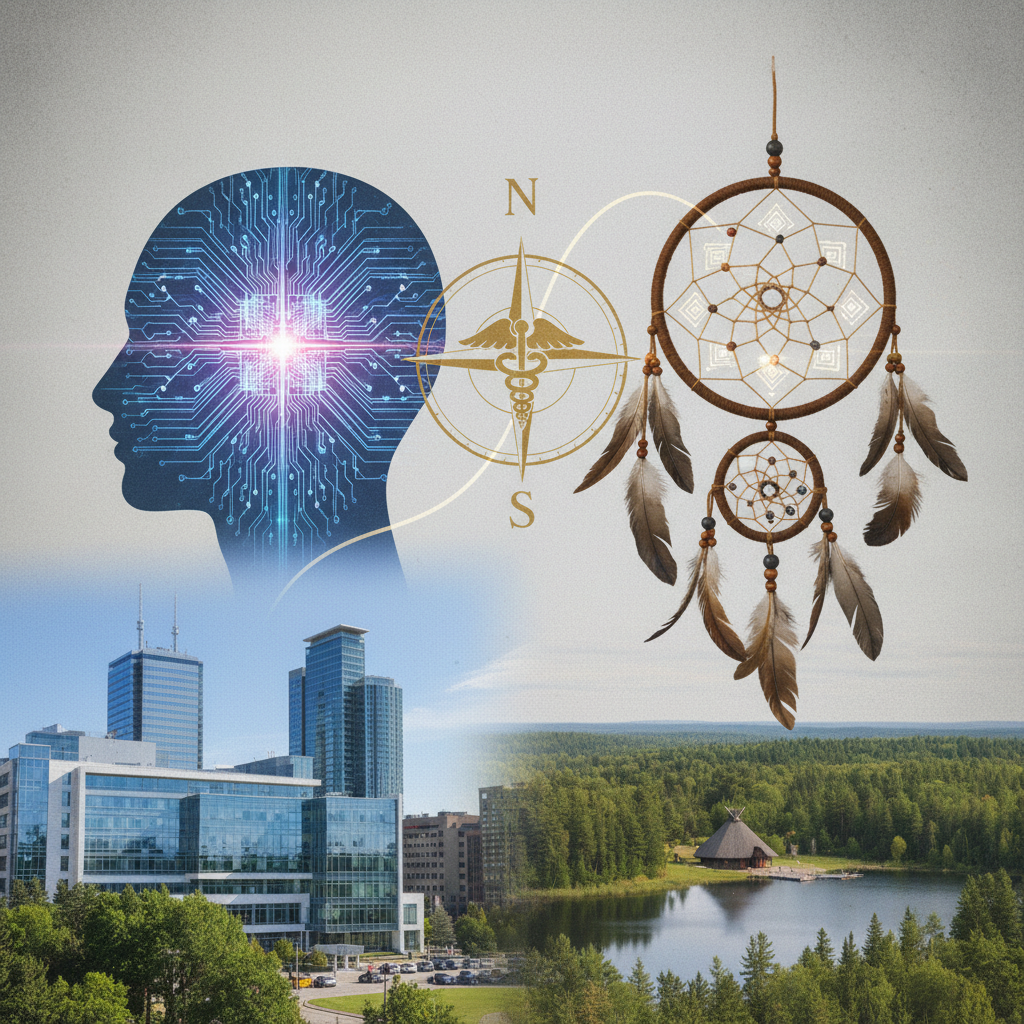

VANCOUVER, BC – The promise of Artificial Intelligence to revolutionize healthcare in Canada, especially in its vast and often underserved northern and rural regions, is palpable. From predictive analytics for disease outbreaks to AI-powered diagnostics in remote clinics, the potential for improved access and outcomes is immense. Yet, as a journalist with deep roots in both Icelandic and Canadian heritage, I find myself reflecting on the ethical frameworks guiding this technological surge, particularly when it intersects with the unique needs and rights of Canada's Indigenous populations.
Just as my Icelandic ancestors relied on sagas and community wisdom to navigate harsh landscapes, modern healthcare AI must be built upon a foundation of trust and respect for local knowledge. The Canadian Institute for Health Information (CIHI) recently highlighted the growing disparities in health outcomes, a gap AI is poised to address. However, the 'how' is as crucial as the 'what'.
Dr. Anya Sharma, a leading ethicist at the University of British Columbia's School of Population and Public Health, emphasized this point in a recent virtual symposium. "We're not just deploying algorithms; we're deploying systems that impact lives, often in communities where historical trauma and mistrust of institutions run deep," Dr. Sharma stated. "For AI to be truly beneficial, it must be co-developed with, and accountable to, the communities it serves. This includes robust data governance models that respect Indigenous data sovereignty, akin to the self-determination principles enshrined in the UN Declaration on the Rights of Indigenous Peoples (UNDRIP)."
Consider the application of AI in early detection of chronic diseases in First Nations communities. While an AI model might flag potential risks with high accuracy, the data used to train it must be ethically sourced, representative, and its deployment must not exacerbate existing power imbalances. The First Nations Health Authority (FNHA) in British Columbia has been a vocal advocate for this approach, pushing for 'Oka-AI' – AI that is 'of the land' and 'of the people'.
My own background, growing up with the Sagas and understanding the importance of oral tradition and collective memory, makes me acutely aware of the value of non-quantifiable data – the stories, the lived experiences, the traditional healing practices. Can AI learn to integrate this? Perhaps not directly, but its design must allow for human-in-the-loop interventions that honour these perspectives.
Furthermore, the 'black box' nature of some AI models raises concerns about transparency and explainability, particularly when clinical decisions are being made. "Patients, and especially communities, need to understand how an AI reached its conclusion," explained Dr. David Chen, a computational health expert at the University of Toronto. "This is not just about trust; it's about informed consent and ensuring that cultural nuances aren't overlooked by an overly generalized model. The Icelandic concept of 'réttlæti' – justice and fairness – must be at the core of our AI development."
The path forward for AI in Canadian healthcare, particularly in its engagement with Indigenous communities, is one of cautious optimism. It requires not just technological prowess, but also profound cultural humility, ethical foresight, and a commitment to genuine partnership. Only then can AI truly serve as a tool for healing and equity, rather than another layer of complexity or potential harm.
Related Articles

AI-Powered Early Cancer Detection: A New Dawn for Vietnamese Women's Health
 Ngo Thi Huừngé
AI in Healthcare: A New Dawn for Sri Lanka's Northern and Eastern Provinces
 Ravi Chandrasekharàn
AI's Ethical North: Canadian Researchers Chart Course for Responsible Innovation
Ingridè Bjornssòn
Morocco's AI Health Revolution: Berber Communities on the Forefront of Digital Wellness
 Tariqù Benaì