
AI's Dual Edge: Opportunities and Gender Disparities in Mexico's Evolving Economy
As AI integration accelerates across Mexico, a new report from UNAM highlights both immense economic opportunities and the critical need to address widening gender disparities, particularly for women in vulnerable sectors. Will Mexico ensure an inclusive digital future?
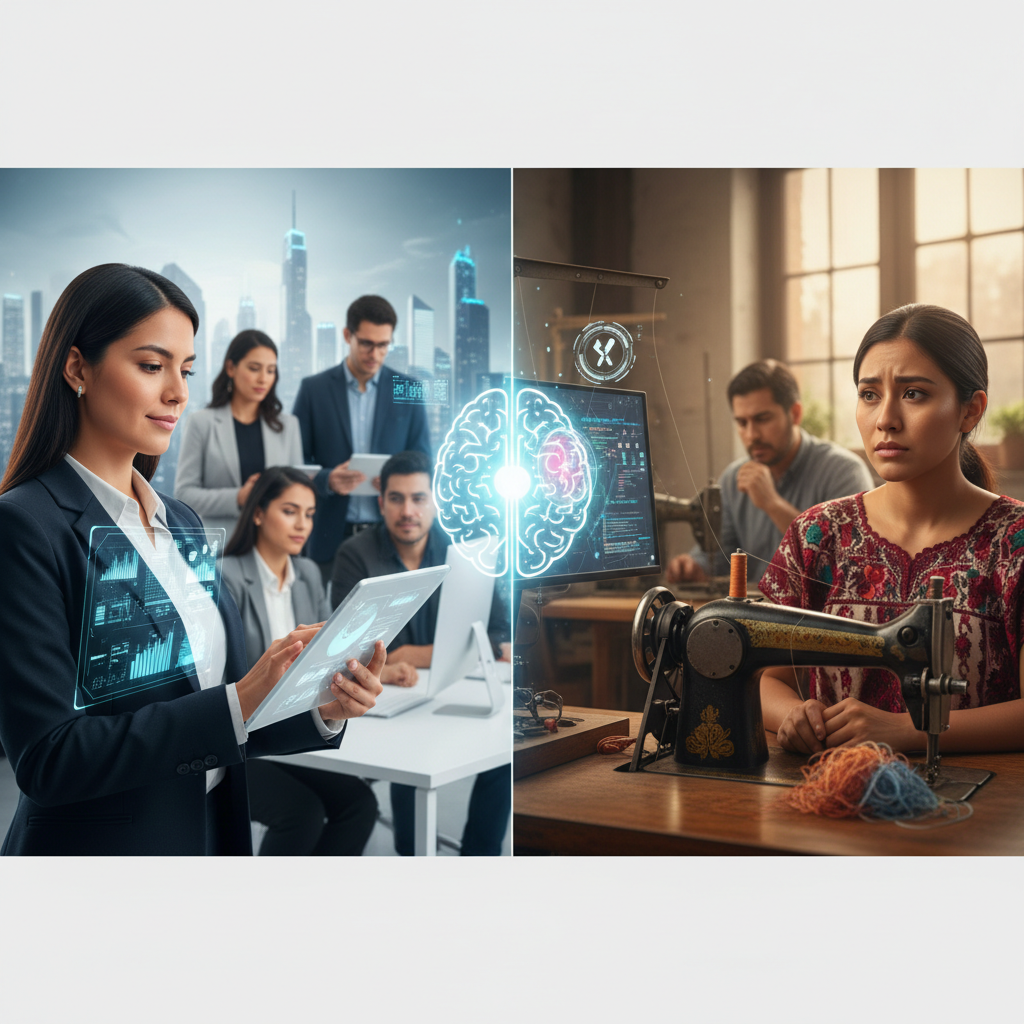

MEXICO CITY – April 22, 2026 – The rapid ascent of Artificial Intelligence (AI) is reshaping global economies, and Mexico is no exception. While the promise of increased productivity and innovation excites policymakers and industry leaders, a recent report from the Universidad Nacional Autónoma de México (UNAM) titled "Instituto de Investigaciones Económicas" paints a nuanced picture, emphasizing both the immense potential and the critical need to address emerging gender disparities within this technological revolution.
"We are at a pivotal moment, a true parteaguas for our nation's economic future," states Dr. Elena Rojas, lead researcher for the UNAM study, during a recent press conference in Ciudad de México. "AI is not just a tool; it's a transformative force. However, our data suggests that without deliberate intervention, the benefits of AI could disproportionately favor men, exacerbating existing inequalities for Mexican women, especially those in informal sectors or traditional manufacturing roles."
According to the report, sectors like advanced manufacturing, logistics, and financial services are seeing significant AI adoption, promising a surge in efficiency and new high-skill jobs. Yet, these roles often require specialized STEM education, an area where Mexican women, despite making strides, still face systemic barriers. The Consejo Nacional de Ciencia y Tecnología (CONACYT) recently reported that while female enrollment in STEM university programs has increased by 15% over the last five years, it still lags behind male enrollment, particularly in fields like computer science and engineering, which are crucial for AI development and implementation.
Conversely, the report highlights that women are overrepresented in administrative, customer service, and light manufacturing roles – positions highly susceptible to automation. "Nuestras mujeres are often the backbone of these industries," Dr. Rojas explains, "and if we don't provide robust reskilling and upskilling programs tailored to their needs, we risk creating a new class of technologically displaced workers. This is not just an economic issue; it's a social justice imperative."
Government initiatives, such as the Programa Nacional de Digitalización Inclusiva, are attempting to bridge this gap. "Our goal is to ensure that AI serves as an engine for inclusive growth, not a wedge," remarked Lic. Sofia Martínez, Undersecretary for Digital Economy at the Secretaría de Economía. "We are collaborating with private industry and educational institutions to develop accessible training modules in AI literacy and data analytics, with a special focus on reaching women in rural areas and marginalized communities through digital literacy centers and mobile training units."
However, experts like Dr. Rojas argue that more aggressive policies are needed, including targeted scholarships for women in AI, incentives for companies to hire and train female AI professionals, and a re-evaluation of labor laws to protect workers in an increasingly automated landscape. "The future of Mexico's economy, and indeed its social fabric, depends on how equitably we navigate this AI revolution," Dr. Rojas concluded. "No podemos dejar a nadie atrás – we cannot leave anyone behind, especially our women, who have so much to contribute to this new digital era."
Related Articles

AI's Algorithmic Bias: A New Frontier in the Fight for Digital Equity for Black Men
 Deshawné Thompsòn
AI's Economic Dawn: Malaysian Women Entrepreneurs Embrace Digital Transformation
 Siti Nurhalizah Rahimàn
AI's Dual Edge: Opportunities and Gendered Challenges for Mexican Women in Tech
Marisèl Rodriguèz
AI's Impact on the American Workforce: A Gendered Economic Shift
 Amèlia Whitè