
AI-Powered Climate Resilience: Mali's Digital Push for Sahelian Farmers
Mali is leveraging AI to empower its agricultural sector against climate change, with new initiatives providing data-driven insights to Sahelian farmers, promising a greener, more resilient future.
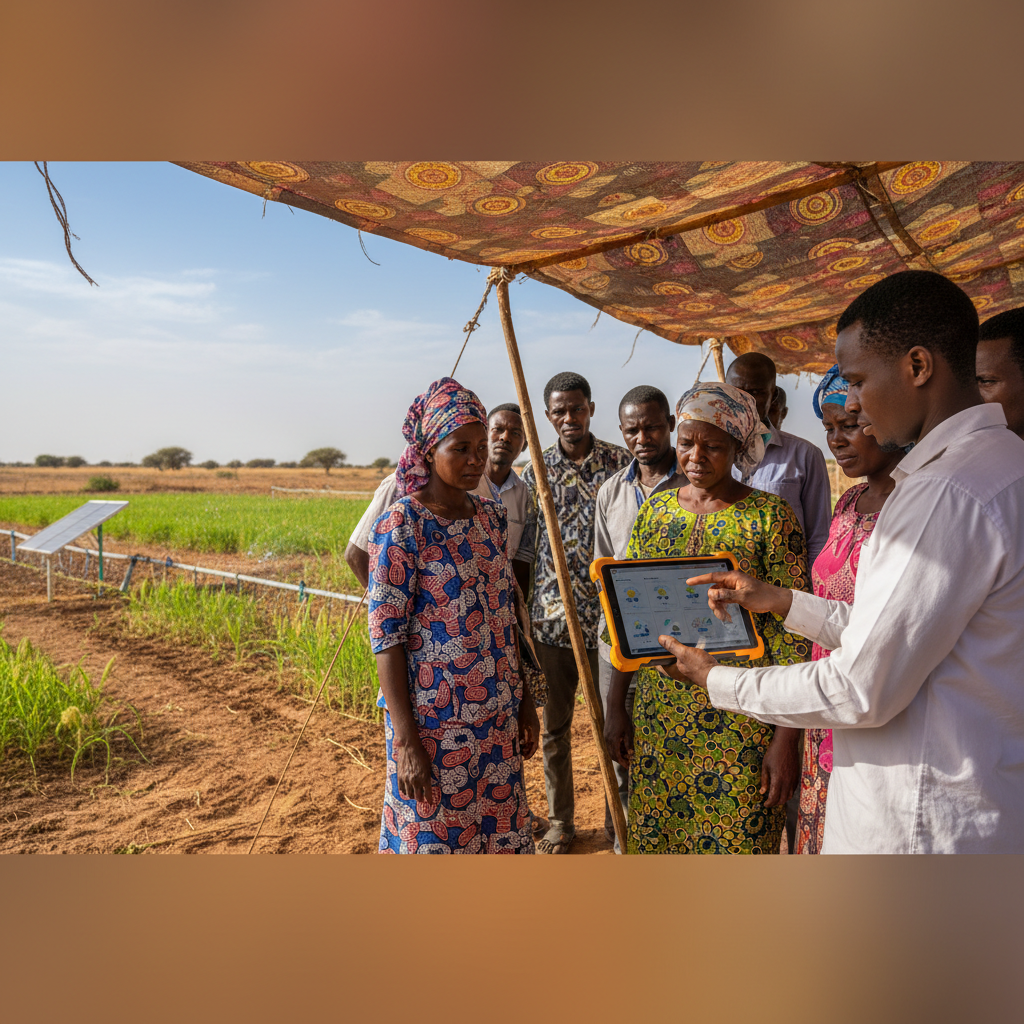

BAMAKO, MALI – In a nation where agriculture forms the very bedrock of existence, the relentless march of climate change presents an existential threat. Yet, from the sun-baked plains of the Sahel, a new beacon of hope emerges: Artificial Intelligence. Mali, a land rich in ancestral knowledge and communal spirit, is increasingly turning to digital innovation to fortify its resilience against environmental adversity.
The Ministry of Agriculture, in collaboration with the Malian Agency for Digital Development (AMDN), recently unveiled the 'Djoliba Climate AI' initiative. This ambitious program aims to deploy AI-driven weather forecasting models and crop optimization tools directly to farmers, particularly those in the vulnerable Mopti and Ségou regions. "Our farmers, the djatigui of our land, have always read the sky and the soil," states Dr. Fatoumata Keïta, Director of Agricultural Innovation at the Ministry. "But with erratic rainfall and prolonged droughts, their traditional wisdom, though invaluable, needs augmentation. AI offers that critical edge, providing hyper-local, real-time data that can mean the difference between a harvest and hunger."
The 'Djoliba Climate AI' platform, accessible via basic feature phones through SMS and simplified USSD interfaces, provides predictive analytics on rainfall patterns, soil moisture levels, and optimal planting times for staple crops like millet, sorghum, and fonio. It also offers early warnings for pest outbreaks, a significant concern for Malian farmers. "This isn't about replacing the farmer's intuition, but enhancing it," explains Ousmane Diallo, a lead data scientist at AMDN. "Imagine a farmer in Koro receiving an alert that a dry spell is imminent, advising them to delay planting by a few days, or to switch to a more drought-resistant variety. This is practical, actionable intelligence."
Local experts emphasize the importance of culturally sensitive implementation. "For the Malian man, community and shared knowledge are paramount," says Professor Moussa Traoré, an ethno-botanist at the University of Bamako. "The success of these technologies hinges on their integration into existing social structures, through farmer cooperatives and village elders. It's not just about the data; it's about how it's communicated and adopted within our tontines (traditional associations)." He stresses the need for local language interfaces and training programs that respect traditional learning methods.
While the initiative is in its nascent stages, early pilot programs have shown promising results. Farmers participating in the pilot reported a noticeable reduction in crop losses and improved yield stability. The long-term vision is to expand 'Djoliba Climate AI' nationwide and integrate it with other digital services, such as access to micro-financing and market information, creating a holistic digital ecosystem for rural Mali. This blend of cutting-edge technology and deep-rooted Malian wisdom may well be the blueprint for climate resilience across the Sahel.
Related Articles
AI in Malian Healthcare: A Double-Edged Sword for Our Communities
Mouhamadouù Bâ
AI 'Eyes' on the Field: Zimbabwe's Warriors Embrace Tech for Talent Scouting
 Zinhlée Khumàlo
AI's Green Promise: Jamaican Women Lead Climate Resilience with Tech
 Keishà Brownè
AI-Powered Green Initiatives: Romanian Women Lead the Charge in Sustainable Agriculture
 Cataliná Ionescù