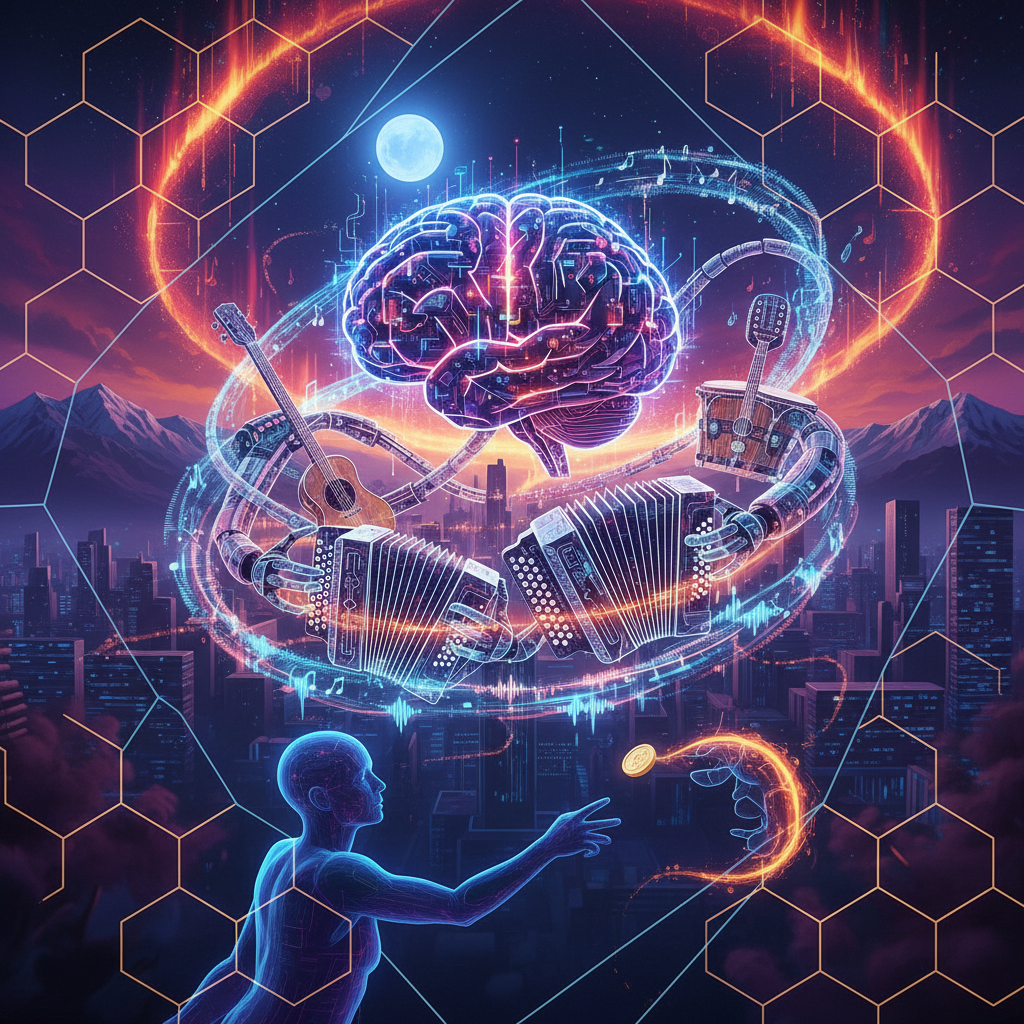

Let me tell you, the future of music isn't a new genre or a fresh face from a talent show. It's a line of code, humming a tune that hasn't been written by human hands, but by algorithms trained on every chord, every beat, every tear-jerking lyric ever recorded. We're not just talking about AI assisting musicians anymore; we're talking about AI being the musician, the producer, and perhaps, the next global superstar. And trust me, the Andes view of AI is different, especially when it starts composing reggaeton.
It sounds like science fiction, doesn't it? But look around. In April 2026, we already have sophisticated AI models that can generate passable melodies, lyrics, and even full instrumental tracks. Companies like Google's DeepMind and OpenAI have shown us glimpses of this power with their experimental music generation tools. The leap from 'experimental' to 'chart-topping' is not as far as you might think, particularly with the insane pace of AI development. We're talking about a future, perhaps in the next five to ten years, where the Billboard Hot 100, or whatever its equivalent will be then, is dominated by tracks crafted entirely by artificial intelligence.
Imagine this: it's 2031. You're driving down the Costanera Norte, the Santiago skyline gleaming, and the radio plays a catchy cumbia. It's got that perfect blend of traditional rhythm and modern pop sensibility. You hum along, tap the steering wheel. Later, you find out the artist, 'Synthwave Santiago,' isn't a person, but a highly advanced generative AI. It analyzed millions of hours of Latin American music, understood the emotional nuances, the cultural touchstones, the precise rhythmic patterns that make us move, and then synthesized something entirely new, yet perfectly familiar. This isn't just about mimicry; it's about algorithmic understanding of human taste at a scale no human producer could ever achieve.
How do we get there from today? Well, the foundations are already laid. We have large language models, image generation models, and now, increasingly sophisticated audio models. The key milestones will involve AI moving beyond mere stylistic imitation to genuine creative innovation. We'll see breakthroughs in emotional intelligence for AI, allowing it to compose music that evokes specific feelings with uncanny accuracy. This means AI won't just write a sad song; it will write your sad song, tailored to your personal listening history and emotional profile. Spotify, with its vast trove of user data, is perfectly positioned to leverage this. Imagine a personalized AI music stream that doesn't just recommend existing songs, but generates new ones on demand, perfectly suited to your mood and activity. It's a terrifyingly efficient feedback loop.
The implications for the music industry are, to put it mildly, an existential crisis. Who wins in this scenario? The tech giants, of course. Companies like Google, Meta, and OpenAI, who own the foundational models and the computational power, will become the new record labels. They'll license their AI composers to artists, or simply release the music themselves. Streaming platforms, like Spotify and Apple Music, will become distribution hubs for an endless, algorithmically generated catalog. For them, it's a dream: infinite content, no pesky artist egos, no royalty disputes with human creators, just pure, scalable data.
And who loses? Oh, mijo, everyone else. The human artists, the songwriters, the session musicians, the producers, the sound engineers, the managers, the entire ecosystem that relies on original human creativity. Their work will be devalued, their livelihoods threatened. Why pay a human band when an AI can generate a dozen perfect tracks in an hour, royalty-free, and never complain about tour bus catering? We're already seeing hints of this with the debates around AI training data and copyright. Artists are rightly concerned that their life's work is being used to train the very machines that will replace them. As Reuters reported, the legal battles over intellectual property in the age of generative AI are only just beginning.
This isn't just a distant Silicon Valley problem. Chile's tech scene is like its wine, underrated and excellent, and our artists, from Mon Laferte to Los Bunkers, are globally recognized. But even they won't be immune. Imagine an AI trained on the entire catalog of Chilean folk music, cueca, cumbia, pop, and rock, capable of spitting out new hits that sound authentically Chilean, yet are entirely synthetic. Will we still value the human touch, the raw emotion, the unique perspective that comes from a life lived under the shadow of the Andes? Or will we be content with perfect, soulless replicas?
"The question isn't whether AI can make music, but whether we, as humans, will allow it to define what music is," said Dr. Elena Rojas, a musicologist at the Universidad de Chile, during a recent panel discussion. "If we lose the human element, we lose a fundamental part of our cultural expression." Her words echo a growing sentiment among artists and cultural critics worldwide. We've seen similar debates in visual arts and writing; music is just the next frontier.
What should readers do now? First, educate yourselves. Understand how these technologies work. Support human artists, now more than ever. Go to live shows, buy their merchandise, stream their music on platforms that pay them fairly, if such platforms still exist. Advocate for policies that protect human creators' intellectual property and ensure fair compensation when their work is used to train AI. This isn't about stopping progress; it's about guiding it responsibly. We need to demand transparency from the tech companies. If a song is AI-generated, it should be clearly labeled as such. Consumers have a right to know.
This isn't just about the music industry; it's about our relationship with creativity itself. Will we become passive consumers of algorithmically optimized content, or will we fight to preserve the messy, beautiful, irreplaceable essence of human art? Santiago has something to say about this, and it's not just a perfectly pitched, AI-generated melody. It's the sound of real people, making real music, with real hearts. And that, I believe, is a tune worth fighting for. For more on the broader implications of AI on creative industries, check out Wired's AI section. The conversation is only just beginning, and it's going to get louder.