Mon Dieu, the arrogance of Big Tech. Just when we thought we had seen it all, with algorithms dictating our shopping habits and social feeds, now they want to dictate our idols. The phenomenon of AI influencers, these perfectly sculpted, endlessly engaging digital entities with millions of followers, has swept across the globe. From the polished perfection of Lil Miquela in the United States to the more avant-garde aesthetics emerging from Asia, these virtual celebrities are raking in fortunes and reshaping the very fabric of celebrity culture. But here in France, we are not so easily swayed by the shimmering allure of the purely synthetic.
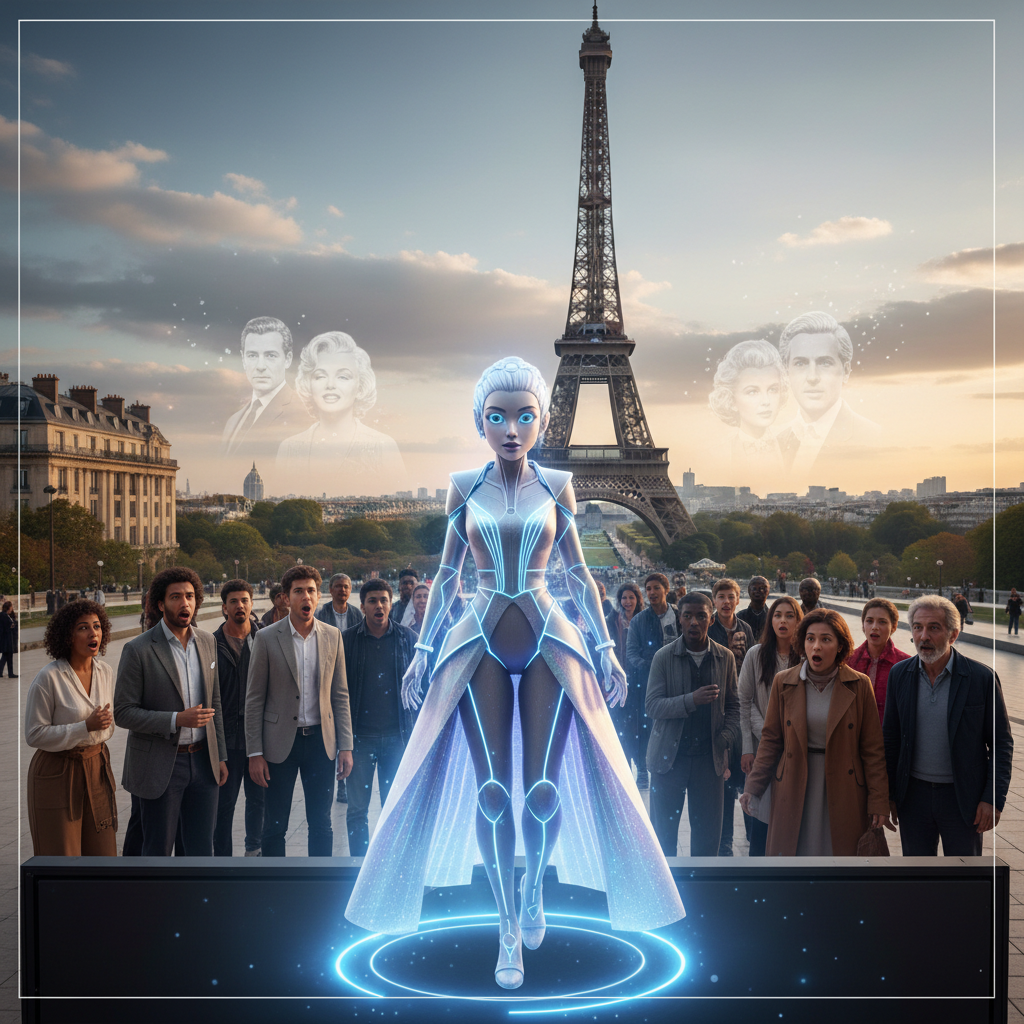
One cannot deny their sheer reach. Take, for instance, the recent partnership between a prominent luxury brand, whose name I shall not dignify by repeating, and an AI model known as 'Aura'. Aura, a digital creation with impossibly smooth skin and eyes that sparkle with an artificial intelligence, boasts 15 million followers on Instagram. Her 'engagement rates' are reportedly 30% higher than those of her human counterparts. This is not just a novelty, it is a multi-billion euro industry in the making. According to a report by Reuters, the virtual influencer market is projected to reach 20 billion dollars globally by 2027. This is a staggering figure, built on pixels and algorithms, not flesh and blood.
Yet, the European way is not the American way and that's the point. While Silicon Valley sees an opportunity for endless scalability and optimized engagement, we in France, and indeed across much of Europe, see a potential erosion of authenticity, a challenge to our very notions of art, creativity, and human connection. Our cultural institutions, our artists, and our philosophers are not simply shrugging their shoulders and embracing this digital deluge. Instead, there is a healthy skepticism, a demand for transparency, and a push for ethical frameworks that go beyond mere market capitalization.
Consider the recent 'scandal' involving 'Clémentine', a French-created AI influencer designed to promote sustainable fashion. While initially lauded for her Parisian chic and eco-conscious messaging, it was later revealed that her 'opinions' were entirely generated by a large language model, a variant of OpenAI's GPT-4, and her 'personal style' curated by a team of human marketers. The backlash was swift and severe. "This is not influence, it is manipulation," declared Dr. Geneviève Dubois, a prominent sociologist at the Sorbonne. "We are not engaging with an individual, but with a highly sophisticated marketing tool disguised as a person. Where is the soul in that? Where is the genuine connection that defines true influence?" Her words resonate deeply with the French spirit of intellectual inquiry and a profound appreciation for the human element in all creative endeavors.
Indeed, the question of authenticity lies at the heart of this debate. When a virtual entity, programmed to be perpetually perfect and agreeable, promotes a product or an idea, what does that mean for genuine human expression? What does it mean for the struggling artist, the passionate activist, or the insightful journalist who cannot compete with an algorithm that never sleeps, never ages, and never makes a mistake? It is a race to the bottom of human experience, optimized for clicks and conversions, not for meaning or depth.
"The very term 'influencer' implies a certain degree of human experience, of trials and triumphs that resonate with an audience," explains Jean-Luc Moreau, a cultural critic writing for Le Monde. "When that experience is simulated, when the 'personality' is a composite of data points and predictive analytics, we are not just losing jobs, we are losing something far more fundamental: the shared human narrative. France says non to Silicon Valley's vision of a world where everything, even our heroes, can be manufactured on demand." This sentiment is echoed across various sectors, from the arts to education, where the value of human-centric creation is fiercely defended.
Even in the realm of health, where AI promises revolutionary advancements, the idea of a virtual health influencer is met with considerable apprehension. Imagine an AI doctor, perfectly articulate and seemingly empathetic, dispensing advice that is technically correct but devoid of the nuanced understanding that comes from years of human interaction and clinical experience. While AI can undoubtedly assist in diagnostics and data analysis, the human touch in care and counseling remains irreplaceable. This is a topic we explored previously in our analysis of AI in healthcare, particularly in the context of Poland's oncology and cardiology [blocked].
The European Union, with its landmark AI Act, is already attempting to grapple with the broader implications of artificial intelligence, focusing on transparency, safety, and fundamental rights. While the Act does not specifically target AI influencers, its principles of human oversight and accountability are highly relevant. Regulators are beginning to ask tough questions about who is responsible when an AI influencer spreads misinformation or promotes harmful products. Is it the creator of the AI model, the platform hosting the influencer, or the brand that collaborates with it? The legal and ethical quagmires are vast and largely uncharted.
Companies like Meta, with its Llama models, and Google, with its Gemini, are constantly pushing the boundaries of what AI can generate, from photorealistic images to compelling narratives. It is only a matter of time before these capabilities are fully unleashed in the influencer space, making it even harder to distinguish between human and machine. The technology is advancing at a breathtaking pace, and the ethical frameworks struggle to keep up. As reported by Wired, the sophistication of deepfake technology, a precursor to many AI influencers, has reached a point where detection is increasingly difficult for the average user.
So, what is the French response to this digital invasion? It is not one of outright rejection, but rather one of critical engagement and a steadfast commitment to human values. We are not afraid of technology, but we insist that it serve humanity, not the other way around. There is a growing movement for 'slow AI', an approach that prioritizes ethical development, cultural preservation, and human well-being over speed and profit. This means investing in European AI startups that focus on augmenting human creativity rather than replacing it, and supporting platforms that champion authentic voices.
Ultimately, the rise of AI influencers forces us to confront a fundamental question: what do we truly value in our public figures, in our art, and in our connections? Is it flawless perfection and endless availability, or is it the messy, unpredictable, and deeply human experience that defines our shared reality? For me, the answer is clear. We must resist the siren song of the perfectly programmed and instead champion the beautiful imperfection of the human spirit. Otherwise, we risk becoming mere spectators in a world where even our dreams are algorithmically optimized. And that, my friends, would be a tragedy of truly epic proportions.