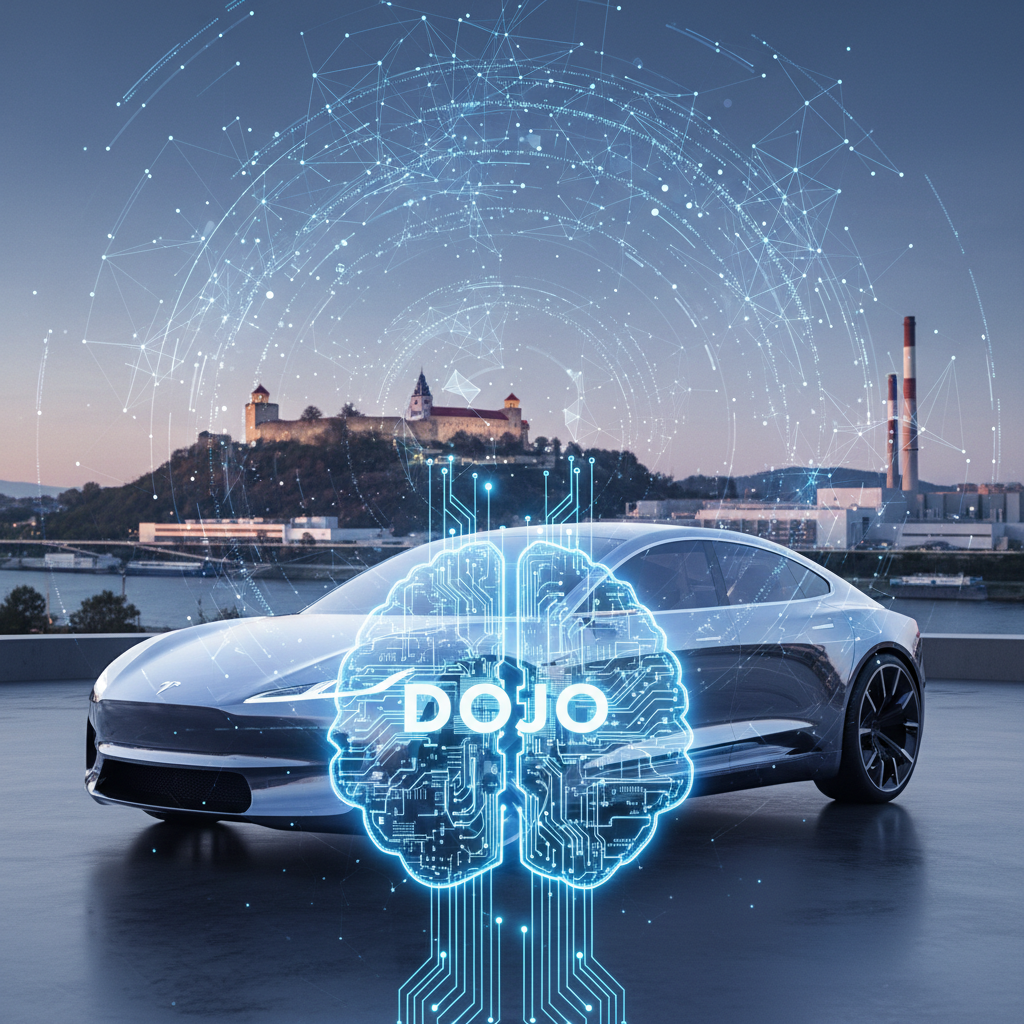

A few weeks ago, I found myself gazing out over the Danube in Bratislava, a city that feels like it is constantly humming with quiet innovation, and I couldn't help but think about the sheer audacity of what Elon Musk and his team at Tesla are trying to achieve. Their latest AI Day announcements, particularly the deep dive into the Dojo supercomputer project, have sent ripples far beyond the usual tech circles. This is not just about faster self-driving cars; it is about building the very infrastructure for a future where AI is woven into the fabric of everything, and believe me, Slovakia is watching closely.
For those who haven't been following every byte and teraflop, Dojo is Tesla's custom-built supercomputer, designed from the ground up to train their neural networks for autonomous driving. We are talking about processing petabytes of real-world driving data, a scale that makes your average data center look like a child's toy. At the recent AI Day, the figures discussed were truly mind-boggling. Tesla revealed plans to significantly expand Dojo's capabilities, aiming for an exaFLOP of performance in the coming years. To put that into perspective, an exaFLOP is a quintillion floating point operations per second. It is a number so large it almost loses meaning, but what it means for AI training is unprecedented speed and efficiency.
Why does this matter so much, especially to us here in Central Europe? Well, Slovakia, as many of you know, is a global automotive powerhouse. We produce more cars per capita than any other country in the world. Our factories, from Volkswagen to Kia to Stellantis, are humming with activity, building the vehicles that drive Europe and beyond. The transition to electric vehicles and, crucially, autonomous driving, is not some distant future for us; it is happening right now, on our factory floors and in our R&D centers. Tesla's advancements in AI for autonomy directly impact the entire automotive supply chain, and that includes us.
"The sheer scale of data processing required for true Level 5 autonomy is astronomical, and custom hardware like Dojo represents a significant competitive advantage," explained Dr. Juraj Hromada, a leading AI researcher at the Slovak University of Technology in Bratislava. "It allows for iterative improvements to neural networks at a pace that generic GPU clusters simply cannot match, giving Tesla a potential lead in the race for fully autonomous vehicles." This sentiment is echoed across the industry. The ability to rapidly iterate and refine AI models based on real-world data is the holy grail for autonomous driving, and Dojo is designed to accelerate that process dramatically.
But it is not just about the cars themselves. Dojo represents a new frontier in specialized AI hardware. While NVIDIA has long dominated the AI chip market with its powerful GPUs, Tesla's move to design its own silicon for AI training is a bold statement. It speaks to a future where companies are increasingly taking control of their entire technology stack, from the software to the underlying hardware. This vertical integration, while challenging, can lead to incredible performance gains and efficiencies. It is a lesson that our own burgeoning tech scene, particularly startups looking to innovate in manufacturing AI or smart city solutions, should heed.
I spoke with Anna Kováčová, CEO of a promising Slovak AI startup focused on optimizing industrial processes, and she shared her perspective. "What Tesla is doing with Dojo is inspiring. It shows what is possible when you think beyond off-the-shelf solutions. For us, it is a reminder that even in a smaller market, specialized innovation can create massive impact. We may not build supercomputers, but we can certainly learn from their approach to problem-solving and efficiency." Her words resonate deeply with the spirit of innovation I see blossoming across the region. Central Europe's quiet revolution is built on this kind of ingenuity.
The implications for talent are also immense. The demand for AI engineers, machine learning specialists, and hardware architects capable of working on such complex systems is skyrocketing. Slovakia's hidden tech talent, particularly in areas like computer vision and embedded systems, is well-positioned to contribute to this global shift. Our universities are producing graduates with strong foundational knowledge, and the challenge now is to retain them and provide opportunities that rival those found in Silicon Valley or other major tech hubs. Initiatives like the AI Slovakia platform are crucial in fostering this ecosystem.
Of course, there are challenges. Building and operating a supercomputer like Dojo is incredibly expensive, requiring massive investments in both hardware and energy. The environmental footprint of such powerful machines is a growing concern, and companies like Tesla will face increasing scrutiny to ensure their AI ambitions align with sustainability goals. Furthermore, the proprietary nature of Dojo means that its benefits are currently confined to Tesla's ecosystem, unlike more open platforms that could accelerate broader AI research.
Looking ahead, the advancements in AI compute, spearheaded by projects like Dojo, will undoubtedly accelerate the development of more capable and robust AI systems across industries. From healthcare to logistics, the ability to train larger, more complex models faster will unlock new possibilities. For Slovakia, a country deeply integrated into the global economy and at the forefront of automotive manufacturing, this means both opportunity and a call to action. We must continue to invest in our talent, foster innovation, and adapt our industries to embrace these powerful new tools. The future is arriving, and it is powered by intelligence, both human and artificial. It is an exciting time to be alive, and I cannot wait to see what comes next. The journey is just beginning, and Bratislava is having its moment, ready to contribute to this incredible technological tapestry. For more insights into cutting-edge AI hardware, you can always check out MIT Technology Review. And for the latest on AI product news, The Verge is an excellent resource.