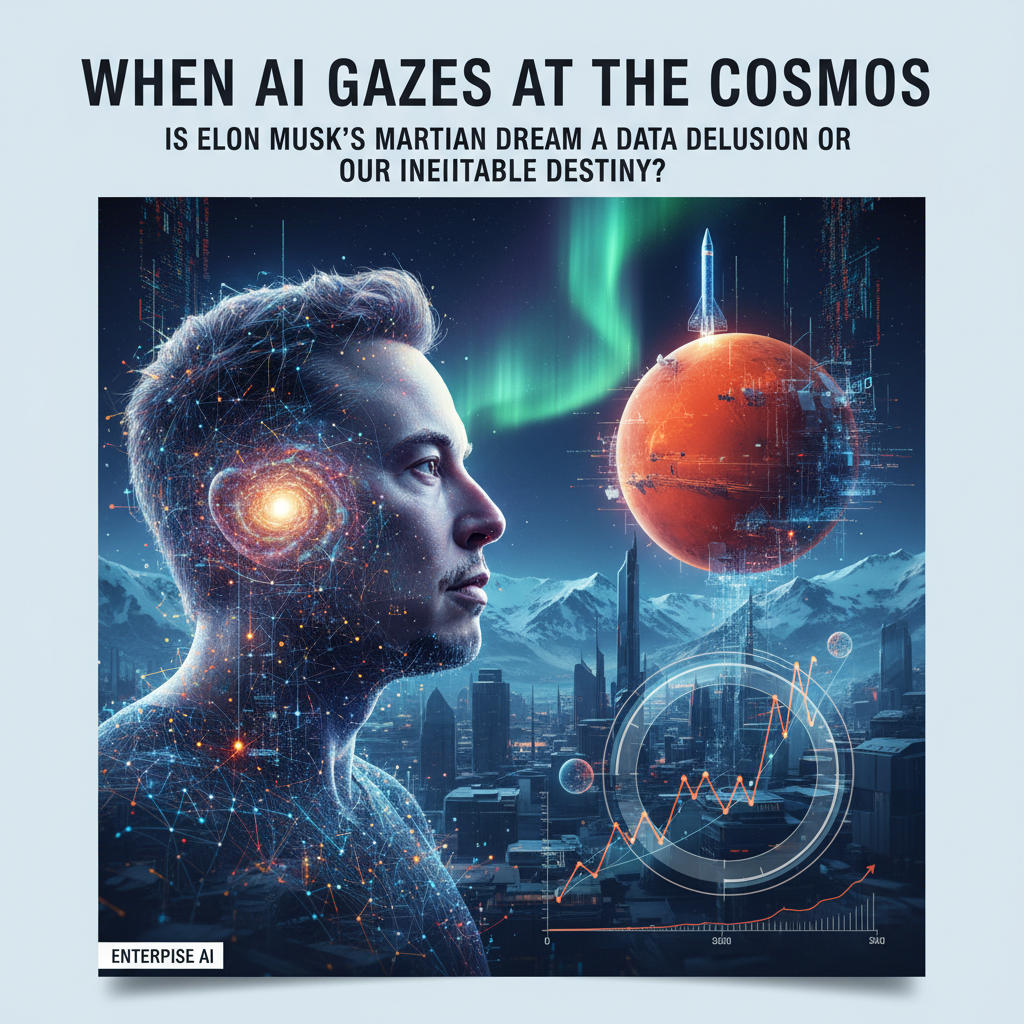

The vast, silent expanse of space has always captivated humanity, a cosmic canvas for our grandest ambitions and deepest questions. For centuries, our exploration has been limited by human endurance, computational power, and the sheer volume of data. Now, a new frontier is emerging, one where artificial intelligence is not merely a tool, but an indispensable partner in our quest to understand the cosmos. The question before us, as we stand on the precipice of unprecedented interstellar endeavors, is this: is AI's role in space exploration a fleeting technological fancy, or the bedrock of our future among the stars?
Historically, space exploration has been a triumph of meticulous engineering and human ingenuity. From the calculated trajectories of the Apollo missions to the robotic perseverance of the Mars rovers, every success has been hard-won. Early forms of automation were present, certainly, but the sheer cognitive load and decision-making responsibility remained firmly with human operators on Earth. Consider the early days of satellite telemetry, where engineers meticulously analyzed every data point. It was a slow, painstaking process, akin to charting a course across the North Sea using only a sextant and paper maps. This approach, while effective, simply cannot scale to the ambitions of today, particularly with the burgeoning data streams from ever more sophisticated sensors and the increasing autonomy required for deep space missions.
Today, the landscape is dramatically different. We are witnessing an exponential surge in data generated from space. Low Earth Orbit is becoming a bustling highway of satellites, each transmitting terabytes of information daily. Companies like SpaceX, with its Starlink constellation, and Amazon, with Project Kuiper, are launching thousands of new satellites, creating a complex web that demands intelligent management. According to a recent report by the Satellite Industry Association, the global space economy reached over $420 billion in 2025, with a significant portion driven by satellite services and ground equipment, areas increasingly optimized by AI. This growth is not just about communication; it extends to Earth observation, climate monitoring, and navigation, all of which benefit immensely from AI-driven analytics.
Let me explain the engineering. AI is being deployed in three primary domains within space exploration: mission autonomy and optimization, scientific data analysis, and the search for extraterrestrial intelligence (seti).
In mission autonomy, AI algorithms are enabling spacecraft to make real-time decisions without constant human intervention. For Mars missions, this is critical. The communication lag between Earth and Mars can be anywhere from 3 to 22 minutes, rendering direct teleoperation impractical for immediate hazard avoidance or scientific target selection. NASA's Perseverance rover, for instance, utilizes an advanced autonomous navigation system, AutoNav, which allows it to drive much faster and more safely across Martian terrain than its predecessors. This is not merely pre-programmed logic; it involves machine learning models trained on vast datasets of Martian topography and potential hazards, allowing the rover to adapt to unforeseen conditions. "The ability for our rovers to make intelligent decisions on their own is paramount for ambitious missions like Mars Sample Return," stated Dr. Lori Glaze, Director of NASA's Planetary Science Division, in a recent press briefing. "AI significantly reduces the operational burden and accelerates scientific discovery."
Satellite AI, meanwhile, is revolutionizing how we manage orbital assets. AI-powered systems are optimizing satellite constellations for collision avoidance, power management, and data routing. This is particularly relevant for Norway, a nation deeply invested in maritime and Arctic surveillance. The Norwegian Space Agency, for example, is exploring AI applications for its micro-satellite programs, aiming to enhance the monitoring of Arctic shipping lanes and environmental changes. Norway's approach to AI is rooted in trust, emphasizing transparency and reliability, especially when autonomous systems are operating in critical infrastructure like space. This is not just about efficiency; it is about resilience and security in an increasingly congested orbital environment. "Our satellites provide invaluable data for everything from fisheries management to climate research," explained Christian Hauglie-Hanssen, Director General of the Norwegian Space Agency. "AI helps us extract maximum value from that data and ensures the longevity of our space assets."
The third, and perhaps most speculative, application is in the search for extraterrestrial intelligence. Seti projects generate immense amounts of radio and optical data, a needle in a cosmic haystack problem perfectly suited for pattern recognition algorithms. Traditional methods struggled with the sheer volume and complexity of potential signals. Modern deep learning models, however, can sift through petabytes of noise, identifying subtle anomalies that might indicate intelligent origins. Breakthrough Listen, the largest scientific program for Seti, is increasingly leveraging machine learning to process its observational data. Dr. Jill Tarter, co-founder of the Seti Institute, has long advocated for advanced computational methods. "We are looking for patterns that we don't necessarily know how to define a priori," she noted in an interview with Wired. "AI gives us the best chance to find something truly unexpected."
However, this rapid integration of AI is not without its challenges. The reliability of AI systems in extreme space environments, the potential for algorithmic bias in data interpretation, and the ethical implications of autonomous decision-making in critical scenarios are all areas demanding rigorous scrutiny. The "black box" nature of some advanced AI models can make debugging and verification incredibly difficult, a significant concern when a multi-billion dollar mission is at stake. Furthermore, the energy demands of training and running these sophisticated AI models are substantial, prompting research into more energy-efficient AI hardware and algorithms, a topic frequently discussed on MIT Technology Review.
So, is AI in space exploration a fad or the new normal? My analysis suggests it is unequivocally the new normal, an indispensable component for the next era of cosmic discovery. The sheer scale of data, the demand for autonomy in deep space, and the need for sophisticated pattern recognition far exceed human capabilities alone. From the precision required for asteroid mining to the complex logistics of establishing a lunar base, AI will be the silent architect behind many future breakthroughs. The Nordic model extends to technology, emphasizing collaboration and responsible innovation, principles that must guide our development of AI for space. We must ensure that as we delegate more cognitive tasks to machines, we do so with a clear understanding of their limitations and a robust framework for oversight.
Ultimately, the vision of Elon Musk's Martian colonies, while ambitious, hinges not just on rocket propulsion, but on the intelligent systems that will sustain life and exploration on another planet. The data deluge from our orbital assets, the autonomous navigation of our rovers, and the tireless search for cosmic neighbors all point to a future where AI is not just assisting, but fundamentally enabling our journey into the unknown. The universe is vast, and our human capacity, while remarkable, is finite. AI offers us a way to expand that capacity, to see further, analyze deeper, and perhaps, finally answer the age-old question: are we alone? The data suggests we are only just beginning to ask the right questions, with the right tools. For further insights into the complexities of AI in autonomous systems, one might consider the discussions surrounding AI agents explained. The journey is long, but with AI as our co-pilot, the destination seems a little less distant.