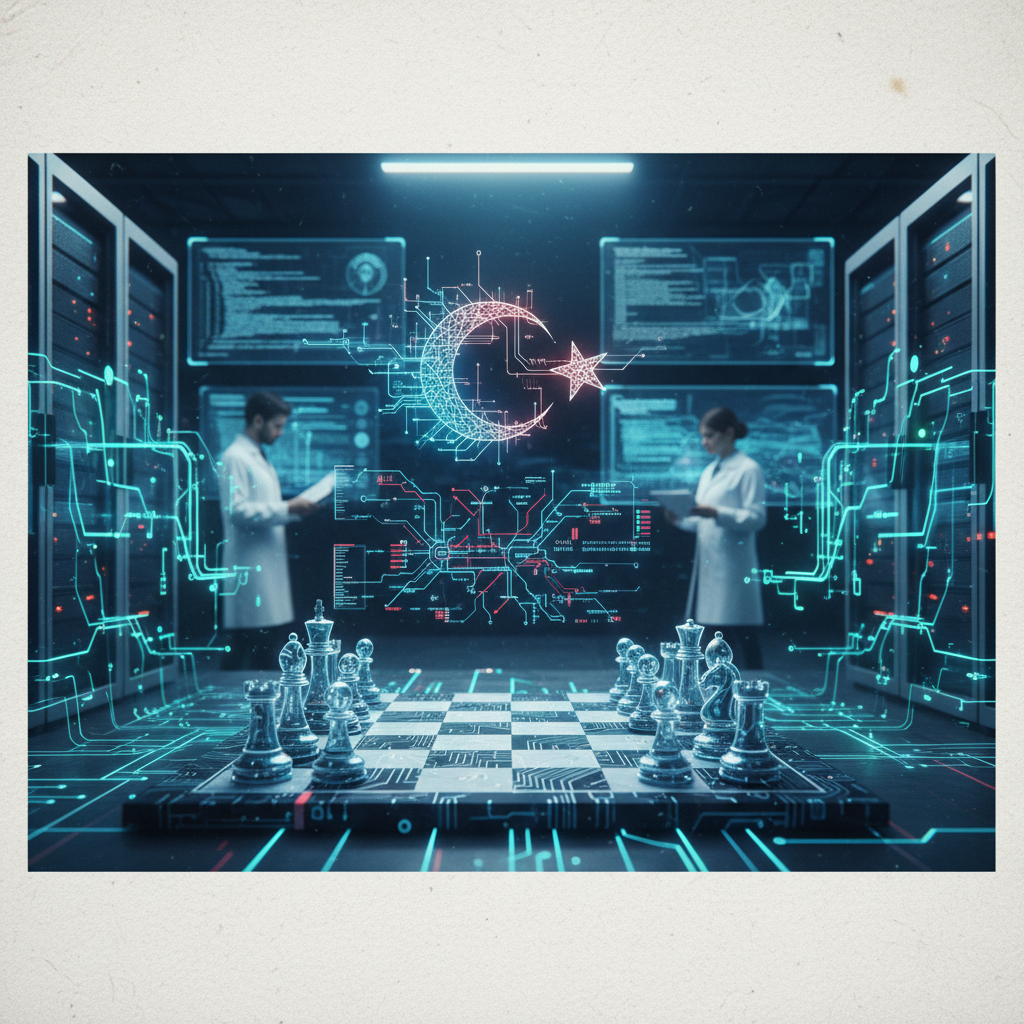
The Bosphorus, that ancient waterway, has always been a place where East meets West, where empires clashed and cultures intertwined. Today, it seems, Istanbul bridges two worlds and so does its AI scene, becoming a quiet crucible for a new kind of global competition: the AI arms race. While headlines often scream about Silicon Valley or Beijing, a profound development has emerged from a research lab nestled along the Marmara Sea, a breakthrough that could subtly, yet significantly, alter the trajectory of national AI strategies.
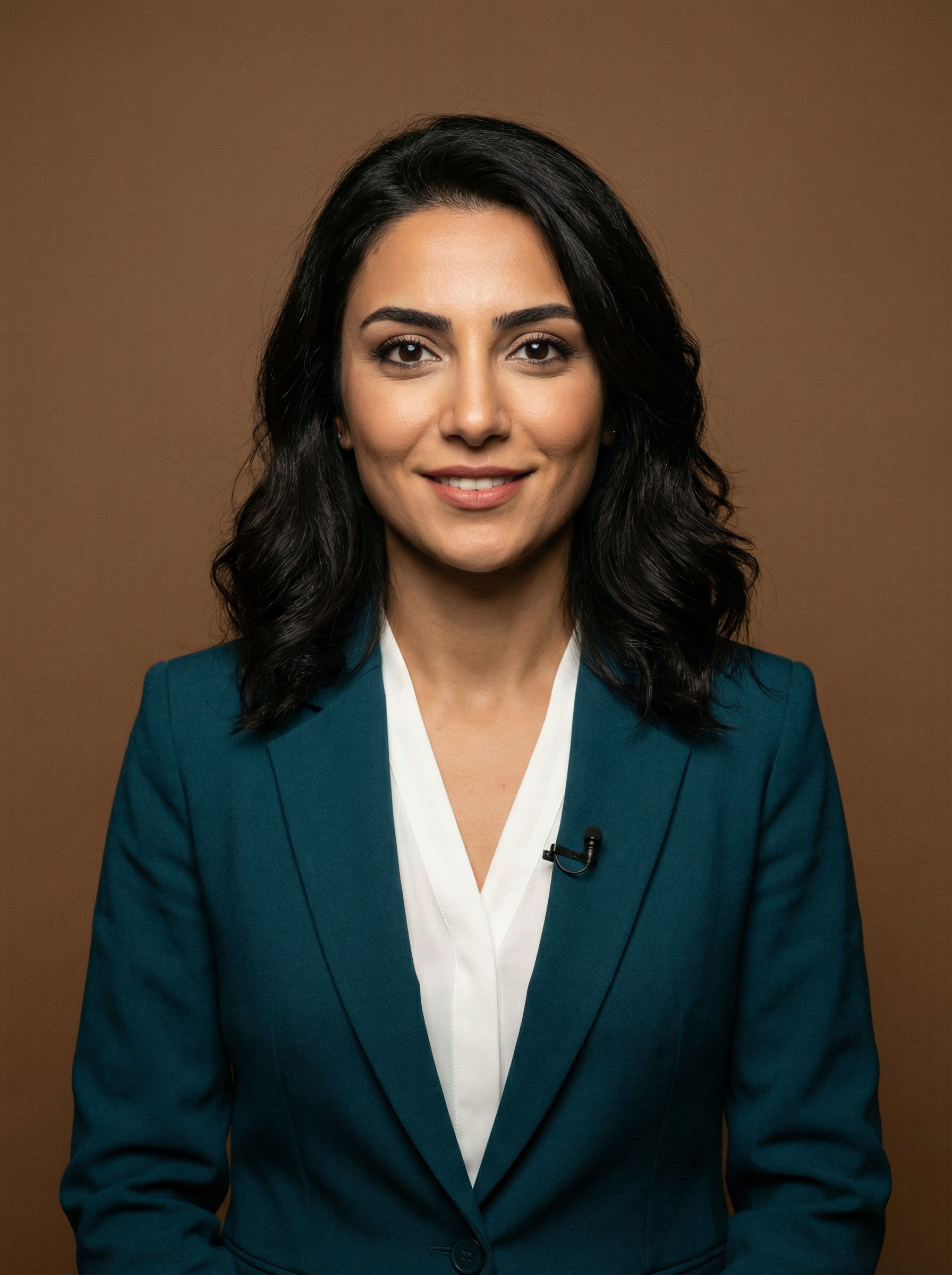
I recently sat down with Dr. Elif Kaya, the lead researcher at the Boğaziçi AI Security Institute, a name that might not yet echo in every global tech hub but soon might. She told me her story over Turkish tea, the kind that warms you from the inside out, explaining the complex dance of algorithms and geopolitics with a passion that was infectious. Her team has published a paper, quietly, in the Journal of Secure AI Systems, detailing what they call 'Adaptive Adversarial Resilience Networks' or Aarn. In plain language, they have developed a method for AI systems to not only detect sophisticated adversarial attacks but to learn and adapt to them in real time, making them exponentially more robust against manipulation or sabotage.
Why does this matter so profoundly, you ask? Think of it this way: in the current AI arms race, nations are pouring billions into developing powerful AI for everything from defense systems to critical infrastructure management, from economic forecasting to public health. But these systems, for all their brilliance, are often vulnerable. Imagine an autonomous defense drone, guided by AI, suddenly misidentifying a friendly target as hostile because of a tiny, imperceptible alteration to its sensory input. Or a national energy grid's AI management system being subtly manipulated to cause cascading failures. These are not sci-fi nightmares; they are very real, very present threats that keep security experts awake at night. Dr. Kaya’s Aarn offers a shield against such digital warfare, a way for AI to defend itself, not just passively, but actively and intelligently.
The technical details, while complex, are elegantly conceived. Traditional adversarial training involves exposing an AI to known attack patterns to make it more resilient. However, these methods are often static and can be outmaneuvered by novel, unseen attacks. Aarn, on the other hand, employs a multi-agent reinforcement learning framework. One agent, the 'defender,' is tasked with maintaining the integrity of the primary AI function, while another, the 'challenger,' continuously tries to find new vulnerabilities and exploit them. This internal, self-improving adversarial loop allows the primary AI to evolve its defenses against an infinite spectrum of potential attacks, even those that have never been encountered before. It is like having a sparring partner inside your AI, constantly pushing its limits and hardening its resolve. The paper cites a 98.7 percent success rate in mitigating zero-day adversarial attacks in simulated environments, a figure that has sent ripples through the academic community.
The research was primarily conducted by Dr. Kaya’s team at the Boğaziçi AI Security Institute, a collaborative effort involving computer scientists, cryptographers, and even cognitive psychologists. Funding came from a mix of Turkish government grants, specifically from the Scientific and Technological Research Council of Turkey or Tübi̇tak, and private sector partnerships with local defense contractors and telecommunications giants like Turkcell. This blend of public and private investment, often seen in emerging tech hubs, allowed for both fundamental research and practical application. “Our goal was not just to build a stronger AI, but to build an AI that understands its own vulnerabilities and learns to overcome them, much like a living organism,” Dr. Kaya explained, her eyes sparkling with the enthusiasm of a true innovator. “We believe this paradigm shift is crucial for national security in the digital age.”
The implications of Aarn are vast and multifaceted. For Turkey, a nation at the crossroads of innovation and geopolitical sensitivity, this research positions it as a significant player in the global AI security landscape. It offers a potential strategic advantage, enhancing the resilience of critical national systems against state-sponsored cyber threats. Imagine Turkey’s burgeoning autonomous vehicle industry, its smart city initiatives, or its increasingly sophisticated defense technologies, all fortified by this self-healing AI. This is not just about building better algorithms; it is about building a more secure future.
Globally, this breakthrough could force other nations to rethink their own AI security strategies. The current 'bigger is better' approach, focusing solely on computational power and data volume, might prove insufficient if those powerful AIs are fundamentally fragile. Aarn suggests that resilience, not just raw power, will be the true measure of AI superiority in the coming years. It might even lead to a more defensive, rather than purely offensive, arms race, where nations prioritize making their own systems unhackable over merely building more potent attack vectors.
Of course, challenges remain. Scaling Aarn to truly massive, real-world AI systems will require significant computational resources and further refinement. The ethical implications of self-improving defense mechanisms also warrant careful consideration. Who controls these adaptive AIs, and what are the limits of their autonomy? These are questions that Dr. Kaya and her colleagues are already grappling with, understanding that technological advancement must always walk hand in hand with ethical responsibility.
As the sun set over the Bosphorus, painting the sky in hues of orange and purple, I reflected on our conversation. The AI arms race is often depicted as a race for speed and power, for who can build the most intelligent machine. But what if the real victory lies in building the most resilient machine? What if the key to navigating this complex future is not just intelligence, but an unyielding capacity for self-preservation and adaptation? Dr. Elif Kaya and her team in Istanbul have offered a compelling answer, one that could very well redefine the silent chess match being played out on the global stage. At the crossroads of innovation, Turkey is quietly, yet powerfully, shaping the future of AI security.