The air in Istanbul, even in April, carries that familiar mix of history and hustle, the scent of simit mingling with the exhaust of passing taxis. It is a city that thrives on human connection, on the bartering, the conversations, the shared cups of tea. So, when I first heard whispers of a startup promising 'human-free businesses,' my journalist's instinct, and my Turkish heart, immediately wondered: what does this mean for us, for the very fabric of our commerce and community?
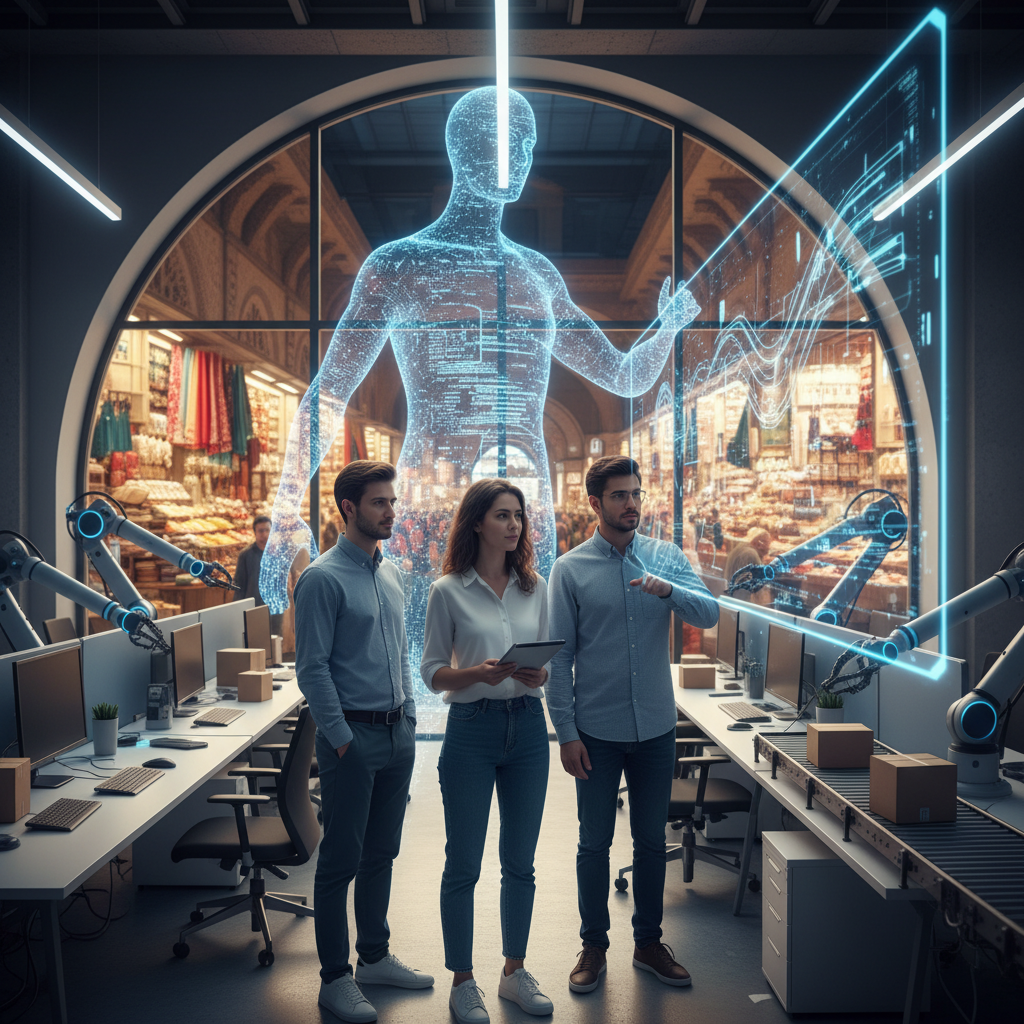
This is the story of 'Otomasyon Hane,' or 'Automation House,' a name that sounds both futuristic and rooted in our traditional Turkish homes. Their audacious goal: to create fully autonomous business operations, from customer service to supply chain management, all powered by advanced AI. It sounds like something out of a science fiction novel, yet here in a sleek office overlooking the Bosphorus, its founder, Elif Kaya, is making it a reality.
The Founder's Vision: From Anatolian Dreams to Algorithmic Realities
Elif Kaya is not your typical tech founder. She grew up in a small town in Central Anatolia, where her family ran a traditional textile business. "I remember spending my summers in the workshop," she told me, her voice soft but resolute, "watching my grandmother meticulously check every stitch, my father negotiating prices in the bazaar. It was all so human, so personal." She told me her story over Turkish tea, the warmth of the glass in my hand a stark contrast to the cold logic of AI.
Her 'aha moment' came during her university years at Boğaziçi, studying industrial engineering. "I saw how much repetitive, time-consuming work went into even the simplest transactions," she explained. "My family's business, like so many others, was limited by human capacity. What if we could free people from the mundane, allowing them to focus on creativity, on connection, on what truly matters?" This wasn't about replacing people, she insists, but about augmenting human potential by offloading the predictable. It was a vision born not of Silicon Valley ambition, but of a deep understanding of the struggles faced by small and medium-sized businesses in Turkey.
After a stint at a global logistics firm, where she witnessed firsthand the inefficiencies of traditional supply chains, Elif returned to Turkey with a burning idea. She assembled a small team of AI engineers and data scientists, many of them fellow Turkish expatriates returning home, drawn by her passionate vision. Otomasyon Hane was born in late 2023.
The Problem They Are Solving: The Burden of the Mundane
Many businesses, particularly small and medium-sized enterprises (SMEs), are stifled by operational overhead. Hiring, training, managing, and retaining staff for repetitive tasks like inventory tracking, basic customer inquiries, order processing, and even initial sales outreach can be a monumental challenge. This is especially true in a dynamic economy like Turkey's, where labor costs can fluctuate and skilled workers are in high demand.
Otomasyon Hane aims to lift this burden. Their platform offers a suite of AI-driven modules that can seamlessly integrate into existing business structures. Imagine a small e-commerce shop owner in Izmir, struggling to keep up with customer emails after hours. Otomasyon Hane's AI can handle 90 percent of these inquiries, routing complex issues to human staff only when necessary. Or consider a textile manufacturer in Bursa needing to optimize their raw material procurement. The AI can analyze market prices, predict demand fluctuations, and even initiate purchase orders with pre-approved suppliers.
"The goal is not to eliminate humans, but to elevate them," says Dr. Canan Yılmaz, a professor of AI ethics at Istanbul Technical University, who has been following Otomasyon Hane's progress. "It allows entrepreneurs to scale without the proportional increase in human resource management, freeing them to innovate and expand into new markets. The ethical considerations are paramount, of course, but the potential for economic growth is undeniable."
The Technology: A Symphony of Algorithms and Data
Otomasyon Hane's core technology is a proprietary blend of large language models (LLMs), reinforcement learning, and advanced robotic process automation (RPA). Their AI agents are designed to learn from a business's historical data, adapt to its unique operational flows, and even anticipate future needs.
For instance, their 'Customer Interaction Bot' uses a fine-tuned LLM trained on Turkish colloquialisms and cultural nuances, allowing it to engage with customers in a way that feels natural and empathetic, a crucial factor in a relationship-driven culture like ours. "It's not just about answering questions, it's about understanding the unspoken," Elif explains, a nod to the subtle art of Turkish hospitality. "Our AI learns to recognize tone, urgency, and even regional dialect differences, providing a truly localized experience."
Their 'Supply Chain Optimizer' employs reinforcement learning to constantly refine logistics, predicting potential disruptions and suggesting alternative routes or suppliers before problems even arise. This proactive approach saves businesses significant time and money, a critical advantage in today's volatile global market.
Market Opportunity: A Sea of Untapped Potential
The market for business automation, particularly for SMEs, is vast and largely underserved. In Turkey alone, SMEs constitute over 99 percent of all enterprises, employing 75 percent of the workforce. Globally, the robotic process automation market is projected to reach over 60 billion dollars by 2030. Otomasyon Hane is strategically positioned to capture a significant share of this, especially in emerging markets where the digital transformation is still gaining momentum.
"We estimate that within the next five years, at least 30 percent of routine business operations in Turkish SMEs could be fully automated," states Professor Emre Demir, an economist at Koç University. "Otomasyon Hane's localized approach, understanding the unique regulatory and cultural landscape of Turkey, gives them a distinct edge over global competitors who often offer one-size-fits-all solutions."
Competitive Landscape: The David and Goliath Scenario
The competitive landscape is populated by global giants like UiPath, Automation Anywhere, and Microsoft, all offering powerful RPA and AI solutions. However, Otomasyon Hane believes its strength lies in its niche focus and cultural sensitivity. "Big tech companies often build for the global lowest common denominator," Elif asserts. "We build for the specific needs of businesses operating in environments like Turkey, with its unique blend of traditional practices and modern aspirations. Istanbul bridges two worlds and so does its AI scene, and our platform reflects that." Their deep understanding of Turkish business law, taxation, and customer expectations allows for a more seamless and effective integration.
They also differentiate themselves through their pricing model, offering scalable solutions that are accessible to even the smallest businesses, a stark contrast to the often prohibitive costs associated with enterprise-level automation platforms.
Funding and What's Next: A Future Unfolding
Otomasyon Hane recently closed a seed round of 5 million dollars, led by a consortium of Turkish and European venture capitalists, including Istanbul-based 'Bosphorus Ventures' and Berlin's 'Europa Tech Fund.' This funding will primarily be used for expanding their engineering team, enhancing their AI models, and launching pilot programs with key industry partners in textiles, e-commerce, and logistics.
Elif envisions a future where Otomasyon Hane becomes the operating system for the next generation of Turkish businesses. "We are at the crossroads of innovation, where ancient trade routes meet digital highways," she muses, looking out at the city lights beginning to twinkle across the Bosphorus. "Our goal is to empower Turkish entrepreneurs to compete on a global stage, not by replacing the human touch, but by freeing it to flourish in new and exciting ways." She plans to expand into neighboring markets in the Middle East and Eastern Europe, leveraging their localized approach to penetrate regions often overlooked by Western tech giants.
As I left Elif's office, the sounds of the city seemed to carry a new resonance. The human element, the beating heart of Istanbul's commerce, felt not threatened, but perhaps, reimagined. Otomasyon Hane isn't just selling software; they are selling a vision of efficiency that allows for more humanity, more creativity, and more connection in a world increasingly driven by algorithms. It is a bold promise, and one that I, for one, will be watching closely. Because in the end, even in a human-free business, the story always begins and ends with people.