
Mon Dieu, the arrogance of Big Tech. While Silicon Valley pontificates about the glorious future of artificial intelligence, Europe is left to clean up the digital detritus of their unregulated ambition. The latest, and perhaps most insidious, threat emerging from this technological free-for-all is the AI-generated deepfake, particularly as it pertains to our sacred democratic processes. With crucial elections on the horizon across the continent, from the European Parliament to national assemblies, the potential for these fabricated realities to sow discord and manipulate public opinion is not merely a hypothetical concern, it is an existential one.
We have seen glimpses, of course. The doctored audio of a Slovakian politician, the synthetic video of a presidential candidate in Indonesia. These are not isolated incidents, they are harbingers. The technology to create hyper-realistic, utterly convincing fake videos and audio is no longer the exclusive domain of state-sponsored actors or highly skilled specialists. It is increasingly accessible, democratized by user-friendly platforms and powerful generative AI models from companies like OpenAI, Google, and Meta. This accessibility is precisely what makes the threat so pervasive and difficult to combat.
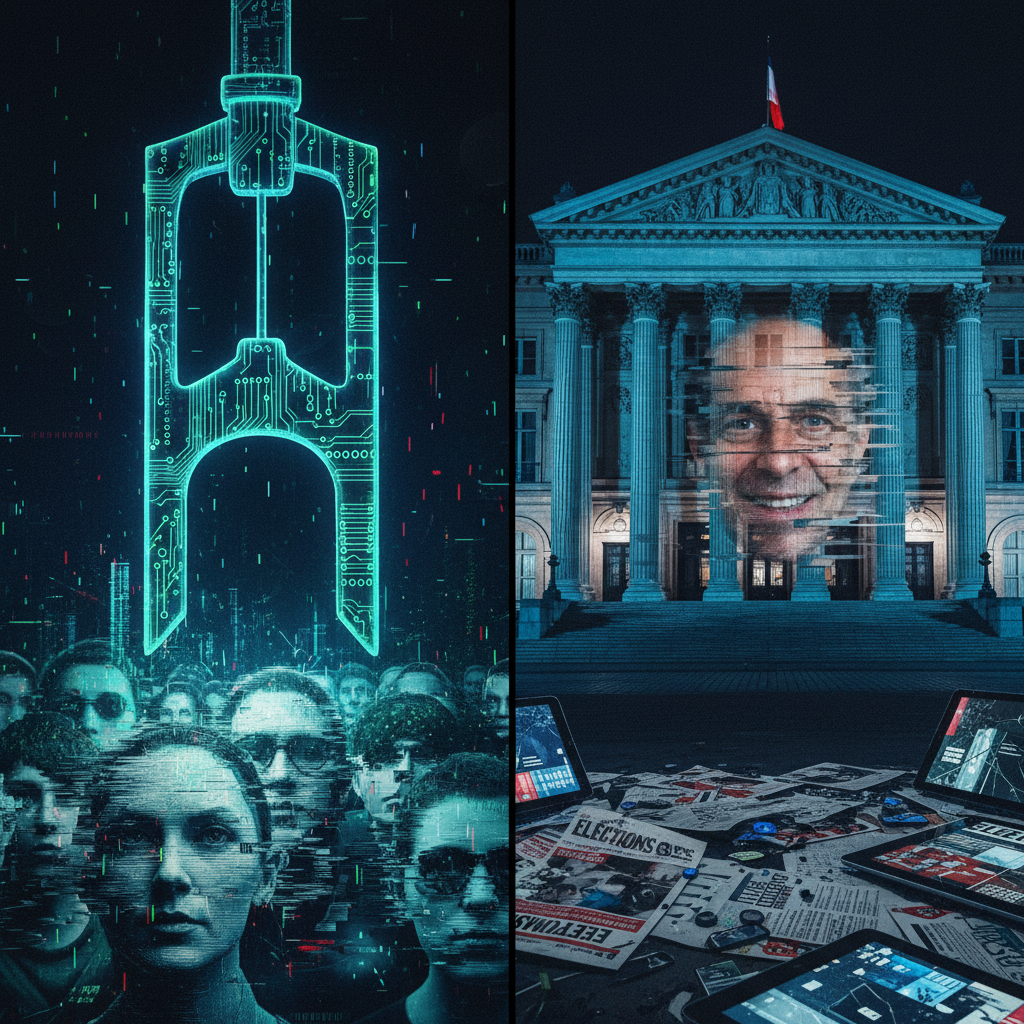
Consider France, a nation that prides itself on its republican values and the integrity of its elections. Imagine a deepfake video emerging days before a critical vote, showing a prominent political figure making a scandalous, fabricated statement. The video spreads like wildfire across social media, amplified by algorithms designed for engagement, not truth. By the time fact-checkers and traditional media can debunk it, the damage is done. The narrative is set, doubt is sown, and the electoral outcome is irrevocably tainted. This is not science fiction, this is the immediate future.
France says non to Silicon Valley's vision of a digital free-for-all. Our approach, and indeed the broader European approach, is rooted in a different philosophy. We prioritize citizen protection, data sovereignty, and democratic integrity over unbridled technological advancement at any cost. The EU AI Act, a landmark piece of legislation, attempts to categorize and regulate AI systems based on their risk level, placing deepfakes squarely in the high-risk category. This is a crucial step, but legislation alone cannot outpace the rapid evolution of these tools.
“The speed at which these deepfake technologies are advancing is terrifying,” stated Věra Jourová, Vice President of the European Commission for Values and Transparency, in a recent address. “We need robust defenses, not just reactive measures, to protect our democracies from this digital pollution.” Her words resonate deeply here. We cannot afford to be constantly playing catch-up. The very foundations of our societies are at stake.
The economic implications of this digital deception are also profound. Trust is the currency of democracy and of a stable economy. When citizens cannot distinguish truth from fabrication, when public discourse is poisoned by synthetic lies, investment falters, markets become volatile, and social cohesion erodes. Who wants to invest in a nation where political stability can be undermined by a few lines of code and a convincing fake video? The cost of rebuilding trust, once shattered, is immeasurable.
Some might argue that this is simply the price of progress, that we must learn to live with these tools. I say, that is a dangerous capitulation. The European way is not the American way, and that is the point. We do not accept that technological innovation must come at the expense of fundamental rights or democratic principles. We have a right to demand that the tools shaping our information ecosystem are designed with safety and integrity in mind, not merely profit and engagement.
Companies like Meta, with its vast reach through Facebook and Instagram, and Google, with YouTube, bear an immense responsibility. They are the conduits through which much of this misinformation flows. While they have invested in detection tools and content moderation, their efforts often feel like a game of whack-a-mole, always a step behind the malicious actors. The sheer volume of content, much of it AI-generated, makes comprehensive human moderation impossible. This is where the debate often shifts to AI-based detection, but even that is a cat-and-mouse game, with generative models constantly evolving to bypass detection.
Consider the recent report from the MIT Technology Review detailing the increasing sophistication of open-source deepfake tools. These are not proprietary secrets anymore. They are available to anyone with an internet connection and a modicum of technical skill. This decentralization of destructive power is what makes the threat so uniquely challenging.
What then is the solution? It is multifaceted. Firstly, we need stronger, globally coordinated regulatory frameworks that hold technology companies accountable for the misuse of their platforms and the products they unleash. The EU AI Act is a start, but it needs international counterparts. Secondly, media literacy is paramount. Educating citizens, particularly younger generations, on how to critically evaluate digital content is a long-term investment in democratic resilience. Thirdly, technological countermeasures, such as digital watermarking and provenance tracking for AI-generated content, must become standard. Companies like Adobe are making strides in this area with initiatives like the Content Authenticity Initiative, but widespread adoption is still a distant goal. You can read more about the broader AI landscape on TechCrunch's AI section.
Finally, we must cultivate a culture of skepticism, a healthy distrust of the hyper-real. In a world where anything can be faked, truth becomes a precious commodity, and its defense, a collective imperative. We cannot allow the digital guillotine of deepfakes to sever the head of our democracies. The fight for truth in the age of AI is not just a technological challenge, it is a moral and political one. And Europe, with its history of defending human dignity and democratic ideals, is uniquely positioned to lead this crucial battle. For more insights on the latest AI developments, The Verge's AI coverage offers a good perspective.
This is not merely about preventing electoral interference in a single country, it is about safeguarding the very mechanisms by which societies choose their future. The stakes, mes amis, could not be higher.