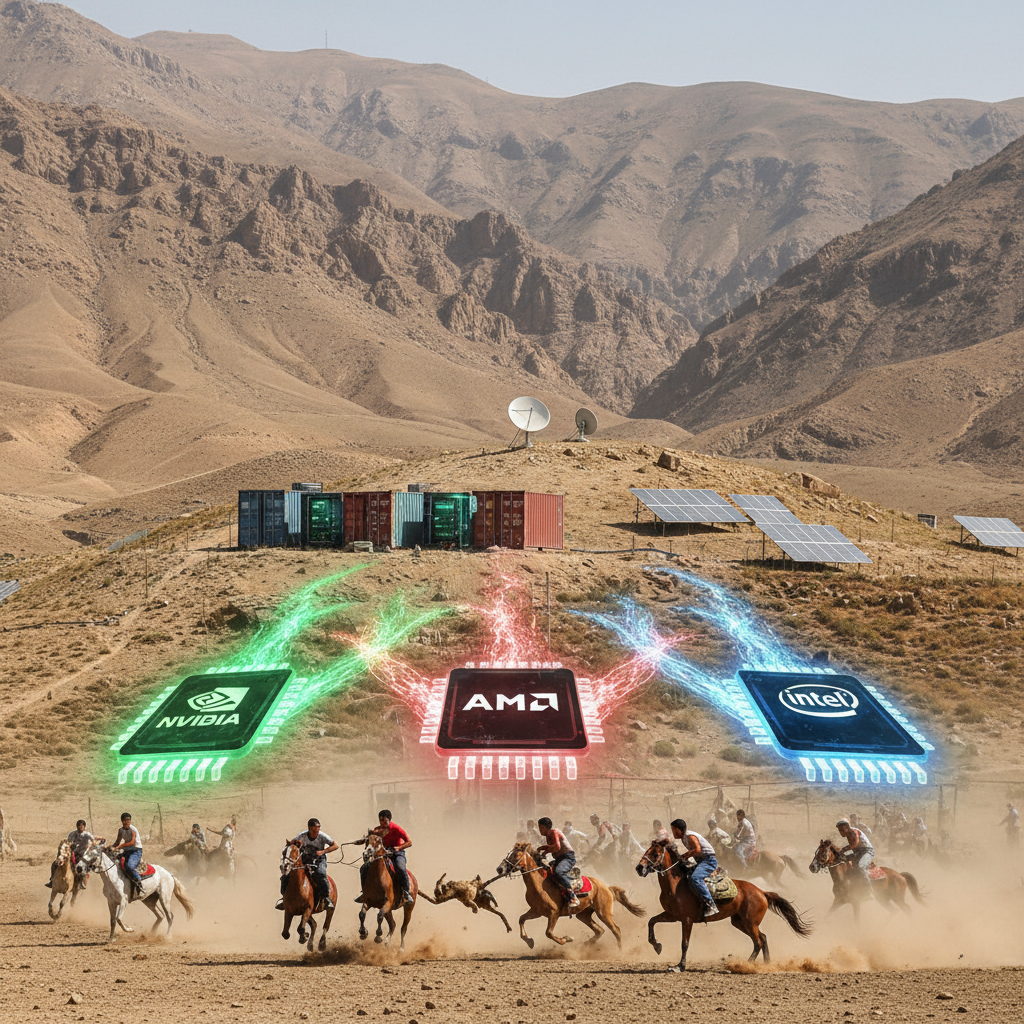

The global discourse surrounding artificial intelligence often fixates on the latest large language models or the most sophisticated algorithms. Yet, beneath this visible surface lies a more fundamental, and arguably more impactful, struggle: the relentless competition among chip manufacturers. NVIDIA, AMD, and Intel are locked in an intense battle for supremacy in the AI hardware market, a contest that reverberates from data centers in California to the remote valleys of Central Asia. For us in Tajikistan, this is not abstract corporate maneuvering; it dictates the very pace and possibility of our technological advancement.
For years, NVIDIA has held a commanding lead, particularly with its Cuda platform and GPU architectures optimized for parallel processing, a cornerstone of deep learning. Their Hopper and Blackwell architectures, with their staggering computational power, have become the gold standard for training massive AI models. Jensen Huang, NVIDIA's CEO, has consistently emphasized the company's role in accelerating the AI revolution, and the market has responded, propelling NVIDIA's valuation to unprecedented heights. Data from industry analysts in late 2025 indicated NVIDIA controlled over 80% of the market for AI accelerators in data centers, a figure that underscores their formidable position.
However, AMD and Intel are not merely spectators. Both companies are investing heavily, recognizing the immense strategic importance of this sector. AMD, under Lisa Su's leadership, has made significant strides with its Instinct MI series, particularly the MI300X. This accelerator, designed to compete directly with NVIDIA's top-tier offerings, has shown promising performance benchmarks, especially in inference tasks and for certain large model deployments. Intel, traditionally dominant in CPUs, is aggressively pushing its Gaudi accelerators through Habana Labs, acquired in 2019, and its new Xeon processors with integrated AI acceleration. Pat Gelsinger, Intel's CEO, has reiterated the company's commitment to providing a diverse portfolio of AI solutions, from edge to cloud.
The reality in Central Asia is different from the headlines that celebrate trillion-dollar valuations and groundbreaking research. Here, the challenge is often one of access, infrastructure, and practical application. While Western tech giants debate teraflops and tensor cores, we consider how these advancements can translate into tangible improvements for our people. For instance, the agricultural sector, a pillar of Tajikistan's economy, stands to gain immensely from AI. Precision agriculture, powered by AI models analyzing satellite imagery and sensor data, can optimize irrigation, predict crop yields, and detect disease early. However, deploying such systems requires robust, energy-efficient, and cost-effective hardware.
Consider the case of the Tajik Agrarian University in Dushanbe. Professor Dilovar Saidov, head of the Department of Digital Agriculture, recently noted, “Our researchers are eager to leverage AI for improving cotton and wheat yields, but the computational resources required are substantial. We need solutions that are not only powerful but also sustainable for our energy grid and budget. The cost per teraflop, and the power consumption, are critical metrics for us, not just raw speed.” This sentiment highlights a crucial point: the chip war is not just about who has the fastest chip, but who can deliver the most practical value under real-world constraints.
The implications for national digital sovereignty are also profound. As AI becomes integral to critical infrastructure, from energy management to public services, reliance on a single vendor or architecture presents strategic vulnerabilities. Diversification of hardware suppliers becomes a national security imperative. Tajikistan, like many nations, seeks to build its own foundational AI capabilities, and this requires a careful assessment of the offerings from NVIDIA, AMD, and Intel. The ability to run local language models, for example, demands significant processing power, and the choice of chip architecture can influence everything from development costs to long-term maintenance.
Recent data from the Ministry of Digital Development indicates that while AI adoption in Tajikistan is still nascent, growing at an estimated 15% annually, the demand for specialized AI hardware is projected to double by 2028. This growth is driven by pilot projects in smart city initiatives, healthcare diagnostics, and educational platforms. For example, a recent collaboration between the Ministry of Education and a local tech startup, 'Maorif AI', aims to personalize learning experiences for students in remote areas. This project, currently in its early stages, relies on efficient edge AI processing to deliver content offline, a scenario where AMD's and Intel's lower-power, integrated solutions might find a distinct advantage over NVIDIA's high-end data center GPUs.
Let's talk about what actually works. In our context, a hybrid approach often proves most effective. While training cutting-edge models might still necessitate access to cloud-based NVIDIA infrastructure, local inference and smaller model fine-tuning can often be handled by more accessible and affordable solutions. “We are seeing a rise in demand for robust, smaller-scale AI servers that can operate reliably in varied environmental conditions,” stated Ms. Gulnora Karimova, Director of the Tajikistan National Data Center. “The flexibility offered by Intel’s integrated AI capabilities in their CPUs, or AMD’s more open software stack, could be very appealing for local deployments where specialized GPU clusters are not feasible.”
The global AI chip market is projected to reach over 400 billion USD by 2030, a staggering figure that underscores the stakes involved. The competition is not just about hardware specifications; it extends to software ecosystems, developer tools, and strategic partnerships. NVIDIA's Cuda remains a powerful lock-in mechanism, but AMD's ROCm and Intel's OneAPI are gaining traction, offering developers more choice and potentially fostering a more open, competitive environment. This is good news for smaller nations, as it reduces dependence on proprietary ecosystems and encourages broader innovation.
For Tajikistan, the path forward involves strategic investment in digital infrastructure, fostering local talent, and carefully evaluating which chip architectures best serve our specific needs. It is about building a foundation for sustainable growth, not chasing every fleeting technological trend. The chip war, far from being a distant skirmish, is shaping the very tools with which we will build our future. Understanding its nuances, and advocating for solutions that are practical and accessible, remains paramount. Our challenges require Tajik solutions, and the right hardware is a critical component of that equation. For more insights into the broader AI landscape, consider exploring resources like Reuters' technology section or MIT Technology Review. The future of AI is not just in the labs of Silicon Valley; it is also being forged in the decisions made in places like Dushanbe.