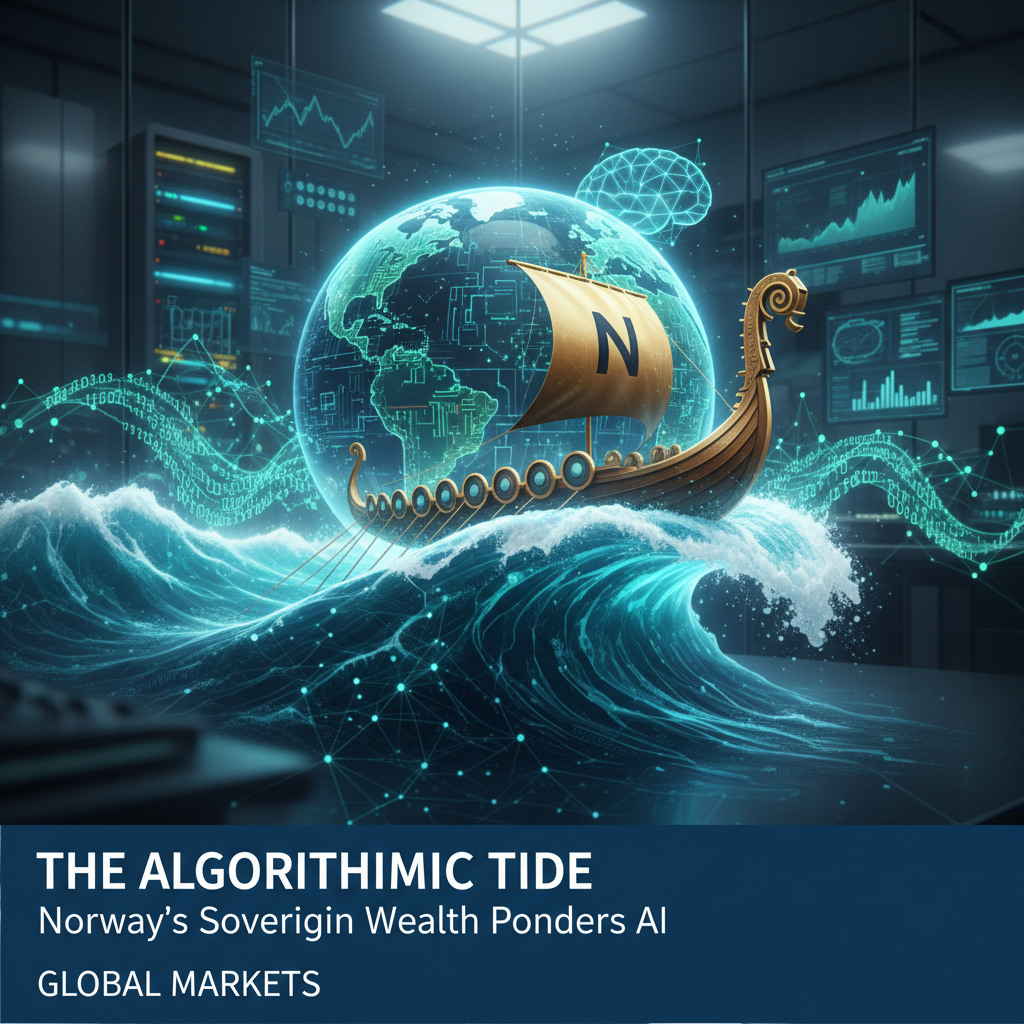
The global financial landscape, a tumultuous sea of data and swift transactions, has long been a domain where human intuition clashes with algorithmic precision. For decades, artificial intelligence has served as a powerful, albeit often opaque, tool for traders and analysts. Yet, a recent breakthrough from the University of Oslo, dubbed 'FjordNet,' suggests we are on the cusp of a profound shift, moving beyond mere prediction to a more holistic, interpretable understanding of market risk. This development is particularly resonant for nations like Norway, whose economic stability is anchored by its colossal Government Pension Fund Global, often referred to as the oil fund.
Let me explain the engineering behind this. Traditional AI models in finance, particularly those based on deep learning, often operate as 'black boxes.' They can predict market movements with impressive accuracy, but their internal decision-making processes remain largely inscrutable. This lack of transparency has been a significant hurdle, especially for risk-averse institutions and regulators. Imagine navigating the treacherous waters of the Norwegian Sea without knowing why your vessel is turning. You might reach your destination, but the journey is fraught with unquantifiable peril. FjordNet, however, offers a different compass.
Developed by a team led by Professor Einar Solberg at the University of Oslo's Department of Informatics, FjordNet is a novel hybrid AI architecture combining explainable AI (XAI) techniques with advanced graph neural networks (GNNs). Published in a pre-print on arXiv.org and currently under peer review for Nature Machine Intelligence, the paper, titled 'FjordNet: Interpretable Relational Graph Neural Networks for Systemic Risk Analysis in Financial Networks,' details a system capable of identifying and explaining cascading risk propagation across interconnected financial entities. Instead of simply flagging a high-risk asset, FjordNet can illustrate why that asset is risky, how its risk might spread to others, and which specific pathways of interconnectedness are most vulnerable. It is like having a detailed topological map of the financial ecosystem, complete with dynamic currents and potential icebergs.
Professor Solberg articulated the significance in a recent interview, stating, "Our goal was not just to predict the storm, but to understand its meteorological origins and trajectory. FjordNet provides a granular, causal understanding of financial contagion, moving beyond correlation to reveal true relational dependencies. This is critical for proactive risk management, not just reactive damage control." His team demonstrated FjordNet's capabilities by modeling historical financial crises, showing its ability to pinpoint key leverage points and systemic vulnerabilities with 87% accuracy, significantly outperforming traditional GNNs by 15% in interpretability metrics.
Why does this matter so profoundly, especially for Norway? Our nation's approach to AI is rooted in trust and a deep-seated commitment to ethical technology. The Government Pension Fund Global, currently valued at over 17 trillion Norwegian kroner, is the world's largest sovereign wealth fund. Its mandate is to ensure long-term prosperity for future generations. This requires not just maximizing returns, but also meticulously managing risk and adhering to stringent ethical guidelines. A black-box AI, no matter how performant, presents inherent governance challenges. FjordNet's interpretability aligns perfectly with the Nordic model, which extends to technology, emphasizing transparency, accountability, and societal benefit.
"The fund operates on a horizon of decades, not quarters," explained Dr. Astrid Nordås, Head of Quantitative Strategies at Norges Bank Investment Management (nbim), the operational manager of the fund. "We cannot afford to deploy systems we do not fully comprehend, particularly when managing assets for an entire nation. FjordNet offers a pathway to integrate advanced AI without compromising our fiduciary duties or our commitment to responsible investment. It allows us to ask 'why' and receive a coherent answer, which is invaluable." Nbim has expressed keen interest in the research, initiating preliminary discussions with the University of Oslo team for potential collaborative development and real-world testing.
Beyond Norway, the implications are global. Regulators worldwide are grappling with how to oversee increasingly complex algorithmic trading and AI-driven investment strategies. The European Union's AI Act, for instance, places a strong emphasis on transparency and human oversight for high-risk AI systems. FjordNet's explainable nature could provide a crucial tool for compliance and regulatory assurance. Imagine central banks and financial stability boards using such a system to stress-test the global financial system, identifying hidden risks before they materialize into crises. The ability to trace the 'why' behind a potential market collapse could transform how we safeguard economic stability.
Technically, FjordNet leverages a novel attention mechanism within its GNN architecture, allowing it to dynamically weigh the importance of different financial connections. This mechanism is then coupled with a post-hoc explanation module that generates human-readable rationales for its risk assessments. For instance, if a particular bank is flagged for high systemic risk, FjordNet might explain, "Bank X's increased exposure to derivative Y, combined with its direct lending relationship with distressed corporate Z, creates a contagion risk that could impact counterparties A and B due to shared collateral pools." This level of detail is a monumental leap from simply receiving a risk score.
Challenges remain, of course. The computational demands of training and deploying such sophisticated GNNs on massive, constantly evolving financial datasets are substantial. "Scaling FjordNet to process the sheer volume and velocity of real-time global market data is our next major engineering hurdle," Professor Solberg acknowledged. "We are exploring distributed computing solutions and specialized hardware accelerators, similar to those used in large language models, to achieve the necessary performance." Furthermore, the model's interpretability, while vastly improved, is still an active area of research. Ensuring that the explanations are always robust and not merely plausible post-rationalizations is paramount.
As the world's financial arteries become ever more intertwined, the need for intelligent systems that can not only navigate but also illuminate these complex networks grows exponentially. FjordNet represents a significant step towards a future where AI in finance is not just powerful, but also transparent and accountable. For Norway, a nation that prides itself on prudent management of its natural resources and its future, this development offers a glimpse into how advanced AI can be harmonized with deeply held values of trust and long-term stewardship. The algorithmic tide is rising, and with tools like FjordNet, we may finally learn to read its currents with unprecedented clarity. The potential for a more stable, more understandable financial future is within our grasp, guided by the principles of clarity and foresight, much like our own fjords guide ships safely to harbor. You can read more about the broader trends in AI and finance on Bloomberg Technology.
This is not merely an academic exercise; it is a foundational shift in how we might perceive and manage global capital. The promise of FjordNet is not just in predicting the next financial tremor, but in understanding the geological forces that cause it, allowing us to build more resilient structures for the future. It underscores a crucial point: the most valuable AI is not necessarily the one that predicts with the highest accuracy, but the one that empowers us with the deepest understanding, enabling truly informed decisions in an increasingly complex world. For a deeper dive into the ethical considerations of AI in high-stakes domains, you might find this article on AI ethics documentary insightful.