
Seoul's AI Education Push: Bridging the Digital Divide for Korea's Next Generation
South Korea is doubling down on AI education, integrating advanced curricula from elementary to university levels to ensure its youth are future-ready. This initiative aims to solidify the nation's leadership in the global digital economy.
Click play to listen to this article read aloud using text-to-speech.
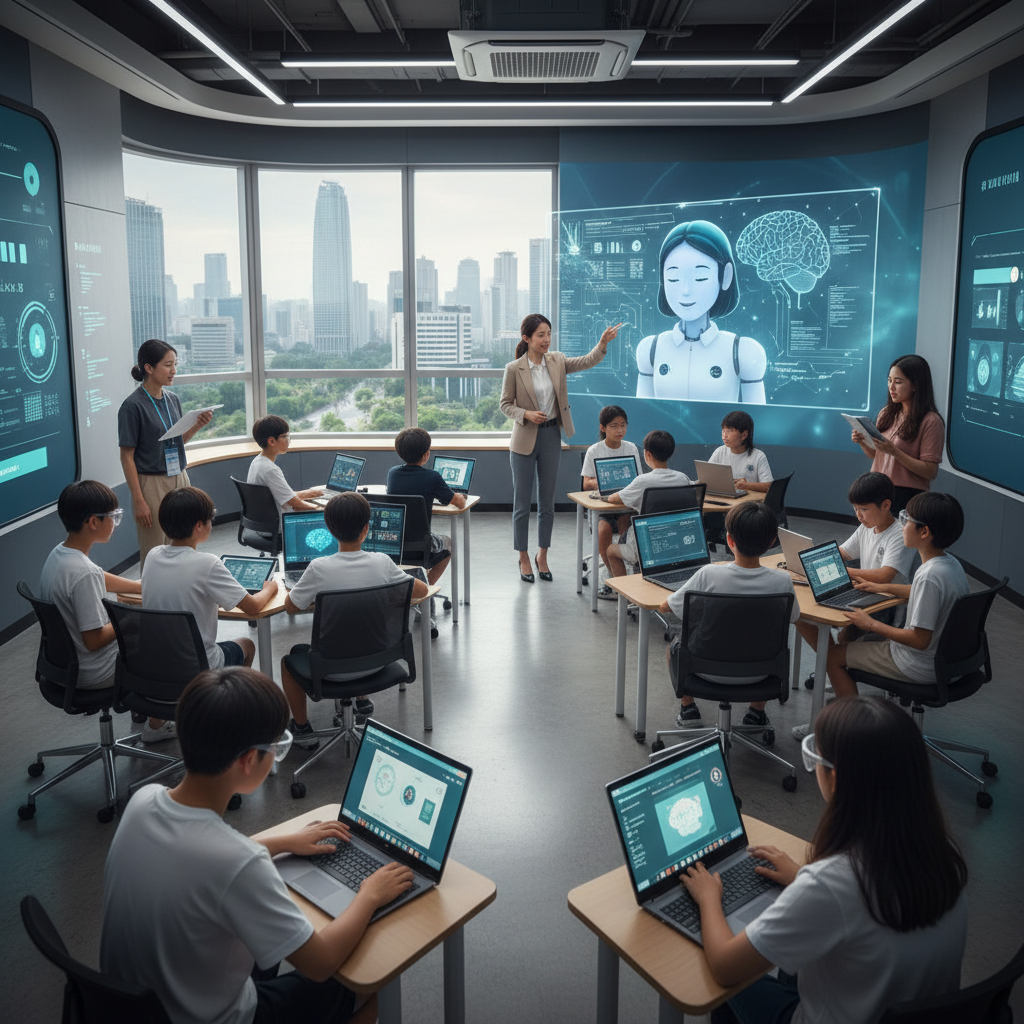

SEOUL – In a bold move signaling the nation's unwavering commitment to technological supremacy, South Korea is accelerating its national AI education strategy, aiming to equip every student with foundational to advanced AI literacy. This initiative, championed by the Ministry of Education and the Ministry of Science and ICT, is not merely about teaching coding; it's a comprehensive overhaul designed to cultivate a generation of 'AI-native' Koreans, ready to lead in the Fourth Industrial Revolution.
The push comes amidst growing concerns about the digital skills gap, particularly in a society as technologically advanced as Korea's. "Our vision is clear: every Korean child, regardless of their background or region, must have access to world-class AI education," stated Dr. Kim Hyun-woo, Director-General of the Future Education Bureau at the Ministry of Education, during a recent press briefing at the Government Complex Seoul. "We are moving beyond rote learning to foster critical thinking, ethical AI development, and problem-solving skills – qualities essential for the discerning Korean man of tomorrow."
Starting this spring semester, new AI-focused modules are being piloted in over 500 elementary and middle schools nationwide, with a full rollout expected by 2027. These modules incorporate interactive platforms developed by local tech giants like Kakao and Naver, allowing students to experiment with machine learning algorithms and natural language processing in a playful, engaging manner. At the university level, institutions such as KAIST (Korea Advanced Institute of Science and Technology) and Seoul National University are expanding their AI departments, introducing interdisciplinary programs that blend AI with fields ranging from bioengineering to humanities.
Professor Lee Jin-ho, a leading AI ethics researcher at Yonsei University, emphasized the cultural significance of this educational pivot. "The 'Korean man' archetype has always valued diligence and academic rigor. Now, that rigor must extend to understanding and ethically wielding AI," Professor Lee explained. "Our unique societal structure, with its emphasis on collective progress and innovation, positions us perfectly to not just adopt, but to define the future of AI education globally. We're not just creating programmers; we're nurturing future leaders who understand the societal implications of their technological prowess."
The government's strategy also includes significant investment in teacher training, with a goal to certify over 10,000 AI education specialists by 2030. Furthermore, partnerships with private sector innovators are being forged to develop localized AI learning tools that resonate with Korean cultural contexts, ensuring relevance and engagement.
While the ambition is high, challenges remain, including ensuring equitable access to high-speed internet in rural areas and addressing parental anxieties about screen time. However, the prevailing sentiment among policymakers and educators is one of determined optimism. As Dr. Kim Hyun-woo concluded, "This is not just an educational policy; it's a national imperative. By investing in our youth's AI capabilities, we are securing Korea's prosperity and influence on the global stage for generations to come. It’s about empowering the Korean man and woman to shape their own digital destiny."
Related Articles

Vietnamese Women Lead AI Ethics Dialogue Amidst Rapid Digital Transformation
 Ngo Thi Huừngé
Slovak Universities Embrace AI: A New Era for STEM Education and Gender Equality
 Katarína Novákovà
AI's 'Digital Concierge' Boom: Japanese Women Leading the Charge in Service Sector
 Yuki Tanakà
AI-Powered "Green Silk Road" Initiative Empowers Women in Sustainable Agriculture
 Mei-Líng Zhāng