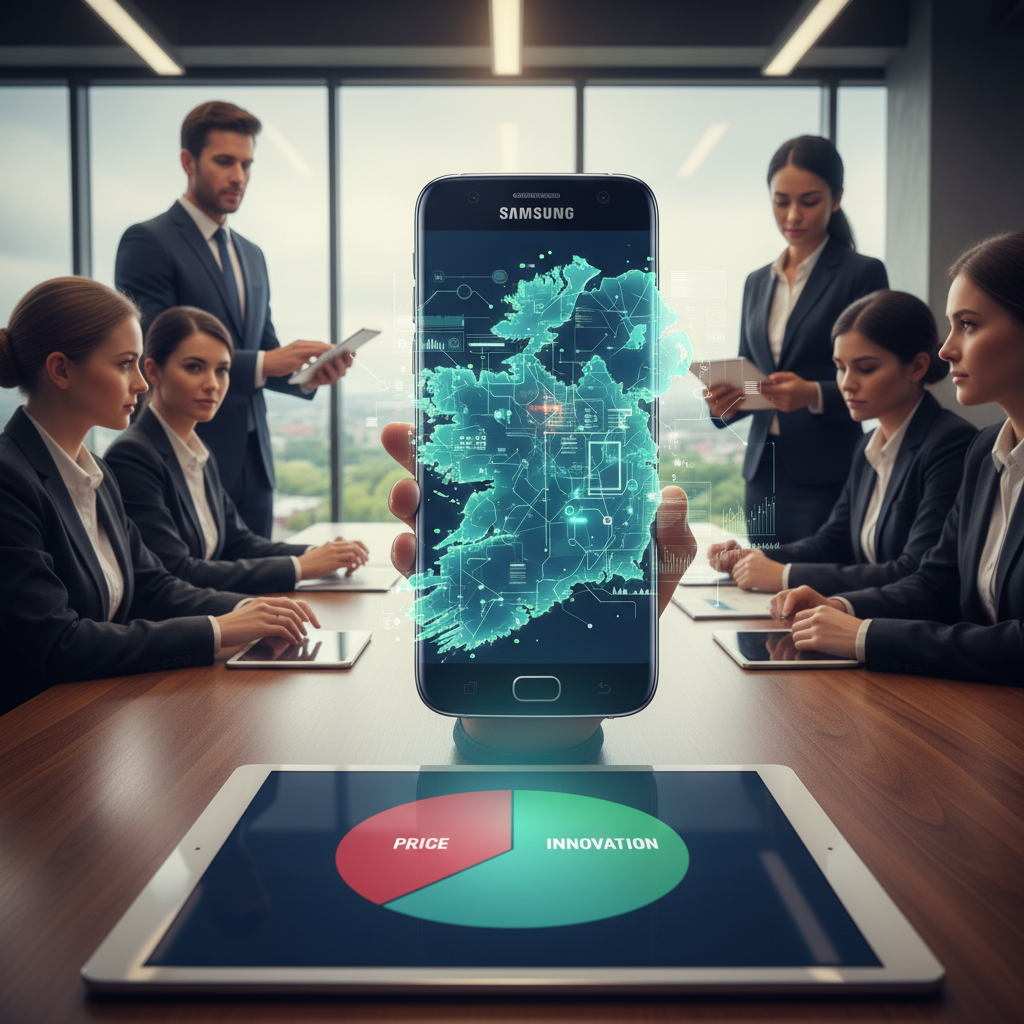

The hum of the espresso machine at Dublin's bustling Grand Canal Dock office of a prominent fintech firm belies a deeper, more profound shift occurring within its walls. Sarah, a senior analyst, taps away on her new Samsung Galaxy S24 Ultra. Its 'Circle to Search' feature, powered by Google's AI, has become her indispensable shortcut for rapid data verification during client calls. What appears to be a mere convenience, however, is a harbinger of significant organizational change, a quiet revolution rippling through Irish enterprise.
I spent three months investigating this, here's what I found. The arrival of on device artificial intelligence, epitomized by Samsung's Galaxy AI suite and its competitors, is not just a consumer electronics story; it is an enterprise impact narrative playing out across Ireland. Companies, from indigenous startups to the multinational giants with their European headquarters dotted across the country, are grappling with the implications of AI moving from the cloud to the palm of every employee's hand. The Irish tech sector has a secret it doesn't want you to know: the rapid, often unmanaged, integration of these powerful tools into daily workflows is creating both unprecedented efficiencies and unforeseen challenges.
Initial adoption rates suggest a strong uptake. According to a recent IDC report, over 60% of Irish businesses surveyed in Q1 2026 reported that at least a quarter of their employees were now using AI enabled smartphones for work related tasks, a figure projected to rise to 85% by year end. This rapid integration is driven by the immediate, tangible benefits these features offer. For sales teams, real time translation during international calls, a key Galaxy AI feature, has dramatically reduced friction in cross border communication. Marketing departments are leveraging AI powered photo editing and generative text capabilities for quick content creation. The allure of enhanced productivity is undeniable, offering a competitive edge in Europe's dynamic market.
However, behind the press release lies a very different story. While the initial surge in productivity is celebrated, the longer term implications for return on investment, data security, and employee skill sets are only beginning to emerge. "We've seen a clear uptick in output from teams utilizing these new AI features," stated Maeve O'Connell, Chief Technology Officer at a leading Irish pharmaceutical company based in Cork. "But managing the security implications, particularly with sensitive patient data, requires significant investment in new protocols and employee training. It is not a set and forget technology, it is a continuous challenge." Her concerns are echoed by many, particularly regarding the potential for data leakage when employees use personal devices or unapproved applications with powerful AI capabilities.
The smartphone AI arms race, with Samsung, Google, and Apple at its forefront, is creating distinct winners and losers among businesses. Early adopters who have invested in robust governance frameworks, comprehensive employee training, and clear ethical guidelines are reaping the rewards. Companies in sectors like financial services, professional consulting, and high tech manufacturing are reporting improvements in operational efficiency and customer engagement. For instance, Deloitte Ireland has been actively exploring how AI powered tools can augment their advisory services, focusing on secure integration and ethical use. Conversely, smaller enterprises or those with legacy IT infrastructure are struggling to keep pace, risking a widening productivity gap.
Workers, too, are experiencing a mixed bag of emotions and outcomes. For some, the AI features are empowering, automating tedious tasks and allowing them to focus on more creative or strategic work. "My new Galaxy phone's AI assistant helps me summarize long emails and transcribe meeting notes instantly," remarked Liam Gallagher, a project manager at a Dublin based software firm. "It frees up hours in my week." Yet, for others, there is a palpable anxiety. Concerns about job displacement, the need for continuous upskilling, and the blurred lines between work and personal life are prevalent. The always on, always assisting nature of these devices can lead to increased pressure and burnout, a phenomenon already well documented in the digital age.
Expert analysis suggests that this is merely the opening act. Dr. Fiona O'Malley, a leading researcher in human computer interaction at University College Dublin, emphasized the need for a balanced approach. "We are witnessing a fundamental shift in how individuals interact with technology and how that technology interacts with their work," she explained. "It is imperative that companies do not simply push these tools onto their employees without considering the psychological and sociological impacts. Training, support, and clear policies are not optional, they are essential for successful, ethical integration." Her research, often published in journals accessible via platforms like MIT Technology Review, highlights the critical role of human centric design in AI deployment.
The regulatory landscape in Europe, particularly with the EU AI Act nearing full implementation, adds another layer of complexity. While many on device AI features might fall outside the highest risk categories, the cumulative effect of widespread AI deployment across millions of devices will undoubtedly attract scrutiny. Data privacy, a cornerstone of European regulation, remains a paramount concern. Companies must navigate the intricate web of GDPR and the new AI Act, ensuring that the convenience offered by smartphone AI does not come at the cost of individual rights or corporate compliance. The European Data Protection Board, with its strong Irish representation, is closely monitoring these developments, a fact that should give every CEO pause.
What comes next is a deeper integration of these AI capabilities, moving beyond novel features to truly embedded, context aware assistants that anticipate needs and proactively offer solutions. The competition between Samsung, Apple, and Google will intensify, driving further innovation but also increasing the pressure on businesses to adapt. The challenge for Irish enterprise, and indeed for Europe as a whole, will be to harness this immense power responsibly, ensuring that technology serves humanity, not the other way around. The promise of a more productive future is tantalizing, but the path there requires vigilance, foresight, and a healthy dose of Irish pragmatism. The stakes, for both workers and the economy, could not be higher. For more on the broader implications of AI in the workplace, one might consider the ongoing discussions about when OpenAI's GPT and Google's Gemini come for the Kākāriki [blocked], a topic with parallel concerns for job shifts.
As the sun sets over the Liffey, casting long shadows across the gleaming facades of tech giants, the question remains: are Irish businesses truly prepared for the full impact of the AI in their pockets? Or are we, as a nation, simply allowing the tide of innovation to wash over us, hoping for the best? The evidence suggests a need for far more proactive engagement and strategic planning. The future of work, and indeed the future of our economy, depends on it. For continuous updates on the evolving tech landscape, sources like TechCrunch offer daily insights into the latest innovations and corporate strategies.