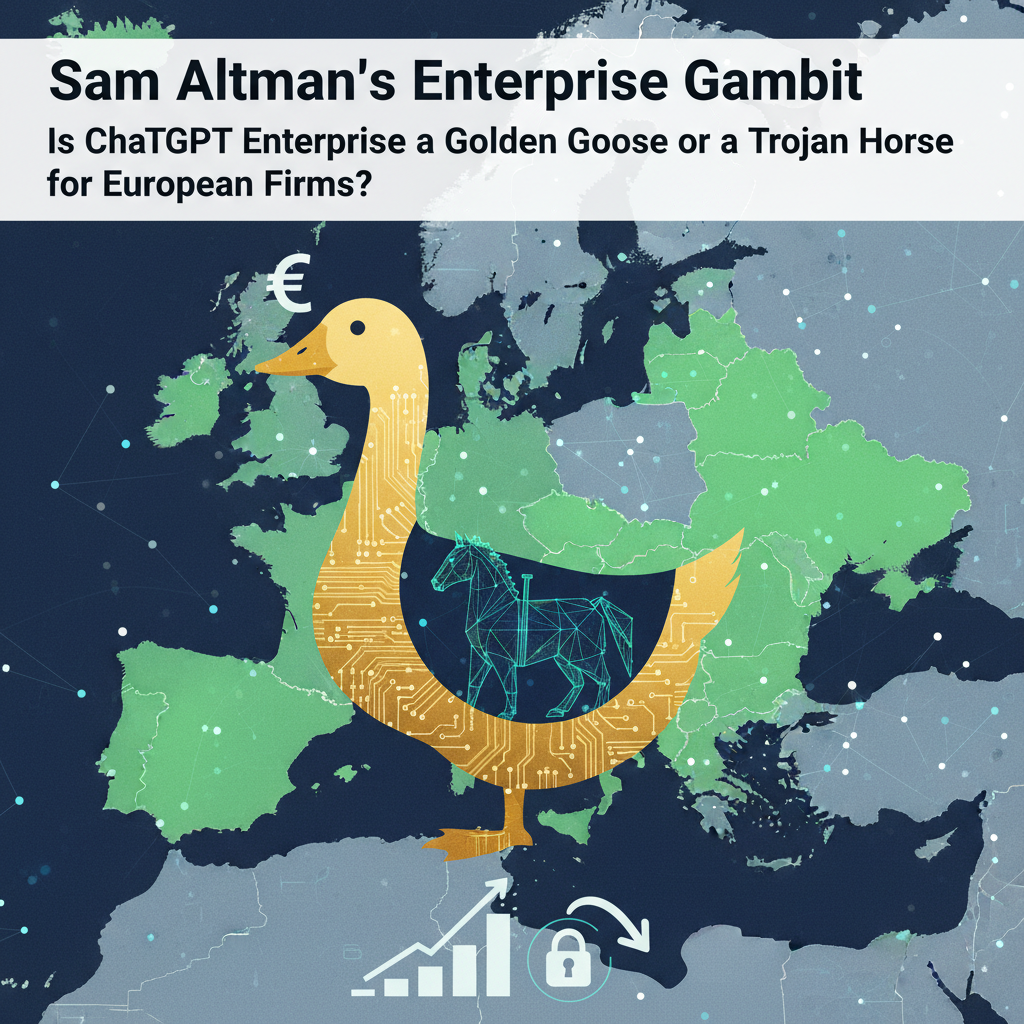

Is the promise of streamlined corporate workflows, powered by OpenAI's ChatGPT Enterprise, a genuine revolution or merely a carefully constructed narrative designed to entice businesses into a new dependency? This question echoes through the boardrooms and data centers of Dublin, a city often lauded as Europe's Silicon Valley, but also one acutely aware of the delicate balance between innovation and regulatory compliance. My investigation into OpenAI's enterprise strategy, particularly its footprint within the European Union, suggests that behind the press release lies a very different story, one fraught with implications for data privacy, algorithmic transparency, and the very sovereignty of European digital infrastructure.
The genesis of this enterprise push is not new. From the early days of cloud computing, American tech giants have sought to embed themselves deeply within the operational fabric of businesses worldwide. What is different now, however, is the nature of the technology itself. Large Language Models, or LLMs, are not merely tools; they are increasingly becoming the cognitive layer of the modern corporation. OpenAI, under the leadership of Sam Altman, has recognized this shift, moving beyond its initial consumer-facing ChatGPT offering to target the lucrative enterprise market with a bespoke, more secure, and supposedly more controllable version.
Historically, European businesses, particularly those in Ireland, have been early adopters of technology, often serving as crucial beachheads for US tech companies entering the EU market. This relationship, however, has always been shadowed by concerns over data transfer, especially in the wake of the Schrems II judgment and the ongoing evolution of the GDPR. The allure of increased productivity, faster content generation, and automated customer service is undeniable, with early adopters reporting significant gains. A recent report by a prominent tech consultancy, for instance, indicated that firms leveraging advanced AI tools saw an average 25% reduction in internal documentation creation time and a 15% improvement in customer query resolution within the first year of implementation. These figures, while compelling, often overshadow the underlying complexities.
I spent three months investigating this, here's what I found. The core appeal of ChatGPT Enterprise lies in its promise of enhanced security, data privacy, and administrative control. OpenAI assures clients that their data is not used to train the public models, and that conversations remain private. However, the exact mechanisms of this isolation, particularly concerning data residency and the potential for 'shadow training' or aggregation of anonymized metadata, remain areas of persistent scrutiny for European regulators. Dr. Aoife Brennan, a leading expert in AI ethics at University College Dublin, expressed her reservations succinctly. “While the assurances from OpenAI are welcome, the devil is always in the details of the service level agreements and the underlying data architecture,” she told me last week. “European firms must exercise extreme diligence; a black box model, however powerful, still presents a significant governance challenge.”
The current state of adoption reflects a cautious optimism. Major financial institutions in Frankfurt and Paris are piloting the technology, as are several prominent pharmaceutical companies based in Cork and Limerick. These early adopters are often driven by the competitive imperative to innovate, fearing they will be left behind if they do not embrace the latest AI advancements. Yet, the enthusiasm is tempered by the looming shadow of the EU AI Act, which is set to impose stringent requirements on high-risk AI systems. Many enterprise applications of LLMs, from HR to financial compliance, could easily fall under this 'high-risk' designation, demanding robust risk assessments, human oversight, and comprehensive data governance frameworks.
Consider the case of a large Irish banking group, which I cannot name due to confidentiality agreements. They are exploring ChatGPT Enterprise for internal knowledge management and code generation. Their primary concern, as articulated by their Chief Technology Officer, Mr. Liam O'Connell, is not merely the cost, but the long-term implications for their intellectual property and regulatory compliance. “We are a highly regulated entity,” Mr. O'Connell explained during a recent private briefing. “The benefit of rapid innovation is clear, but the cost of a data breach or a compliance failure, particularly under GDPR, is simply too high. We need absolute certainty on data residency and model integrity. The current offerings, while advanced, still require a leap of faith that many European institutions are not yet prepared to make.”
This sentiment is echoed by regulatory bodies. The Irish Data Protection Commission, a key enforcer of GDPR, has consistently emphasized the need for transparency and accountability in AI systems. The very nature of large, proprietary models like those offered by OpenAI can conflict with these principles, making it difficult for companies to fully understand or explain how decisions are reached, a concept known as 'explainability'. This is not merely an academic concern; it has tangible legal and ethical ramifications for businesses operating within the EU.
From a broader European perspective, the push by US-based AI giants like OpenAI and Microsoft, which heavily invests in OpenAI, raises questions about digital sovereignty. As more critical corporate workflows become dependent on these external AI services, the potential for vendor lock-in grows. This could stifle local innovation and create a reliance on non-European infrastructure, a scenario that many policymakers in Brussels and national capitals view with apprehension. Dr. Elara Dubois, a policy analyst at the European Centre for Digital Rights, was unequivocal in her assessment. “The Irish tech sector has a secret it doesn't want you to know: its reliance on foreign tech infrastructure creates inherent vulnerabilities. While OpenAI offers impressive capabilities, the long-term strategic implications for European digital autonomy cannot be ignored. We must ask if we are merely outsourcing our intelligence to Silicon Valley.”
Some companies are attempting to mitigate these risks by adopting hybrid approaches, leveraging open source models like those from Mistral AI or Meta's Llama for sensitive internal tasks, while using proprietary solutions for less critical, public-facing applications. This strategy, however, adds complexity and requires significant internal expertise, a resource that is often scarce. The market for AI talent in Ireland, for example, is fiercely competitive, with a significant brain drain towards larger tech hubs or the very companies whose services are being considered. For more on the broader tech landscape, one might consult TechCrunch's AI section.
My verdict is this: OpenAI's ChatGPT Enterprise is undoubtedly a powerful tool, capable of reshaping corporate workflows and delivering tangible efficiencies. However, to view it as a panacea, particularly for European firms, would be a profound misjudgment. The current trajectory suggests a dual reality: one where early adopters gain a competitive edge, and another where a deeper reckoning with data governance, regulatory compliance, and digital sovereignty is inevitable. The question is not whether this trend is a fad, but whether European businesses are prepared to navigate its complexities, demanding greater transparency and control, or if they will simply be swept along by the current, potentially sacrificing long-term strategic independence for short-term gains. The next few years, particularly as the EU AI Act takes full effect, will be a crucial test of Europe's resolve in shaping its own digital destiny. For further insights into the evolving landscape of AI regulation, MIT Technology Review offers comprehensive analysis. The dialogue around these issues is critical, and the stakes could not be higher for the future of European industry. OpenAI's official blog often provides updates on their enterprise offerings, though it naturally presents a company-centric view. The contrast between their public statements and the concerns of regulators and experts is stark, and it is here, in this gap, that the real story unfolds.