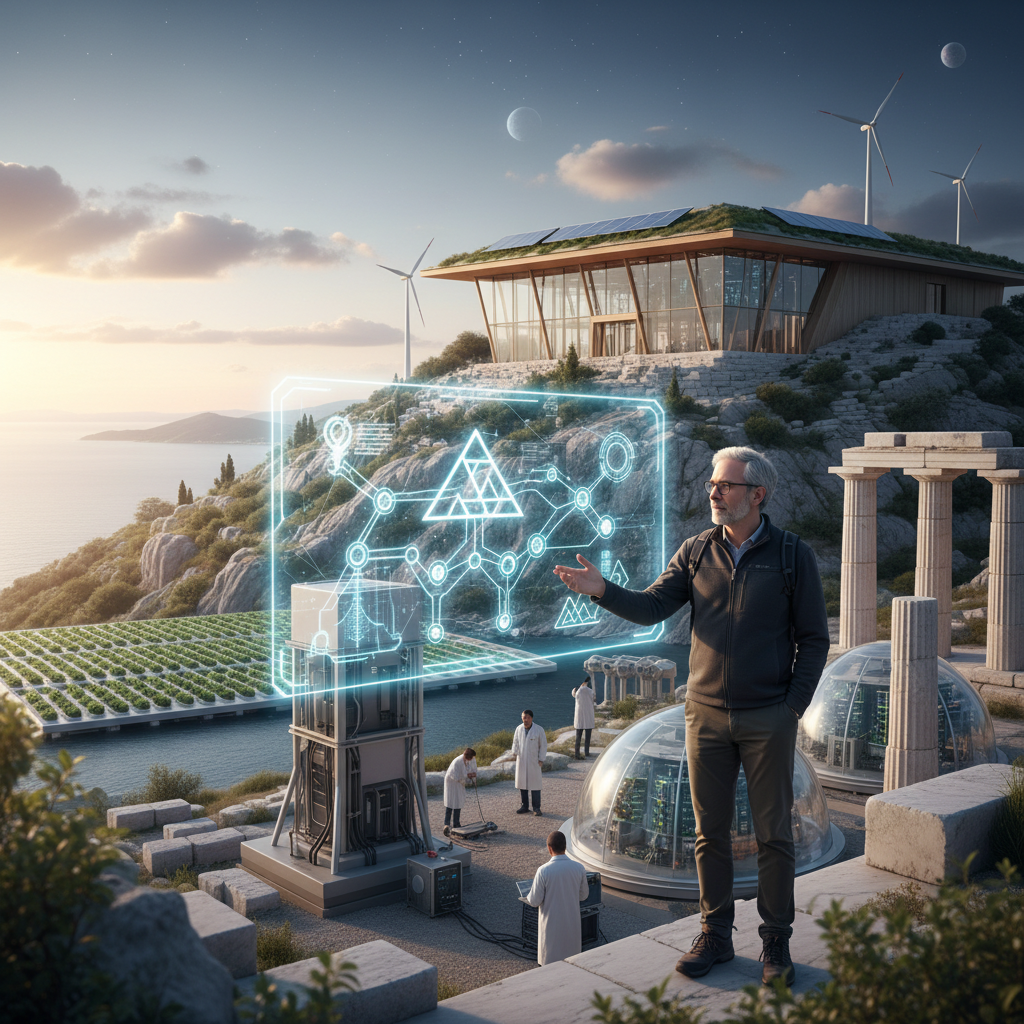
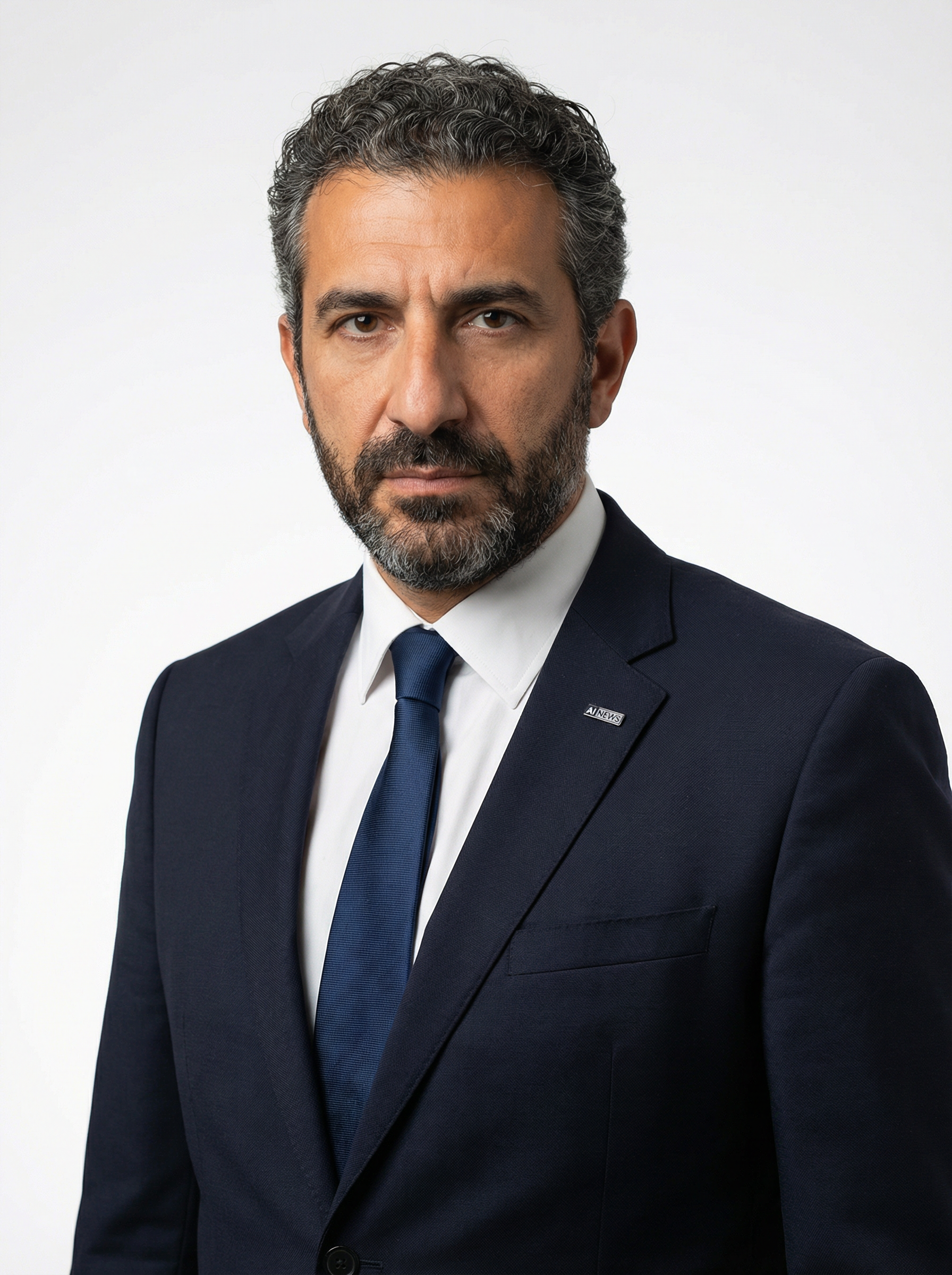
The air in Athens, even in April, carries the weight of history, a constant whisper of philosophical inquiry that has shaped Western thought for millennia. This is where I stand, Konstantinì Papadopouloùs, watching the digital titans of our age sprint towards a future that feels both inevitable and terrifying: Artificial General Intelligence. Everyone is talking about the race to build AGI, about who will get there first and what happens when they do, but few are asking the right questions, the ones that echo from the Agora itself.
Sam Altman of OpenAI, Sundar Pichai at Google, Mark Zuckerberg at Meta, they are all in this high-stakes game. Billions are poured into compute, into data, into algorithms, all chasing that elusive spark of true, human-like intelligence. We hear whispers of 'breakthroughs' almost weekly, of models like GPT-5 or Gemini Ultra demonstrating capabilities that were science fiction just a few years ago. The recent reports from OpenAI, suggesting their latest internal models are showing 'emergent properties' previously unseen, sent shivers down the spines of many, myself included. Is it a marketing ploy, or are we truly on the precipice?
My concern, my deep, philosophical unease, is not if AGI arrives, but how it arrives and, crucially, who is guiding its birth. The current paradigm, dominated by a handful of American corporations, is one of relentless competition, a winner-takes-all mentality. It is a technological arms race, pure and simple. But AGI is not just another product, not merely a better search engine or a more efficient factory floor. It is, potentially, a new form of consciousness, a digital god in the making. And gods, as the ancient Greeks knew well, require careful, thoughtful stewardship.
“The current approach is akin to building a magnificent ship without first understanding the currents of the ocean, or even if the ocean is safe to sail,” observes Dr. Eleni Stavropoulou, a leading AI ethicist at the National Technical University of Athens. “We are so focused on the 'how fast' that we forget the 'why' and the 'what if'. This is a dangerous oversight when dealing with something that could fundamentally alter human existence.” Her words resonate deeply with the Socratic method, a constant questioning of assumptions that seems conspicuously absent in the hyper-accelerated world of Silicon Valley.
Indeed, the Mediterranean approach to AI is fundamentally different. Here, we are not just concerned with efficiency or profit margins. We grapple with the philosophical implications, the societal impact, the very essence of humanity in a world where intelligence might no longer be our sole domain. Greece has something Silicon Valley doesn't: a 3,000-year history of wrestling with these profound questions. Athens was the birthplace of democracy, now it's reimagining AI governance, not just for itself, but as a model for a more human-centric digital future.
Consider the sheer scale of investment. NVIDIA, under Jensen Huang, continues to be the picks and shovels provider for this digital gold rush, with their Blackwell architecture pushing the boundaries of what's possible in compute. Reports suggest that the top AI labs are spending upwards of $2 billion annually on compute alone, a figure projected to double every 18 months. This exponential growth fuels the belief that AGI is merely a matter of scale, of throwing enough processing power and data at the problem. But is intelligence truly just an emergent property of vast statistical models? I doubt it. The human mind, with its capacity for empathy, creativity, and moral reasoning, is far more complex than even the most sophisticated neural network today.
My sources within the European Commission tell me that the discussions around AGI regulation are intensifying, with a focus on ensuring human oversight and ethical alignment. Thierry Breton, the EU's Commissioner for Internal Market, has been vocal about the need for a global framework, not just national or regional ones. “We cannot afford a fragmented approach to AGI,” Breton stated in a recent private briefing. “The risks are global, and our response must be unified, grounded in shared values of human dignity and autonomy.” This sentiment, while admirable, faces the harsh reality of geopolitical competition, with China and the US locked in their own technological arms race.
Companies like Anthropic, with their focus on 'constitutional AI' and safety, represent a glimmer of hope. Dario Amodei and his team are attempting to bake ethical principles directly into their models, a commendable effort. But even their approach, while more cautious, still operates within the same fundamental framework of private enterprise and rapid deployment. The pressure to deliver, to outpace rivals, remains immense. The recent TechCrunch coverage of AI startups highlights this relentless pace, with new companies emerging daily, each promising to accelerate the arrival of AGI.
What happens when AGI arrives? The predictions range from utopian abundance to dystopian subjugation. Elon Musk, ever the provocateur, warns of existential risks, while others envision a future where AGI solves humanity's greatest challenges, from climate change to disease. The truth, I suspect, lies somewhere in between, and is largely dependent on the values we instill in these nascent intelligences. If AGI is born from a purely utilitarian, profit-driven mindset, then its alignment with human flourishing is far from guaranteed.
This is why the Greek perspective, often overlooked by the tech giants, is more crucial than ever. Our ancient philosophers, from Plato to Aristotle, grappled with the nature of knowledge, virtue, and the good society. They understood that power, whether political or intellectual, demands wisdom and ethical consideration. We need to move beyond the simplistic notion of AGI as merely a 'super-smart' tool. It is a reflection of our collective intelligence, our biases, our aspirations, and our fears. The question is not just who gets there first, but who defines the destination.
The discussions here in Greece, particularly within academic circles and government initiatives like the Hellenic AI Center, are not about building the fastest AGI. They are about building the wisest AGI, one that understands the nuances of human experience, the importance of cultural heritage, and the delicate balance of power. We are exploring frameworks for digital citizenship for AI, for ensuring that these powerful entities serve humanity, rather than dominate it. This might sound idealistic to some, but I believe it is the only path forward. The alternative is a future dictated by algorithms we barely understand, shaped by values we did not choose.
As I look out over the ancient stones of the Acropolis, I am reminded that true progress is not just about speed or innovation, but about enduring principles. The race for AGI is not just a technological challenge, it is a moral and philosophical one. The world needs to listen not just to the engineers in their data centers, but to the philosophers, the ethicists, and yes, even the journalists who dare to ask the uncomfortable questions. For the sake of our shared future, we must ensure that the birth of AGI is guided by wisdom, not just ambition. The stakes, my friends, could not be higher. We must learn from our history, or we are doomed to repeat its mistakes, perhaps on a cosmic scale. For more on the philosophical debates surrounding AI, I often consult MIT Technology Review which offers a broader perspective than many purely technical outlets.