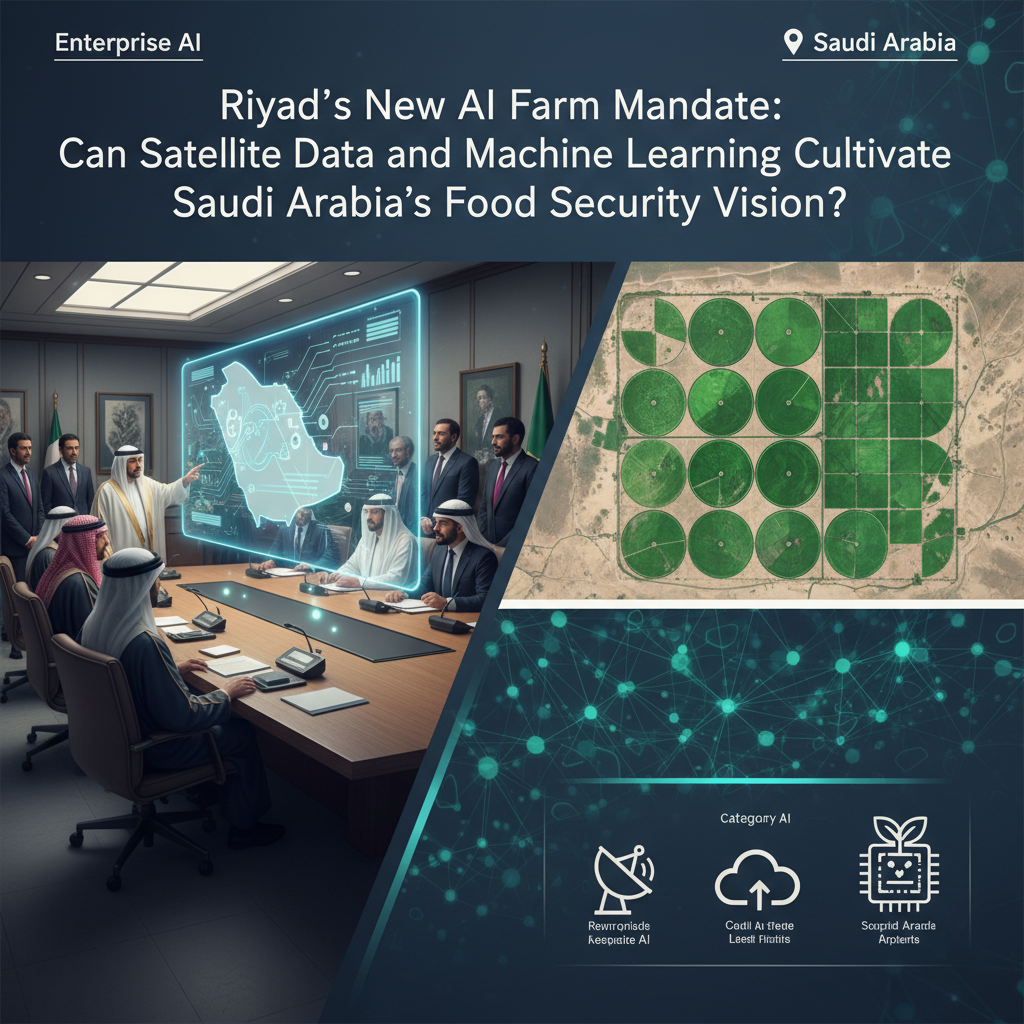

The Kingdom of Saudi Arabia, long a nation defined by its vast oil reserves, is now charting an ambitious course to redefine its agricultural landscape through the strategic application of artificial intelligence. In a significant policy announcement this month, the Ministry of Environment, Water, and Agriculture, in conjunction with the Saudi Data and Artificial Intelligence Authority (sdaia), introduced a comprehensive regulatory framework governing the use of AI in agriculture. This new mandate, dubbed the "National AI in Agriculture Governance Standard," aims to integrate precision farming, advanced crop monitoring, and yield optimization technologies across the nation's burgeoning agricultural sector.
This policy move is not merely an academic exercise, it is a direct response to the imperatives of Vision 2030, which explicitly calls for enhanced food security and economic diversification away from hydrocarbons. The Kingdom's Vision 2030 demands results, not promises, and the current reliance on food imports, estimated at over 70 percent, represents a strategic vulnerability. AI, particularly in agriculture, offers a compelling solution to optimize scarce resources, primarily water, and maximize output in challenging climatic conditions. The new standard provides guidelines for data collection, algorithmic transparency, ethical deployment of AI systems, and interoperability across various agricultural technologies. It mandates that all AI solutions deployed in farming operations, from drone-based crop health analysis to automated irrigation systems, must adhere to strict data privacy protocols and undergo rigorous testing for bias and accuracy.
Behind this ambitious initiative are key figures within the Saudi government and its strategic agencies. Dr. Abdullah Al-Ghamdi, President of Sdaia, has been a vocal proponent of leveraging AI for national development. Speaking at a recent forum in Riyadh, he emphasized, "Our objective is not simply to adopt technology, but to cultivate a resilient and sustainable agricultural ecosystem. This framework ensures that AI serves as a catalyst for growth, protecting both our natural resources and the livelihoods of our farmers." The Ministry of Environment, Water, and Agriculture, under the leadership of His Excellency Eng. Abdulrahman Al-Fadley, has been instrumental in translating these high-level aspirations into practical regulatory measures. Their collaboration signifies a coordinated governmental effort to address a critical national challenge through technological innovation.
In practice, this new framework will have far-reaching implications. Agricultural enterprises, from large-scale corporate farms to smaller family-owned operations, will need to adapt their technology strategies. For instance, companies deploying AI-powered irrigation systems, which use sensor data and predictive analytics to determine optimal water usage, will now be required to demonstrate the system's accuracy and its adherence to data security standards. Similarly, startups offering drone-based crop surveillance and disease detection will need to certify their algorithms and ensure the integrity of the data collected. The standard also encourages the development of open-source AI models and data-sharing platforms, aiming to foster innovation and prevent vendor lock-in. This could lead to a significant uplift in local AI development, as Saudi universities and research institutions are incentivized to contribute to agricultural AI solutions tailored to regional needs.
Initial reactions from the industry have been largely positive, albeit with a healthy dose of pragmatism. Major agricultural players, such as the National Agricultural Development Company (nadec), have expressed support for the clarity the framework provides. "This regulation is a crucial step towards standardizing AI adoption in our sector," stated Eng. Fawaz Al-Fawaz, CEO of Nadec. "It provides the necessary guardrails for responsible innovation, which is essential as we scale our operations using advanced technologies like satellite imagery analysis and machine learning for yield prediction." Smaller agritech startups, however, have voiced concerns about the potential compliance burden, particularly for nascent companies with limited resources. They argue that overly stringent requirements could stifle innovation, suggesting a tiered approach to regulation based on the scale and risk profile of the AI application. Investment in AI infrastructure, particularly high-performance computing and data centers, is expected to surge. The desert is blooming with data centers, and this policy will only accelerate that trend, creating new opportunities for companies like NVIDIA and Google Cloud to support the computational demands of agricultural AI.
Civil society organizations and consumer advocacy groups have also weighed in, primarily focusing on ethical considerations and data privacy. The Saudi Consumer Protection Association, for example, has highlighted the importance of ensuring that AI systems do not inadvertently lead to unfair market practices or disadvantage small farmers. They advocate for clear mechanisms for redress and robust auditing processes for all AI models used in critical agricultural decisions. Concerns about the potential for job displacement due to automation have also been raised, prompting calls for government-backed retraining programs for agricultural workers. This perspective underscores the need for a holistic approach that considers the societal impact alongside technological advancement, ensuring that the benefits of AI are equitably distributed.
Will it work? The success of Saudi Arabia's National AI in Agriculture Governance Standard will depend on several critical factors. Firstly, effective implementation and enforcement will be paramount. A well-crafted policy is only as good as its execution. This will require significant investment in regulatory capacity, including training inspectors and establishing robust auditing mechanisms for AI systems. Secondly, the framework must remain adaptable. The field of AI is evolving at an unprecedented pace, and rigid regulations could quickly become obsolete. A mechanism for periodic review and revision will be essential to ensure the standard remains relevant and effective. Finally, fostering a collaborative ecosystem involving government, industry, academia, and civil society will be crucial. The Kingdom’s ambitious goals require collective effort, not fragmented initiatives.
While the challenges are considerable, the potential rewards are immense. By strategically deploying AI, Saudi Arabia aims to not only enhance its food security but also to become a leader in sustainable desert agriculture, a model for other arid nations. The integration of AI in agriculture is not just about technology; it is about building a future where innovation serves national resilience and prosperity. This measured, data-driven approach, if executed diligently, could indeed cultivate a new era for Saudi agriculture, transforming the Kingdom's relationship with its land and its future food supply. The journey from oil money meets machine learning in the fields is just beginning, and the world will be watching its harvest. For further insights into global AI policy trends, readers may consult analyses from MIT Technology Review or Reuters Technology. For those interested in the foundational aspects of AI, a deeper dive into machine learning principles can be found on platforms like Ars Technica.