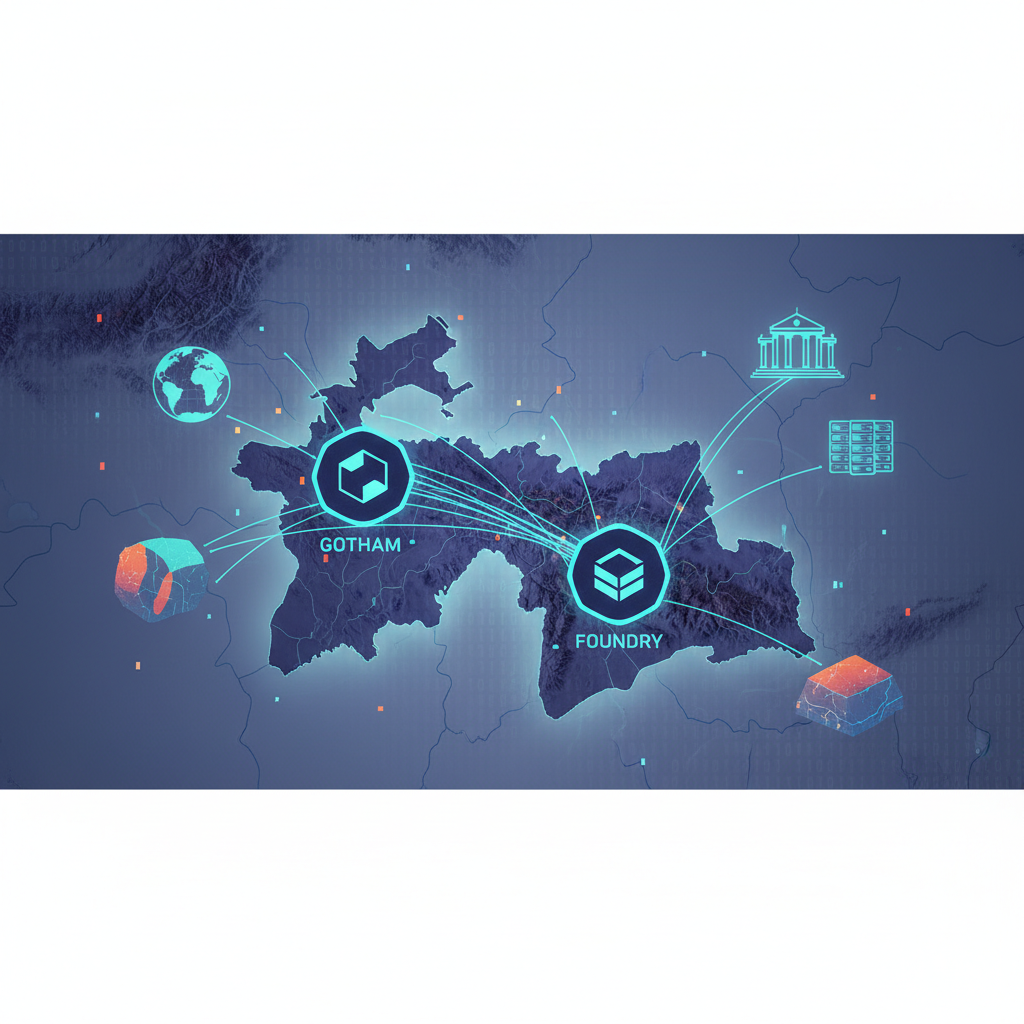

Does the world truly need Palantir's AI platforms, Gotham and Foundry, or are we witnessing the quiet consolidation of a new form of digital control, one contract at a time? This is not a rhetorical question for many, especially those of us observing from regions where data sovereignty and privacy are not abstract concepts but tangible struggles.
For decades, Palantir Technologies, co-founded by Peter Thiel, has operated largely in the shadows, its name synonymous with intelligence agencies and defense contracts. Its origins trace back to the early 2000s, emerging from the post 9/11 security landscape. The company built sophisticated data analytics platforms, initially Gotham, designed to integrate disparate datasets for counterterrorism efforts. Later came Foundry, aimed at optimizing operations for commercial and government entities. The historical context is crucial here: Palantir did not emerge from a desire to build general purpose AI for the masses, but from a specific, often classified, need to make sense of vast, complex, and sensitive information for powerful institutions. This foundational purpose continues to define its trajectory and the controversies it attracts.
Today, Palantir's reach is undeniable. Reports indicate its platforms are utilized by over 50 governments and numerous corporations globally. In 2023, the company reported revenue growth of 20% year over year, reaching approximately 2.2 billion USD, with government contracts accounting for a significant portion of this figure. Data from its Q4 2025 earnings call, for instance, showed a 31% increase in U.S. government revenue, highlighting its deepening ties with Washington. Its Artificial Intelligence Platform, or AIP, is now being aggressively marketed as the solution for everything from military logistics to supply chain optimization and even public health management. The company claims AIP can integrate large language models, like OpenAI's GPT or Google's Gemini, with an organization's internal data, providing actionable insights at unprecedented speed. This is not merely about data visualization; it is about predictive analysis and decision support on a grand scale.
However, the reality in Central Asia is different from the headlines. While Palantir secures lucrative contracts in Western capitals, its presence here is minimal, if not entirely absent in official capacities. This is not due to a lack of data challenges or complex problems that AI could address. Rather, it reflects a different set of priorities, geopolitical alignments, and a cautious approach to external technological dependencies. Our institutions, often operating with limited budgets and a strong emphasis on national control, tend to favor localized solutions or partnerships with countries perceived as more aligned with our long term interests. The idea of a foreign entity holding the keys to critical national data infrastructure, even under the guise of advanced AI, raises significant concerns about sovereignty and potential data exploitation.
Expert opinions on Palantir's trajectory are sharply divided. Dr. Elena Petrova, a senior analyst at the Eurasian Center for Digital Governance, expressed skepticism during a recent online forum. “Palantir’s business model thrives on opacity and deeply embedded, long term contracts,” she stated. “While they promise efficiency, the fundamental question remains: who truly controls the narrative when your most sensitive data flows through proprietary, black box algorithms? For emerging economies, this presents a significant risk of vendor lock-in and a loss of strategic autonomy.” She argues that the allure of cutting edge technology often overshadows the critical need for transparency and local capacity building.
Conversely, some defense strategists view Palantir as an indispensable tool. General Marcus Thorne, retired from the U.S. Department of Defense, recently commented to Reuters Technology that “Palantir’s platforms have been instrumental in modernizing intelligence operations. Their ability to fuse disparate data sources, from satellite imagery to social media feeds, provides a comprehensive operational picture that no other system can replicate. It’s not about surveillance for its own sake, but about making faster, more informed decisions in complex environments.” His perspective underscores the perceived necessity of such powerful tools for national security objectives.
Yet, the ethical implications are profound. Organizations like the American Civil Liberties Union have repeatedly raised concerns about Palantir’s role in immigration enforcement and predictive policing, citing potential for bias and lack of accountability. The company’s contracts with law enforcement agencies have drawn criticism for enabling mass surveillance and targeting vulnerable communities. This is not a distant problem; the principles of data ethics and algorithmic fairness are universal, and their neglect in one region sets a dangerous precedent for all.
From a Tajikistani perspective, the discussion around Palantir is less about adopting its platforms and more about understanding the broader implications of such powerful, centralized AI systems. Tajikistan's challenges require Tajik solutions, often emphasizing sustainable development, agricultural optimization, and water resource management. Our focus is on practical applications that directly improve livelihoods, not on sophisticated surveillance tools. For instance, developing AI models to predict water scarcity in the Vakhsh River basin or optimizing crop yields through localized data analysis would be far more impactful than deploying a system designed for geopolitical intelligence. The question for us is not how to integrate Palantir, but how to leverage AI to address our specific, tangible needs without compromising our sovereignty or ethical principles. MIT Technology Review has often highlighted the need for localized AI development, a sentiment that resonates deeply here.
So, is Palantir’s AI empire a global necessity or a form of digital colonialism? The answer, like many complex issues, is nuanced. For powerful governments and large corporations, its platforms offer undeniable capabilities for data integration and decision support, addressing complex challenges that traditional systems struggle with. The data supports its continued growth and deep entrenchment in these sectors. However, the lack of transparency, the proprietary nature of its algorithms, and the potential for misuse raise serious questions about accountability and ethical governance. For nations like Tajikistan, the trend serves as a cautionary tale and a call to action. We must prioritize building our own technological capabilities, fostering local talent, and developing AI solutions that are transparent, accountable, and aligned with our national values and development goals. Let's talk about what actually works for our context, not just what is marketed as the most advanced. The future of AI should be one of empowerment and localized innovation, not centralized control by a few powerful entities. The choice, ultimately, rests with each nation to define its digital destiny. We must ensure that the tools we embrace serve humanity, not merely power structures.