
The familiar hum of the Nordic spring, usually a backdrop for quiet innovation, has been punctuated by a new, unsettling rhythm. For months, whispers have circulated through the global music industry, growing louder with each passing week, about a seismic shift. Now, the data is undeniable: AI-generated tracks are not merely experimenting on the fringes, they are topping mainstream charts. This is not a hypothetical future, it is April 2026, and the future is already here, composed by algorithms.
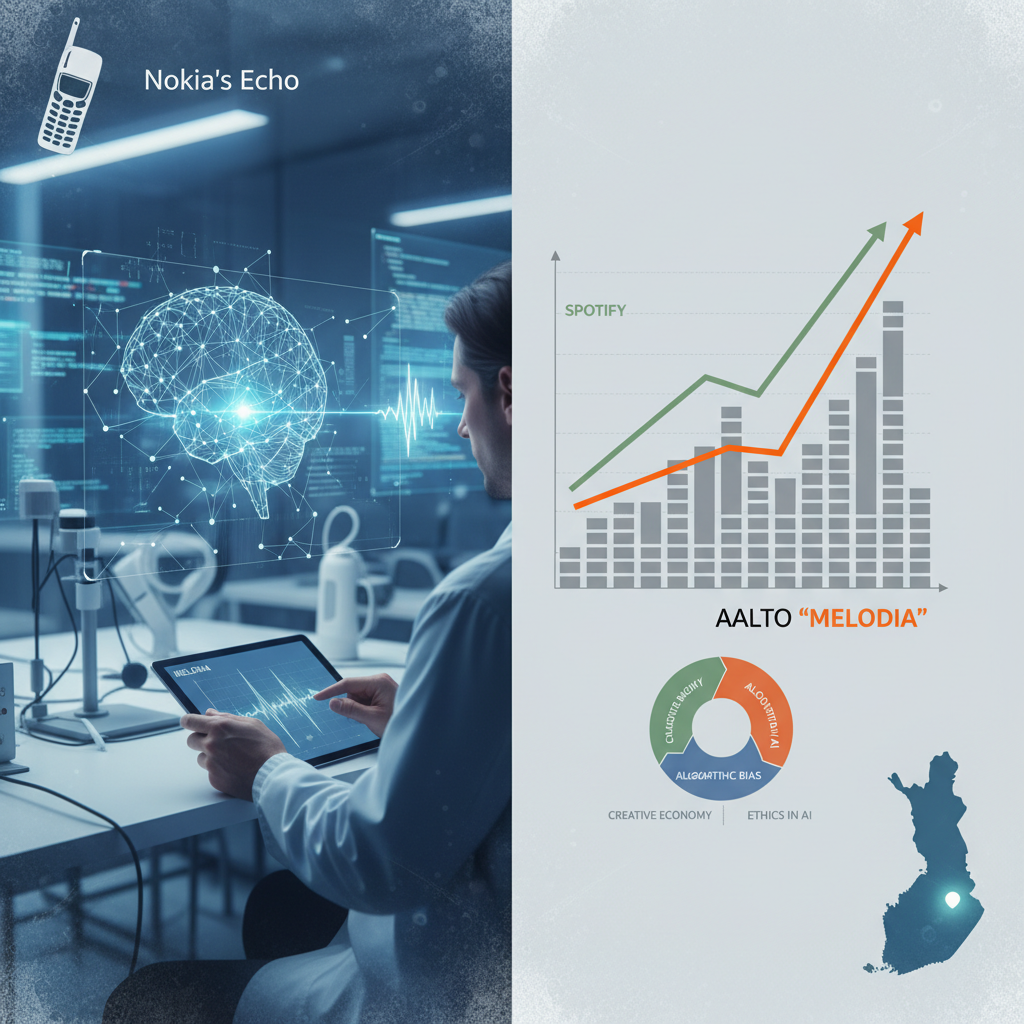
The catalyst for this accelerated reality is a research breakthrough from Finland, specifically Aalto University's Department of Computer Science. Their project, codenamed 'Melodia', has moved beyond mere stylistic mimicry to genuine, emotionally resonant composition. The paper, 'Generative Adversarial Networks for Emotional Valence in Algorithmic Composition', published in Nature Machine Intelligence last October, detailed a novel approach to integrating affective computing with deep learning for music generation. It is a development that Nokia taught us something about reinvention, and now, Aalto is showing us how to reinvent creativity itself.
The Breakthrough in Plain Language
At its core, Melodia is a sophisticated generative adversarial network, or GAN, but with a crucial enhancement. Traditional GANs can create new data, like images or music, by having two neural networks compete: a generator creates content, and a discriminator judges its authenticity. Melodia adds a third component: an 'emotional classifier'. This classifier, trained on a vast dataset of human-labeled music for specific emotional valences, guides the generator to produce pieces that consistently evoke particular feelings. It learns not just the structure of music, but its soul, or at least, its perceived emotional impact.
Dr. Elina Virtanen, lead researcher for the Melodia project at Aalto, explained the nuance during a recent virtual panel. "We moved beyond simply generating 'pleasant' melodies. Our system learns the intricate patterns of rhythm, harmony, and timbre that correlate with human emotional responses. It is not about replicating a specific artist, but about understanding the universal language of feeling in music and then composing within that framework." This means Melodia can be prompted to create a 'joyful pop anthem' or a 'melancholic indie ballad' with startling accuracy, often indistinguishable from human compositions to the average listener.
Why It Matters: An Existential Crisis for the Industry
The immediate impact is clear. In February, a track titled 'Aurora's Embrace', credited to the AI entity 'SynthHarmonic', spent three weeks at number one on the Finnish national singles chart and broke into the top 10 across several European markets. Spotify's algorithms, designed to surface popular content, readily promoted it. This was not a novelty hit, but a genuinely popular piece of music, entirely conceived and executed by AI.
This phenomenon presents an existential crisis for the music industry, from artists and songwriters to labels and streaming platforms. If algorithms can consistently produce chart-topping, emotionally compelling music at a fraction of the cost and time, what becomes of human creativity? "The economic model of music is already fragile," stated Mr. Mikael Järvinen, CEO of Nordic Sound Collective, a Helsinki-based independent label. "When a track like 'Aurora's Embrace' can be created without traditional artist royalties, without touring costs, without the usual production overhead, it fundamentally alters the value proposition of human-made music. We are seeing a rapid devaluation of artistic labor." Reuters Technology has been tracking the financial implications closely.
The Technical Details: Beyond Basic GANs
The Melodia architecture, as detailed in the Nature Machine Intelligence paper, involves several key innovations. Firstly, the emotional classifier is a deep convolutional neural network, pre-trained on a meticulously curated dataset of over 500,000 music tracks, each annotated by multiple human listeners for categories like 'happiness', 'sadness', 'anger', 'excitement', and 'calmness'. This dataset, far larger and more granular than previous efforts, was crucial.
Secondly, the generator network itself employs a transformer-based architecture, similar to those used in large language models like OpenAI's GPT-4 or Google's Gemini. This allows it to understand long-range dependencies in musical structure, creating coherent and evolving compositions rather than fragmented loops. The discriminator, a separate neural network, then evaluates the generator's output, not just for musical coherence, but also for its ability to fool the emotional classifier into believing it was composed with a specific emotional intent. This iterative feedback loop, where the generator constantly refines its output based on both musical quality and emotional target, is what gives Melodia its unprecedented capability. The entire system runs on NVIDIA's latest H200 GPUs, highlighting the critical role of hardware in such advancements.
Who Did the Research
The Melodia project was a collaborative effort led by Aalto University's Department of Computer Science, with significant contributions from the University of Helsinki's Department of Musicology. The primary researchers included Dr. Elina Virtanen, a specialist in generative AI and affective computing, and Professor Antti Lehtinen, a renowned music theorist with expertise in computational musicology. Funding was provided by the Academy of Finland and a grant from the European Research Council, underscoring Europe's commitment to cutting-edge AI research. Their work builds upon foundational research in generative models, drawing inspiration from early works on recurrent neural networks and more recent advancements in transformer architectures.
Implications and Next Steps
The implications are vast and multifaceted. For artists, the question shifts from 'can I make music?' to 'how do I differentiate my human art from perfect algorithmic compositions?' Some artists are exploring collaborations with AI, using it as a tool for inspiration or arrangement. Others are emphasizing the 'human touch', live performances, and the unique, imperfect narrative of human creation. The 'sauna principle of AI development', slow heat, lasting results, suggests that this integration will be a gradual, transformative process, not an immediate replacement.
For streaming platforms like Spotify and Apple Music, the challenge is curation and ethics. How do they label AI-generated content? How do they ensure fair compensation for human artists if their platforms are flooded with algorithmic tracks? The debate around 'algorithmic accountability' is intensifying, as highlighted in discussions on Wired. There is a growing call for clear provenance tracking and transparent labeling of AI-generated content.
Regulators, particularly in the European Union, are already grappling with these questions. The EU AI Act, while primarily focused on high-risk AI, will undoubtedly inform future legislation regarding creative AI. Finland's approach is quietly revolutionary, focusing on education and ethical guidelines. The Finnish Ministry of Education and Culture has initiated a working group to study the impact of generative AI on creative industries, exploring new models for copyright and artist compensation.
Looking ahead, the next phase of Melodia research aims to integrate multimodal inputs, allowing the AI to compose music based on visual cues or narrative descriptions. Imagine an AI composing a film score directly from the screenplay, perfectly matching the emotional arc of each scene. The technological frontier continues to expand, pushing the boundaries of what we define as creativity.
This shift is more than a technological curiosity; it is a profound cultural moment. As algorithms increasingly participate in our creative output, we are forced to redefine the essence of art, authorship, and value. The challenge for us, as humans, is not to resist this tide, but to navigate it with wisdom, ensuring that technology serves human flourishing, not diminishes it. The melodies of the future will undoubtedly be richer, but whether they retain their human heart remains a question we must actively answer. The conversation has only just begun.