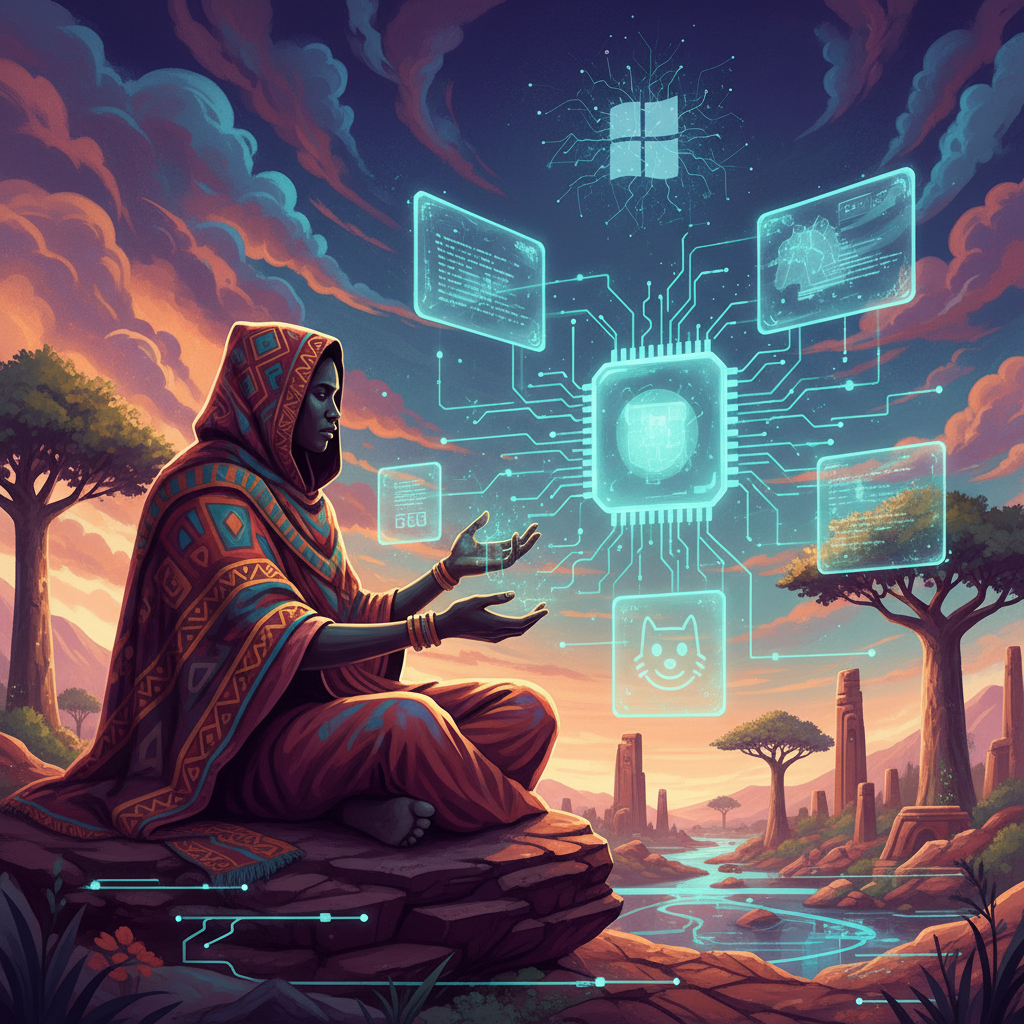

Let me tell you, from the bustling streets of Harare, where innovation often springs from necessity and creativity is a birthright, the talk about AI in coding, specifically Microsoft's GitHub Copilot, feels different. It is not just about lines of code or efficiency metrics; it is about possibility. It is about a digital sangoma, a wise elder whispering guidance as you weave the future with your fingertips. And frankly, I'm calling it now: this tool, or rather, the philosophy behind it, is going to reshape our digital landscape in ways most people in the West are only beginning to grasp.
For too long, the narrative of technological advancement has been a one-way street, flowing from Silicon Valley outwards. But what happens when the tools become so intuitive, so accessible, that the barrier to entry for creation plummets? That is where Copilot enters the chat, literally. It is an AI pair programmer, powered by OpenAI's Codex, that suggests code and entire functions in real time. Imagine a young coder in Bulawayo, with a brilliant idea for an app that solves a local problem, but perhaps lacking years of formal training or access to a vast network of senior developers. Copilot becomes their silent mentor, their digital apprentice, helping them bridge the knowledge gap and manifest their vision into reality. This is not just about making experienced developers faster; it is about making development possible for a whole new generation of creators.
I have seen firsthand the hunger for digital skills here. Programs like the Zimbabwe Institute of Technology are churning out bright minds, eager to build. But even with the best education, the sheer volume of frameworks, languages, and best practices can be overwhelming. Copilot, in its current iteration, and certainly in its future forms, acts as a force multiplier. It allows those with a strong understanding of logic and problem-solving to bypass some of the rote memorization and syntax struggles. It frees up mental bandwidth for the truly creative, architectural thinking. This is where the magic happens, where the unique perspectives from our continent can finally be coded into existence with fewer technical hurdles.
Some might argue, and I have heard these whispers even here, that tools like Copilot will make developers redundant, that it will devalue human skill. They say it is a crutch, that it encourages laziness, or that it will lead to a homogenization of code, stifling true innovation. I hear you, I really do. The fear of being replaced by a machine is a primal one, especially in economies where jobs are already precious. But I see it differently. I see it as an evolution, a shift in focus. Just as the invention of the printing press did not eliminate writers, but rather democratized knowledge and elevated the art of storytelling, AI coding assistants will not eliminate developers. They will elevate the role of the developer from a mere code-writer to an architect of solutions, a problem-solver who leverages powerful tools to bring complex ideas to life.
Think about it this way: a master sculptor does not spend all their time sharpening their chisels; they spend it envisioning the form, understanding the material, and executing their artistic intent. Copilot is like a self-sharpening chisel, a tool that handles the mundane, repetitive tasks, allowing the human artist to focus on the grand design. It helps identify bugs, suggests optimal patterns, and even translates comments into code, or vice versa. According to a study published by GitHub, developers using Copilot complete tasks significantly faster, and they report feeling more satisfied with their work. This is not just about speed; it is about empowerment and reducing cognitive load.
And let us not forget the implications for open source. The very foundation of GitHub is collaboration and shared knowledge. Copilot, trained on billions of lines of publicly available code, is a testament to this collective intelligence. It learns from the best, and in turn, helps everyone write better code. This creates a virtuous cycle, accelerating the pace of innovation globally. For African developers, who often rely heavily on open source communities due to resource constraints, this is a game-changer. It means access to a level of coding expertise that might otherwise be out of reach.
Of course, there are challenges. The ethical considerations around intellectual property, the potential for propagating biases present in the training data, and the need for rigorous testing of AI-generated code are all valid concerns. We cannot simply abdicate our responsibility to the machine. As Satya Nadella, Microsoft's CEO, has often emphasized, AI must be developed responsibly and with human oversight. He has spoken about the importance of 'co-pilots' rather than 'auto-pilots', underscoring the human in the loop. This is a critical distinction. We must remain the captains of our digital ships, with AI as our trusted navigator, not our replacement.
The real transformation lies not just in the lines of code generated, but in the minds it frees up. It is about enabling a new wave of digital artisans to emerge from every corner of the globe, bringing their unique cultural flavors and problem-solving approaches to the world stage. Imagine applications designed with a deep understanding of Shona or Ndebele cultural nuances, built by developers who can now focus on the creative expression rather than grappling with syntax. This is not a pipe dream; it is the inevitable trajectory of accessible AI tools.
We are on the cusp of a creative explosion in software development, driven by these intelligent assistants. The future is African, and these tools are helping us build it, one intelligent suggestion at a time. Watch this space. The next groundbreaking innovation, the next world-changing app, might just be coded with the help of a digital sangoma, right here in Zimbabwe. For more insights into how AI is shaping global tech, you can always check out what MIT Technology Review is reporting, but remember, sometimes the most profound shifts happen quietly, far from the usual spotlights.
This is not merely about a tool; it is about a paradigm shift. It is about empowering the unheard voices, the untapped potential, and allowing the rich tapestry of human creativity to be woven into the very fabric of our digital future. And that, my friends, is something worth getting excited about.