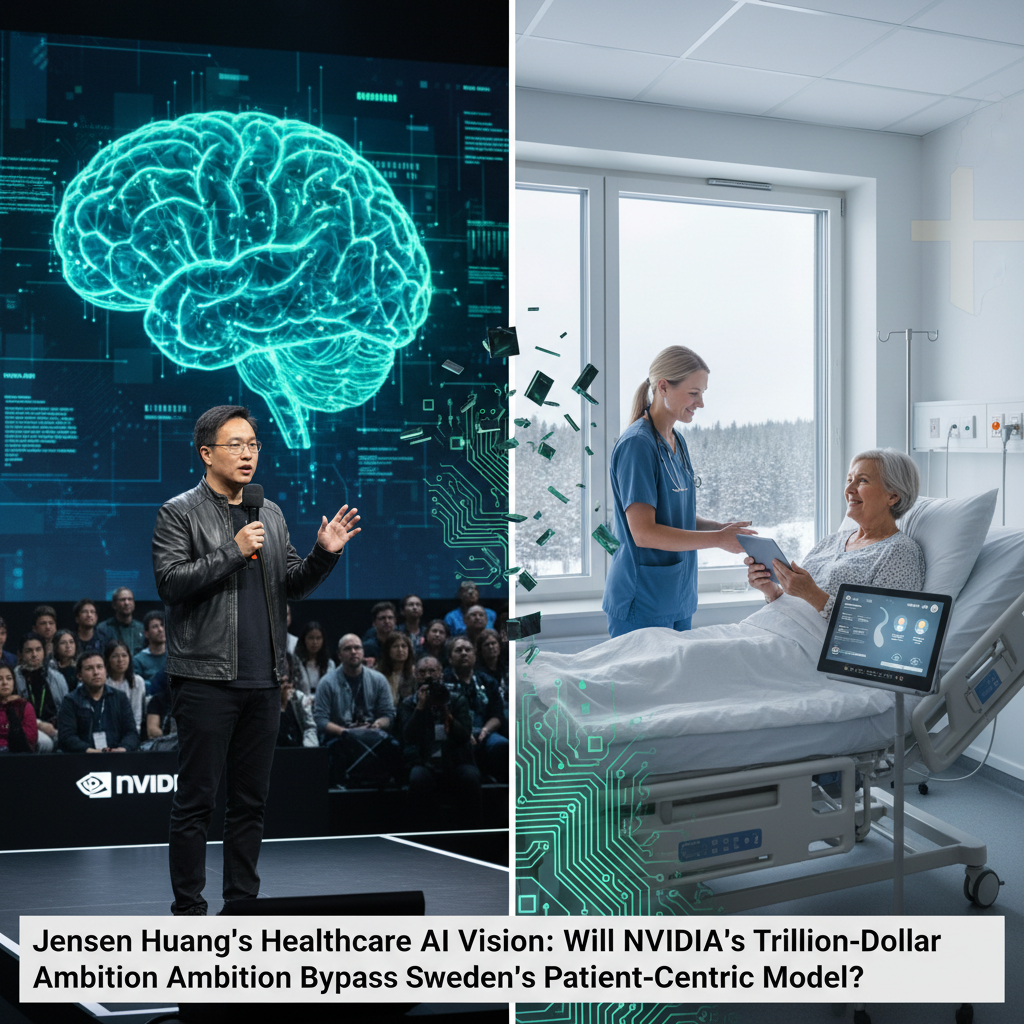

Jensen Huang, the charismatic CEO of NVIDIA, recently unveiled a series of ambitious initiatives aimed at embedding artificial intelligence deeply within the global healthcare sector. His keynote, delivered with characteristic fervor, painted a picture of a future where AI accelerates drug discovery, refines diagnostics, and personalizes treatment plans with unprecedented precision. The market, predictably, responded with enthusiasm, further cementing NVIDIA's position at the vanguard of the AI hardware revolution. Yet, from a Swedish perspective, these grand pronouncements invite a crucial question: at what cost, and for whose ultimate benefit?
NVIDIA's strategy is undeniably comprehensive. They are not merely selling GPUs, the indispensable engines of modern AI. They are cultivating an entire ecosystem, from specialized software platforms like NVIDIA Clara, designed for medical imaging and genomics, to partnerships with pharmaceutical giants and research institutions. The vision is clear: to become the foundational infrastructure for all AI-driven healthcare. Estimates suggest this market could reach hundreds of billions of dollars annually within the next decade, a significant slice of NVIDIA's projected trillion-dollar AI economy. However, the path from Silicon Valley's innovation labs to Sweden's public healthcare system is rarely straightforward.
Let's look at the evidence. Sweden, with its universal healthcare system and a strong tradition of data privacy, approaches technological integration with a degree of caution that might seem anachronistic to some American tech evangelists. Our national personal identity numbers, while facilitating seamless healthcare, also underscore the immense responsibility in handling sensitive patient data. The General Data Protection Regulation, GDPR, is not merely a bureaucratic hurdle here, it is a fundamental safeguard.
Dr. Ingrid Karlsson, a leading bioethicist at Karolinska Institutet, articulated this concern succinctly. “While the potential for AI to enhance diagnostics is undeniable, we must ask about the provenance of the training data and the transparency of the algorithms. Who owns the insights derived from our collective health data? And how do we ensure these powerful tools do not exacerbate existing health inequalities, rather than mitigate them?” Her point is well taken. The sheer scale of data required to train NVIDIA's advanced models often necessitates vast, anonymized datasets, a process fraught with ethical complexities, particularly when aggregated across diverse populations.
NVIDIA’s initiatives, such as their collaboration with Recursion Pharmaceuticals to accelerate drug discovery using AI, are certainly impressive. They promise to compress years of research into months, potentially bringing life-saving treatments to market faster. This is a compelling narrative, especially for patients suffering from rare diseases. However, the commercial imperative driving these partnerships often overshadows the more nuanced discussions around data governance and equitable access to these AI-powered advancements. Will these breakthroughs be accessible to all, or will they primarily benefit those within well-funded private systems?
Historically, the Swedish model suggests a different approach. Our healthcare system prioritizes universal access and public trust. Any integration of AI, no matter how transformative, must align with these core values. This means rigorous independent validation, transparent algorithmic decision-making, and robust mechanisms for patient consent and data control. The idea of a proprietary, black-box AI system making critical health recommendations without clear oversight is simply incompatible with our regulatory and ethical landscape.
Consider the practicalities. Implementing NVIDIA's AI infrastructure, which often requires significant investment in specialized hardware and cloud computing resources, presents a formidable challenge for publicly funded healthcare providers. While the long-term benefits might justify the cost, the initial capital outlay and the ongoing operational expenses could strain already stretched budgets. “We are always open to innovation that genuinely improves patient outcomes and efficiency,” stated Lars Nilsson, Director of Digital Health at Region Stockholm. “However, any solution must demonstrate clear return on investment, integrate seamlessly with our existing digital infrastructure, and, crucially, respect the stringent data privacy standards our citizens expect. It cannot be a technology looking for a problem, nor can it compromise patient trust.”
Furthermore, the question of vendor lock-in is pertinent. As NVIDIA consolidates its position as the dominant provider of AI hardware and software for healthcare, concerns arise about future pricing, interoperability, and the ability of public systems to maintain control over their technological destiny. Scandinavian data paints a clearer picture of the importance of open standards and robust competition to prevent monopolies that could dictate terms to public services. We have seen how critical infrastructure can become vulnerable when controlled by a single, powerful entity.
While NVIDIA's advancements in areas like federated learning, which allows AI models to be trained on decentralized datasets without directly sharing raw patient information, offer some reassurance regarding privacy, the fundamental questions remain. How will these systems be audited? Who is accountable when an AI makes an error? And how do we ensure that the focus remains on the patient, rather than the profit margins of a hardware manufacturer?
The enthusiasm surrounding Jensen Huang's vision for healthcare AI is understandable. The potential to revolutionize medicine is immense. However, as we in Sweden have learned through decades of building a robust public healthcare system, technological progress must always be tempered by ethical considerations, democratic oversight, and a steadfast commitment to the well-being of all citizens. The trillion-dollar AI ecosystem NVIDIA envisions must demonstrate its value not just in computational power, but in its ability to serve human needs responsibly and equitably. For more on the broader implications of AI in healthcare, one might consult MIT Technology Review. For specific AI industry news, TechCrunch often provides timely updates. The ethical frameworks for such advancements are constantly evolving, as discussed on platforms like Wired. The future of healthcare AI is not merely a technical challenge, it is a societal one, and Sweden will continue to scrutinize its development with a critical, patient-first lens. The debate is far from over. The real work, the ethical and societal integration, has only just begun.