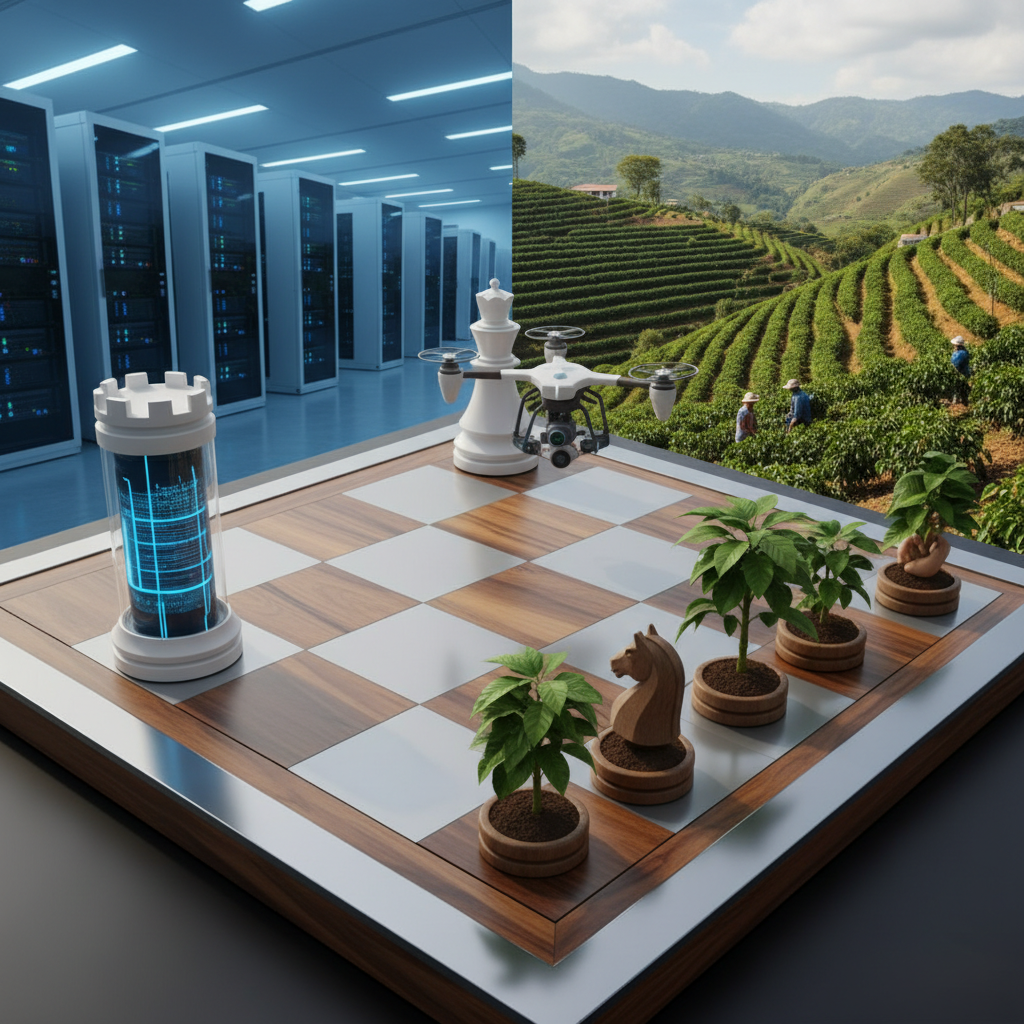
From the lush green mountains of my homeland, Costa Rica, I have watched enough technological waves crash upon our shores to know that not every innovation is a blessing. We are a small nation, yes, but one that has often led the way in environmental stewardship and sustainable practices. So, when a behemoth like Google starts talking about 'revolutionizing' agriculture with AI, especially in our region, my ears perk up, but my skepticism remains firmly rooted, like a good coffee plant in rich volcanic soil.
The strategic move by Google, through what I will call 'Project Agribot' for clarity, is not just about selling software. It is a comprehensive, multi-pronged approach to embed their AI ecosystem deep into the global food supply chain, from seed to supermarket. For Costa Rica, this means their advanced satellite imagery, machine learning models, and IoT sensors are now being pitched as the ultimate solution for everything from banana plantation management to coffee yield optimization. They are offering tools for precision irrigation, early disease detection, and hyper-localized weather predictions, all powered by their cloud infrastructure and AI algorithms.
Context and Motivation: Why Now, Why Here?
Google's motivation is clear: agriculture is a multi-trillion dollar global industry, and it is ripe for data-driven transformation. Traditional farming methods, while often sustainable in their own right, struggle with efficiency, resource waste, and the increasing pressures of climate change. Enter AI. By offering solutions that promise to reduce water usage by 30%, increase yields by 15%, and minimize pesticide application, Google positions itself as a savior, a partner in food security. For a country like Costa Rica, where agriculture still forms a significant part of our economy and identity, these promises are alluring. Our agricultural sector, particularly our exports of coffee, bananas, and pineapples, faces global competition and climate variability. The idea of using AI to gain a competitive edge and ensure crop resilience is very attractive.
However, it is not purely altruistic. This is about data. Every sensor deployed, every drone flight, every farmer's input, feeds into Google's vast data lakes. This agricultural data, when aggregated and analyzed, becomes incredibly valuable. It allows for better model training, more accurate predictions, and ultimately, a deeper understanding of global food production patterns, which can then be monetized in various ways, from futures trading to targeted advertising for agricultural inputs. As Sundar Pichai, Google's CEO, has often emphasized, the future is AI-first, and that applies to every sector, including the soil beneath our feet.
Competitive Analysis: The Giants and the Niche Players
Google is not alone in this field. Microsoft, with its 'FarmBeats' initiative, has also been pushing AI and IoT solutions for agriculture, often leveraging its Azure cloud services. IBM has its 'Watson Decision Platform for Agriculture.' Then there are the specialized startups, the nimble players who often understand the nuances of local farming better than the tech giants. Companies like Cropin, which has seen success in Asia, focus specifically on agricultural intelligence, offering tailored solutions often built on open source frameworks or regional data. You can read more about similar initiatives in other regions on TechCrunch.
What sets Google apart is its sheer scale and its existing infrastructure. They have the satellite imagery from Google Earth, the cloud computing power of Google Cloud, and the machine learning expertise developed across their search, advertising, and autonomous vehicle divisions. This allows them to offer a more integrated, end-to-end solution, often at a scale that smaller competitors cannot match. Their strategy is to become the underlying operating system for agriculture, much like Android is for mobile phones or Chrome is for web browsing. They aim to be indispensable.
Strengths and Weaknesses: A Pura Vida Perspective
The strengths of Google's Project Agribot are undeniable. The potential for increased efficiency and sustainability is real. Imagine a coffee farmer in Tarrazú receiving an alert on their phone, powered by satellite data and local sensor readings, indicating the precise moment their plants need water, or detecting an early sign of coffee rust before it devastates the crop. This kind of precision farming can lead to significant savings in water, fertilizer, and labor, while also improving crop quality and yield. This aligns perfectly with Costa Rica's commitment to environmental protection and efficient resource use. MIT Technology Review has covered the promise of AI in agriculture extensively.
However, there are significant weaknesses and concerns, especially from our Costa Rican perspective. One major issue is data ownership and privacy. When Google collects vast amounts of data from our farms, who truly owns that data? What prevents it from being used for purposes beyond agricultural optimization, or even sold to third parties? Farmers, particularly smallholders, often lack the technical literacy or legal resources to understand and negotiate these complex data agreements. There is a real fear that this could lead to a new form of digital colonialism, where our most valuable resource, our land and its produce, becomes another data point in a global corporate ledger.
Another weakness is the 'one size fits all' approach that often accompanies large tech solutions. Our agriculture is incredibly diverse, from the high-altitude coffee farms to the lowland banana plantations. The specific soil compositions, microclimates, and cultural practices vary dramatically. Can a generalized AI model, however sophisticated, truly capture these nuances without significant local adaptation and input? The cost of implementation is also a barrier. While Google might offer pilot programs, the long-term investment in sensors, connectivity, and training can be prohibitive for many small and medium-sized farms, potentially widening the gap between large, industrialized agriculture and the more traditional, family-run operations.
Furthermore, what about job displacement? While precision farming promises efficiency, it also implies a reduction in manual labor for tasks like scouting fields or manual irrigation. In a country where agricultural jobs are still vital, this needs careful consideration. The pura vida approach to AI, for us, means ensuring technology serves our people and our environment, not the other way around.
Verdict and Predictions: Is This Strategy Enough?
Is Google's Project Agribot strategy enough? For Google, it is a smart play for market dominance and data acquisition. For global agriculture, it offers genuine potential for efficiency and sustainability. But for Costa Rica, the answer is more nuanced. It is a powerful tool, but one that must be wielded with caution and a clear understanding of its implications.
My prediction is that Google will continue to expand its agricultural AI offerings, pouring resources into making their models more robust and their hardware more accessible. They will likely form partnerships with local agricultural cooperatives and government agencies to gain trust and facilitate adoption. We will see more sophisticated drone and satellite monitoring, and increasingly autonomous farm equipment guided by their AI. The immediate future will see increased yields and reduced waste in farms that adopt these technologies.
However, the long-term success in places like Costa Rica will depend not just on Google's technological prowess, but on their willingness to truly collaborate, to respect local knowledge, and to address concerns around data sovereignty and equitable access. We need to ensure that the benefits are broadly distributed, not just concentrated in the hands of a few large producers. Costa Rica proves you don't need Silicon Valley to innovate, but we can certainly learn from their tools, provided we maintain our autonomy and our values. The challenge for us is to harness these powerful technologies while safeguarding our unique agricultural heritage and our commitment to a sustainable future. If we fail to do so, we risk becoming merely another data farm in Google's grand global strategy, rather than a true partner in practical innovation in paradise.