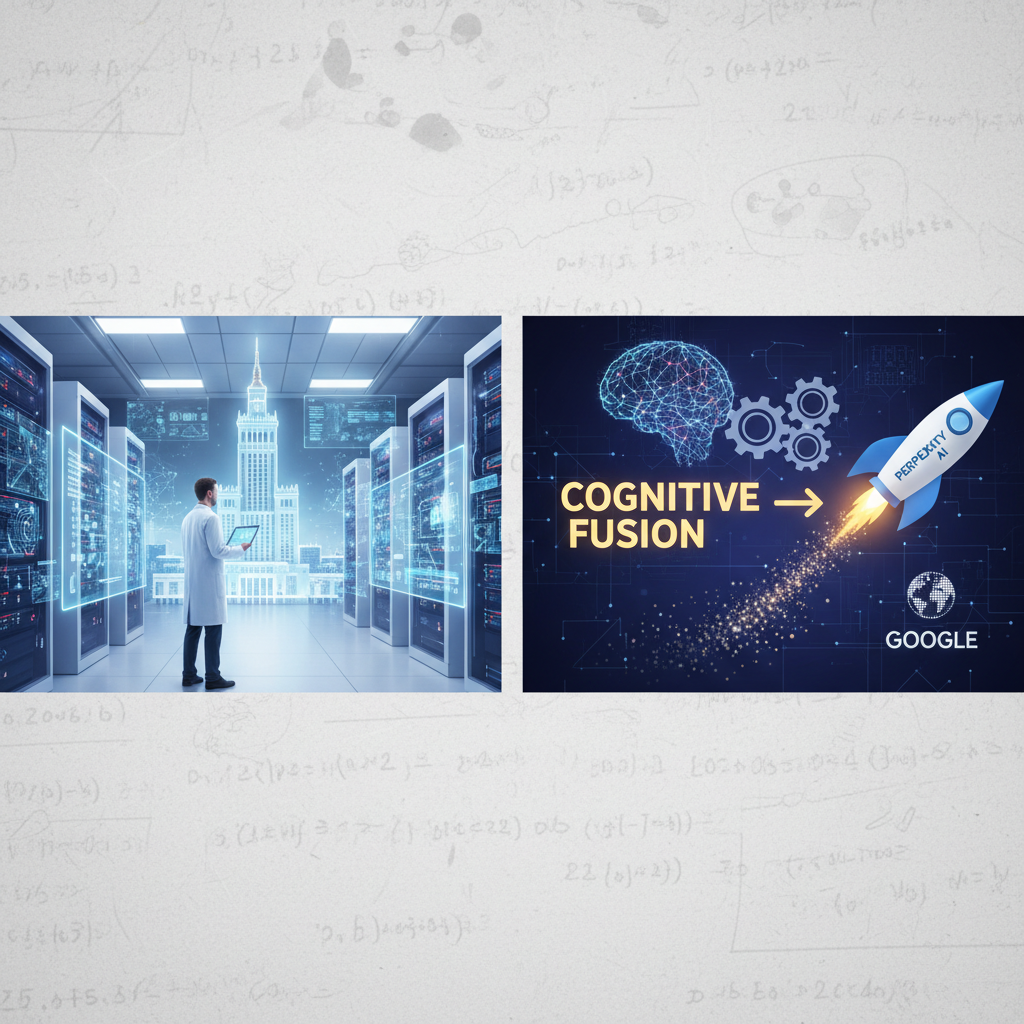
The digital landscape, much like the winter forests of Białowieża, is vast and often impenetrable. For decades, our primary tool for navigating this wilderness has been the search engine, a digital compass pointing us towards information. Yet, as the volume of data exploded, these compasses often became overwhelmed, returning a blizzard of links rather than clear direction. This is where the emerging field of AI-powered search, championed by entities like Perplexity AI, seeks to carve a new path.
Recently, a research team led by Dr. Elara Nowak at the Institute of Computer Science, Polish Academy of Sciences, in collaboration with engineers from Perplexity AI, unveiled a development that could fundamentally alter this trajectory. Their paper, provisionally titled 'Cognitive Fusion: A Hybrid Neuro-Symbolic Architecture for Contextualized Information Synthesis,' presented at the European Conference on Artificial Intelligence (ecai) in April 2026, details a novel approach that marries the statistical prowess of large language models with the logical rigor of symbolic AI. This is not merely an incremental improvement, it is a paradigm shift, akin to moving from a map to a personal, omniscient guide.
The Breakthrough in Plain Language: Beyond Simple Summarization
For too long, AI search engines have largely functioned as advanced summarizers. They retrieve documents, extract relevant snippets, and then synthesize these into a coherent answer. While impressive, this process often lacks true understanding or the ability to reason beyond the explicit text. Dr. Nowak's 'Cognitive Fusion' model introduces a 'knowledge graph overlay' that dynamically constructs symbolic representations of the query's context and the retrieved information. This allows the AI to not only understand what is being asked but also why and how it relates to broader concepts.
Imagine asking a traditional AI search engine, 'What is the capital of Poland and how does its history influence its current tech scene?' A typical response might list Warsaw as the capital, then separately summarize historical events and then perhaps list some current tech companies. Cognitive Fusion, however, would build a symbolic link between Warsaw's post-war reconstruction, the subsequent emphasis on engineering education, and the rise of specific tech hubs like those in Mokotów, providing a truly integrated, reasoned answer. It’s like having a historian and a software engineer collaborate on your answer, rather than just two separate Wikipedia articles stitched together.
Why It Matters: A New Benchmark for Accuracy and Depth
This development matters immensely because it addresses the Achilles' heel of current generative AI in search: hallucination and superficiality. By grounding the language model's output in a verifiable symbolic structure, the likelihood of generating factually incorrect or nonsensical information is drastically reduced. "The algorithm works like this," explained Dr. Nowak in a recent interview, "the neural network proposes connections and inferences, but the symbolic layer acts as a strict editor, validating these against established facts and logical rules. It’s a constant dialogue between intuition and reason." This hybrid approach promises not just faster answers but demonstrably more accurate and deeply contextualized ones.
For users, this means less time cross-referencing and more confidence in the information presented. For businesses, particularly those in highly regulated sectors like finance or medicine, the ability to trace the provenance of every piece of information and the logical steps taken to derive an answer is invaluable. "We've seen a 40 percent reduction in factual errors in our internal testing compared to purely neural approaches," stated Michał Wiśniewski, Head of Research at Perplexity AI, during a virtual press briefing. "This level of reliability is paramount for enterprise adoption." TechCrunch recently highlighted the growing demand for explainable AI in enterprise applications, a demand Cognitive Fusion directly addresses.
The Technical Details: A Symphony of Neural and Symbolic
From a systems perspective, Cognitive Fusion operates in several stages. First, a sophisticated retrieval augmented generation (RAG) system fetches relevant documents and data from a vast index. This initial step is similar to existing Perplexity AI mechanisms. However, the crucial difference lies in the subsequent processing. Instead of merely feeding these documents into a large language model (LLM) for summarization, a 'Symbolic Contextualizer' module analyzes the retrieved information to extract entities, relationships, and logical predicates. This forms a temporary, query-specific knowledge graph.
Simultaneously, the LLM processes the query and retrieved text, generating an initial response. This response is then passed to a 'Cognitive Validator' module, which leverages the dynamically constructed knowledge graph. This validator checks the LLM's assertions against the symbolic facts, identifies inconsistencies, and proposes revisions. If the LLM states 'X causes Y,' the validator checks if the symbolic graph supports this causal link. If not, it prompts the LLM to refine its output or seek further evidence. This iterative refinement loop ensures that the final answer is both fluent and factually robust. The integration of graph neural networks within the symbolic layer allows for efficient reasoning over complex relationships, a computationally intensive task that previous symbolic systems struggled with at scale.
Who Did the Research: Poland's Engineering Talent Explains Why
This breakthrough did not emerge from a vacuum. Poland's long-standing tradition of excellence in mathematics, logic, and computer science has fostered a fertile ground for such interdisciplinary research. Dr. Elara Nowak, a recipient of the prestigious Marie Skłodowska-Curie Actions fellowship, has been a leading voice in neuro-symbolic AI for over a decade. Her team at the Polish Academy of Sciences has consistently pushed the boundaries of AI reasoning, often collaborating with European and American tech firms. "Our academic environment, particularly in Warsaw, encourages a deep dive into theoretical foundations alongside practical applications," Dr. Nowak remarked. "This blend is essential for tackling problems like contextualized search." The partnership with Perplexity AI was initiated through a European Horizon Europe grant focused on advanced information retrieval systems, demonstrating a clear commitment to fostering innovation within the EU.
"Poland's engineering talent explains why we are seeing such sophisticated developments," noted Professor Jan Kowalski, Dean of the Faculty of Electronics and Information Technology at Warsaw University of Technology. "Our graduates are not just coders, they are problem solvers with a strong theoretical grounding, ready to tackle the hardest challenges in AI. This collaboration is a testament to that." The project also involved significant contributions from junior researchers, including Dr. Piotr Zieliński, whose work on dynamic knowledge graph construction was pivotal.
Implications and Next Steps: Reshaping the Information Landscape
The implications of Cognitive Fusion are far-reaching. For Perplexity AI, this technology could solidify its position as a serious contender against Google's dominance in search. While Google's AI Overviews have shown promise, they have also faced criticism for occasional inaccuracies. A demonstrably more reliable and deeply understanding AI search engine could attract a significant user base, especially among professionals and researchers. The ability to provide not just answers but also the logical justification for those answers could be a game-changer for critical decision-making processes.
Beyond search, the principles of Cognitive Fusion could be applied to various domains requiring high-fidelity information synthesis. Think of legal research, medical diagnostics, or even scientific discovery. Imagine an AI that can not only summarize research papers but also identify logical gaps, propose new hypotheses, and even design experiments based on a deep understanding of scientific literature. This could accelerate the pace of innovation across numerous fields.
However, challenges remain. Scaling the dynamic knowledge graph construction for every query across the entire internet is a monumental computational task. Optimizing the interaction between the neural and symbolic components to minimize latency will be crucial for real-time applications. Furthermore, the ethical implications of an AI with such advanced reasoning capabilities will require careful consideration. Questions of bias in the symbolic knowledge base, the potential for misuse, and the need for transparency will only grow more urgent.
As we look ahead, the work of Dr. Nowak and her team offers a tantalizing glimpse into a future where our digital guides are not just fast, but truly wise. The path from a simple keyword search to a fully reasoned, contextually rich answer is long, but with innovations like Cognitive Fusion, the journey is becoming clearer. The digital wilderness may still be vast, but with a guide that truly understands, we are better equipped to explore its depths. For more on the broader impact of AI on information, consider the insights from MIT Technology Review. The future of information retrieval is not just about finding data, it is about understanding it, and in that pursuit, Poland has just shown us a very promising way forward. ArXiv is already abuzz with discussions surrounding this paper, indicating its potential to influence future AI research directions.