
The air in Turin, even on a crisp April morning, often carries the faint scent of espresso and the distant hum of industry. It is a city of elegant arcades, baroque architecture, and a proud automotive heritage, a place where precision engineering has always been a way of life. But in a discreet, modern building nestled amongst the historic factories, something new, yet deeply Italian, is taking shape: the future of AI infrastructure. This is the home of Synapse Italia, a company that, in its quiet way, is becoming an indispensable partner for the world's most ambitious AI projects, including those pushing the boundaries of autonomous systems like Tesla's AI Day announcements and the Dojo supercomputer project.
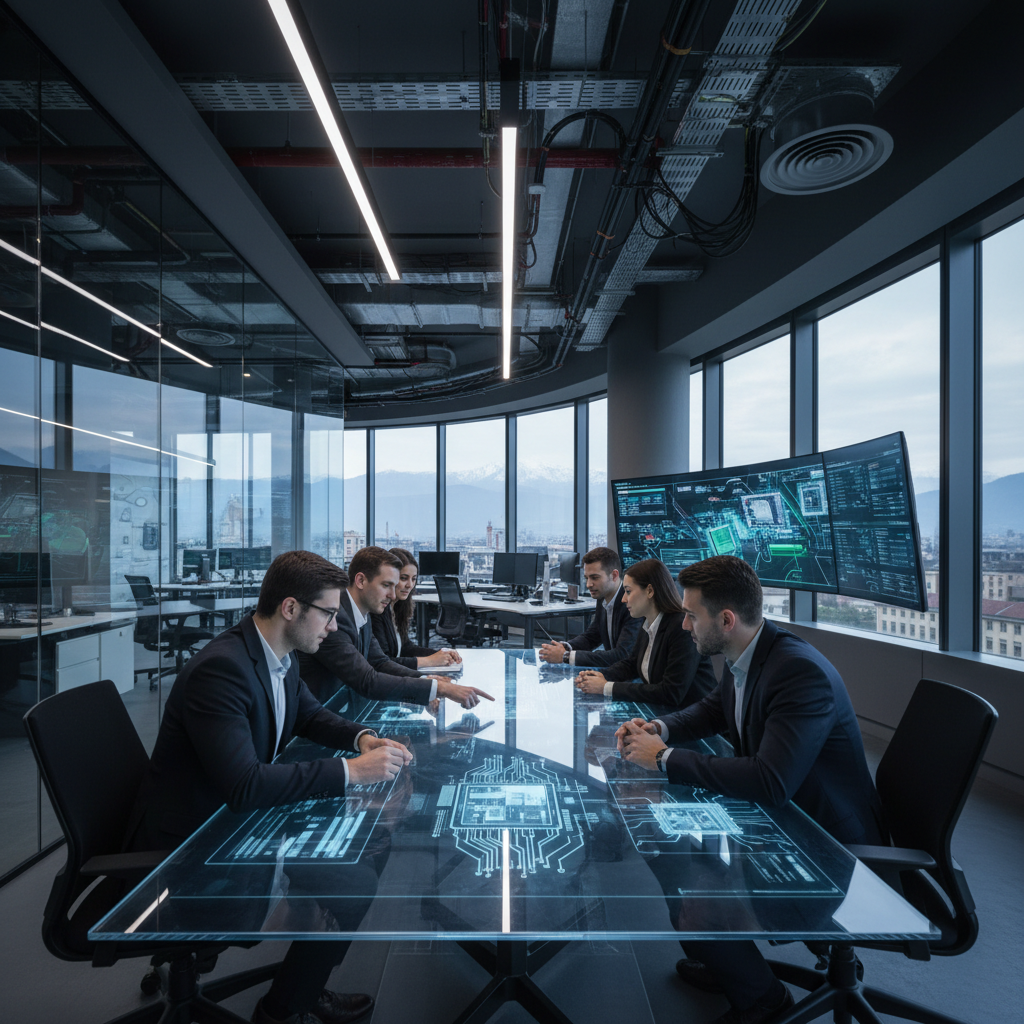
I remember visiting their headquarters, a place where the sleek lines of modern design meet the warmth of Italian hospitality. The CEO, Dr. Sofia Rossi, a woman with an infectious laugh and eyes that sparkle with intelligence, greeted me with a genuine smile. "Mattèo," she began, gesturing towards a complex schematic on a large screen, "we are not just building chips here, we are building the brains of tomorrow's intelligence. And we are doing it with the same passion and attention to detail that goes into a Ferrari engine or a perfectly tailored suit. Italy does AI differently, with style."
Synapse Italia's journey began not with a grand vision of AI dominance, but with a very specific, very Italian challenge: how to optimize complex industrial processes. Dr. Rossi, a former lead architect at STMicroelectronics, and her co-founder, Marco Bianchi, a brilliant computer scientist from Politecnico di Torino, saw a gap. Existing hardware, even the most powerful GPUs, was designed for general-purpose computing. The emerging needs of deep learning, especially for real-time, low-latency inference and energy-efficient training, demanded something more specialized. Their initial focus was on custom ASICs for automotive manufacturing, helping Italian giants like Fiat and Pirelli streamline their production lines with predictive maintenance and quality control. This early work laid the foundation for their expertise in highly optimized, application-specific integrated circuits.
Their big break came when the global AI race truly began to heat up. As companies like Tesla started talking about custom AI chips for their autonomous driving systems and supercomputers like Dojo, the need for specialized hardware became undeniable. Synapse Italia, with its deep roots in automotive and its proven track record in custom silicon, was perfectly positioned. They pivoted, leveraging their expertise to design and manufacture AI accelerators that could handle the immense computational demands of large language models and complex neural networks with unparalleled efficiency. They weren't just making faster chips, they were making smarter ones, designed from the ground up for AI workloads.
So, how does Synapse Italia make its money? Their business model is multi-faceted, but primarily revolves around two key areas: custom AI accelerator design and licensing of their proprietary IP cores. For major players like Anthropic and Google, they design bespoke silicon solutions, tailored to the unique architectures of their cutting-edge models. This often involves close collaboration, sometimes for years, resulting in chips that offer significant performance and energy efficiency advantages over off-the-shelf alternatives. Secondly, they license their highly optimized AI processing units (APUs) and interconnect IP to other hardware manufacturers and cloud providers. This allows companies to integrate Synapse Italia's core technology into their own chip designs or data center infrastructure, accelerating their AI capabilities without the need for ground-up development. Their revenue run rate now comfortably exceeds $150 million annually, a testament to the critical role they play.
Their customer list reads like a who's who of the AI world. Beyond their foundational work with European automotive firms, Synapse Italia has become a quiet enabler for companies pushing the boundaries of AI. They have partnered with Anthropic to optimize the inference speed of Claude, making its responses even more fluid and natural. Google has integrated Synapse Italia's specialized IP into some of its next-generation Tensor Processing Units, particularly for edge AI applications. Even Meta, with its vast AI research initiatives, has tapped into Synapse Italia's expertise for energy-efficient training solutions. "Our chips are the unsung heroes," Dr. Rossi explained, "they work behind the scenes, making the magic happen faster and with less energy. It's like the perfect Italian coffee machine, you don't think about the mechanics, just the perfect espresso it delivers." The company currently employs over 400 people across its main Turin campus, with smaller design offices in San Francisco, London, and Tokyo, allowing them to stay close to their diverse customer base and talent pools.
Of course, the competitive landscape is fierce. NVIDIA, with its dominant GPU ecosystem, remains the Goliath in the room. Companies like Cerebras Systems and Graphcore also offer specialized AI accelerators. However, Synapse Italia differentiates itself through its deep specialization in custom, energy-efficient designs, particularly for inference and specific training workloads. While NVIDIA's GPUs are powerful generalists, Synapse Italia's ASICs are precision instruments. "We don't try to be everything to everyone," Marco Bianchi told me during a tour of their R&D lab, "we focus on where we can deliver truly unique value: hyper-optimized silicon for specific AI challenges. It's a niche, yes, but a very valuable one." Their Series A funding of $20 million was led by Accel, followed by a $50 million Series B from Sequoia Capital, and a recent $80 million Series C round spearheaded by Andreessen Horowitz, demonstrating strong investor confidence.
The company culture at Synapse Italia is a fascinating blend of Silicon Valley ambition and Italian family values. Dr. Rossi fosters an environment of intense collaboration and intellectual rigor, but also one where work-life balance and personal well-being are genuinely valued. Lunch breaks often involve lively discussions over pasta, and team-building events might be a truffle hunt in Piedmont or a weekend retreat in the Dolomites. "We believe that happy engineers are brilliant engineers," Dr. Rossi said with a smile. This approach has helped them attract top talent, including several key hires from NVIDIA and Intel, drawn by the opportunity to work on cutting-edge hardware in a more human-centric environment.
Yet, scaling a hardware company in the current global climate presents its own set of challenges. The semiconductor industry is notoriously capital-intensive, and supply chain disruptions can be a constant headache. Furthermore, the rapid pace of AI innovation means their designs must constantly evolve. There are internal debates, for example, about how much to invest in general-purpose AI chips versus maintaining their focus on highly specialized solutions. "It's a tightrope walk," admitted Roberto Mancini, their Head of Engineering, "we need to innovate constantly, but also remain true to our core strengths. It's a delicate balance, like crafting the perfect risotto." The regulatory environment, particularly in Europe, is also a growing concern, with discussions around AI ethics and hardware sovereignty potentially impacting their global operations. You can read more about the broader AI hardware landscape on TechCrunch.
For the bull case, analysts point to Synapse Italia's unique position at the intersection of automotive and AI, a market expected to grow exponentially. Their proven ability to deliver custom, high-performance, and energy-efficient solutions makes them an attractive partner for any company serious about deploying AI at scale. "Synapse Italia is not just riding the AI wave, they are helping to build the surfboard," observed Dr. Elena Ricci, a senior analyst at Gartner. "Their specialized approach offers a compelling alternative to the general-purpose chip giants, especially for niche applications where efficiency is paramount." The bear case, however, highlights the inherent risks of a hardware startup: intense competition, reliance on a few large customers, and the potential for larger players to simply acquire their capabilities. The cost of developing new fabrication processes is astronomical, and a single misstep in design could be catastrophic. The market for AI hardware is projected to exceed $100 billion by 2030, according to some reports, but capturing a significant slice of that pie requires constant innovation and flawless execution. For a deeper dive into the strategic implications of AI hardware, MIT Technology Review often covers these trends.
As I left Turin, the sun was setting over the Alps, painting the sky in hues of orange and purple. Synapse Italia, with its blend of Italian craftsmanship and cutting-edge machine learning, represents something truly special. It's a reminder that the future of AI isn't just being built in Silicon Valley, but in unexpected corners of the world, often by people driven by a deep sense of purpose and a passion for excellence. La dolce vita meets machine learning, indeed. The world watches to see if this Italian gem will continue to shine brightly in the global AI spotlight, proving that even in the most technical of fields, the human touch, the Italian touch, can make all the difference. For more on the global AI industry, you can always check Reuters Technology.