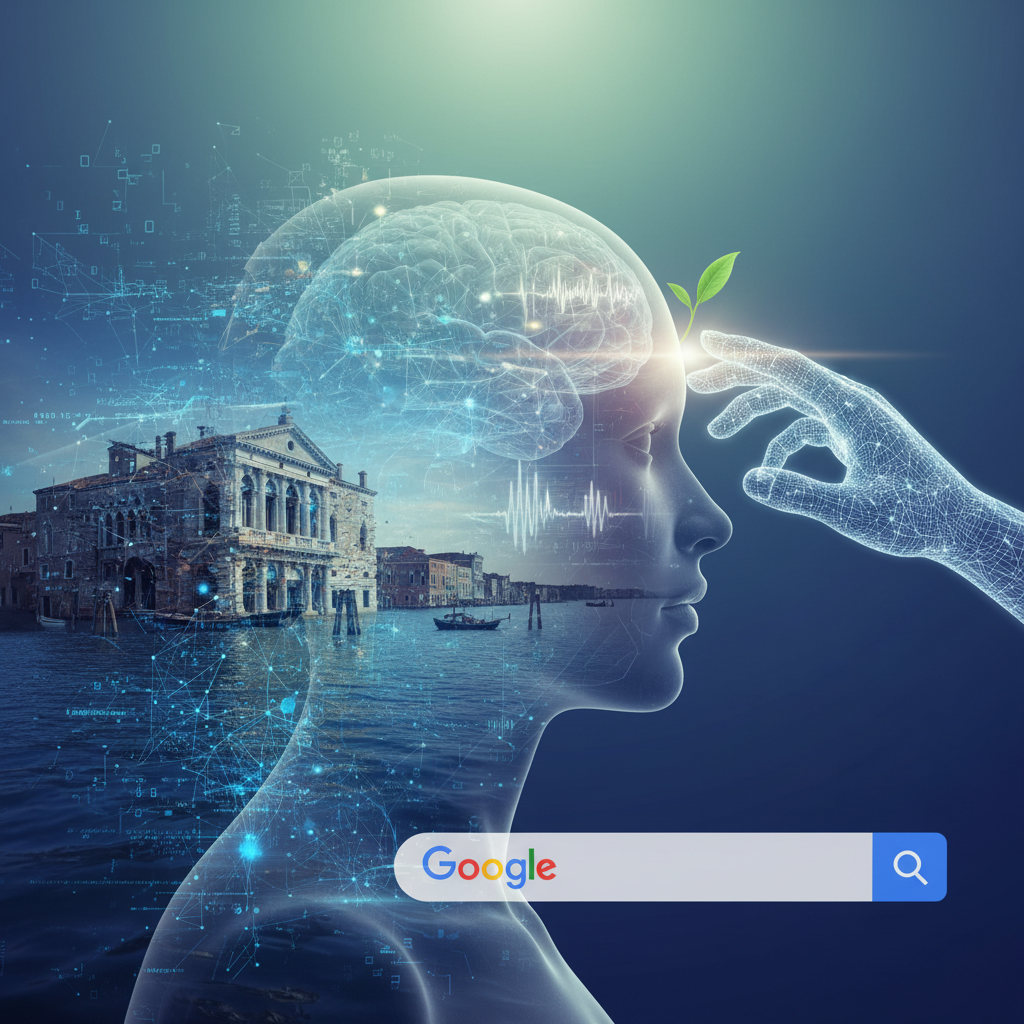

The scent of salt and history hangs heavy in the air as I walk along the Riva degli Schiavoni, watching the vaporetti cut through the emerald water. Venice, my beloved Venezia, is a city built on defying the impossible, a testament to human ingenuity against the relentless tide. Yet, these days, the tide feels different, more insistent, and the ingenuity needed is on a scale we've never seen before. It’s not just the acqua alta that threatens; it's the gnawing anxiety in the hearts of its people, a feeling that perhaps even our most advanced tools, like artificial intelligence, might not be enough. This is where the human story of climate change truly begins, in the delicate balance between hope and despair, and how AI plays its part in our minds.
I recently spoke with Elena Rossi, a third-generation gondolier whose family has navigated these canals for over a century. Her hands, calloused from years of rowing, gestured towards the shimmering lagoon. "My nonno, he would tell stories of the high water, but it was an event, a spectacle. Now, it's a constant worry, like a low hum in the background of our lives. We see the Mose barriers, we hear about the scientists and their computer models, but still, the fear, it stays." Elena's words echo a sentiment I've heard across Italy, from the farmers in Puglia battling unprecedented droughts to the mountain communities in the Dolomites witnessing glaciers recede at an alarming pace. The climate crisis isn't just an environmental problem; it's a profound psychological challenge, and our interaction with AI in this context is shaping our cognitive response.
For years, the narrative around AI and climate change has been largely optimistic: a powerful tool, a digital superhero ready to crunch data, optimize energy grids, predict extreme weather, and design sustainable materials. Companies like Google, with its DeepMind unit, have been deploying AI to make data centers more energy efficient, reducing cooling needs by up to 40 percent in some cases. NVIDIA's GPUs, often seen as the engine of AI, are also being leveraged for complex climate modeling, simulating atmospheric conditions and ocean currents with unprecedented detail. The promise is immense, a beacon of hope in a darkening world. But what happens when that beacon, however bright, doesn't immediately solve the problem, or worse, overwhelms us with the sheer scale of the challenge?
Dr. Sofia Moretti, a cognitive psychologist at the University of Bologna, explains this phenomenon. "We call it 'solution aversion' or 'information overload paralysis'. When people are bombarded with dire warnings about climate change, even if accompanied by technological solutions, the sheer complexity and magnitude can lead to a sense of helplessness. AI, while offering powerful insights and solutions, can also contribute to this if not presented carefully. If it feels like an insurmountable black box, rather than a collaborative partner, it can deepen the psychological burden." She emphasizes that the way we interact with AI, the language it uses, and the transparency of its operations are crucial for fostering a sense of agency rather than despair. We need to feel like we are part of the solution, not just passive recipients of algorithmic decrees.
Consider the farmer in Sicily, Marco Bellini, whose olive groves have suffered from erratic rainfall. He uses an AI-powered irrigation system, developed by a local startup in collaboration with Microsoft's Azure AI, that analyzes soil moisture, weather forecasts, and even satellite imagery to optimize water usage. "Before, it was guesswork, tradition," Marco told me. "Now, the system tells me precisely when and how much. It's a relief, yes, but also, it's a constant reminder that the climate is so unpredictable, I need a machine to tell me how to grow olives, something my ancestors did by instinct." This is the subtle psychological shift: reliance on AI can be empowering, but it also underscores the severity of the crisis, potentially increasing cognitive load and anxiety about a future where human intuition feels insufficient.
Italy does AI differently, with style, often blending ancient wisdom with cutting-edge tech. In a workshop in Milan, I saw how AI is being used to design more sustainable fashion, optimizing material cuts to minimize waste. Yet, even here, the human element is paramount. The designers I spoke with felt a sense of urgency, a responsibility to use AI not just for efficiency, but for ethical production. "It's about making better choices, not just faster ones," said Isabella Conti, a lead designer at a sustainable fashion house. "The AI helps us see the impact, but the human heart still guides the aesthetic and ethical decisions." This human-centric approach is vital for preventing AI from becoming another source of detachment.
The challenge, then, is not just about building smarter AI, but about building AI that understands and supports human psychology in the face of an existential threat. We need interfaces that simplify complex data, rather than overwhelming us. We need AI that offers actionable insights, fostering a sense of control and efficacy, rather than merely predicting doom. We need systems that explain their reasoning, building trust and reducing the feeling of being at the mercy of an inscrutable algorithm. The MIT Technology Review has published extensively on the need for explainable AI, a concept that becomes even more critical when dealing with high-stakes issues like climate change.
Dr. Antonio Ricci, a climate scientist and AI ethics researcher at the Politecnico di Torino, highlighted the importance of localized, culturally sensitive AI applications. "A global AI model for climate might be scientifically sound, but if it doesn't resonate with local traditions, economic realities, or psychological frameworks, its adoption will be limited. We need AI that speaks to the Italian farmer, the Venetian gondolier, the Alpine guide, in a way that feels empowering and relevant to their specific challenges." He pointed to initiatives where local communities are co-designing AI tools for flood prediction or sustainable agriculture, ensuring that the technology serves their needs and reduces, rather than exacerbates, their anxieties. This collaborative approach is key to harnessing AI's potential without alienating the very people it aims to help.
La dolce vita meets machine learning, but the intersection is not always smooth. The constant stream of climate news, often amplified by AI-driven algorithms on social media, can lead to what psychologists call "eco-anxiety." While AI can help us monitor and predict, it also plays a role in how we consume and process this often-disturbing information. The algorithms that personalize our feeds can inadvertently trap us in echo chambers of despair or denial, making it harder to engage constructively with solutions. We need to be mindful of how our digital environments, shaped by AI, are influencing our emotional and cognitive responses to the climate crisis.
So, what can we, as individuals, do? First, be discerning consumers of information. Seek out diverse sources, and question the narratives presented, even those seemingly backed by AI. Second, engage with AI not as a magic bullet, but as a powerful tool that requires human guidance and ethical consideration. Understand its limitations as well as its strengths. Third, focus on local actions and community involvement. When AI solutions are implemented at a local level, with direct human input, they become more tangible and less overwhelming, fostering a sense of collective efficacy. Finally, recognize the psychological toll of climate change and seek support if needed. It's okay to feel overwhelmed, but it's crucial to channel those feelings into constructive engagement rather than paralysis.
The future of our planet, and our psychological well-being within it, hinges on how we integrate AI into our climate response. It's not just about the algorithms, the data, or the computing power of companies like OpenAI or Anthropic. It's about us, the humans, and how we choose to wield these powerful tools. Can we use AI to foster hope, agency, and collective action, transforming our cognitive landscape from one of fear to one of determined resilience? I believe we can, but it will require a conscious, empathetic effort, a true blend of human wisdom and machine intelligence, to navigate these turbulent waters together. For more insights into the psychological impacts of AI, you might find articles on The Verge useful for staying updated on consumer AI trends and their broader societal implications.