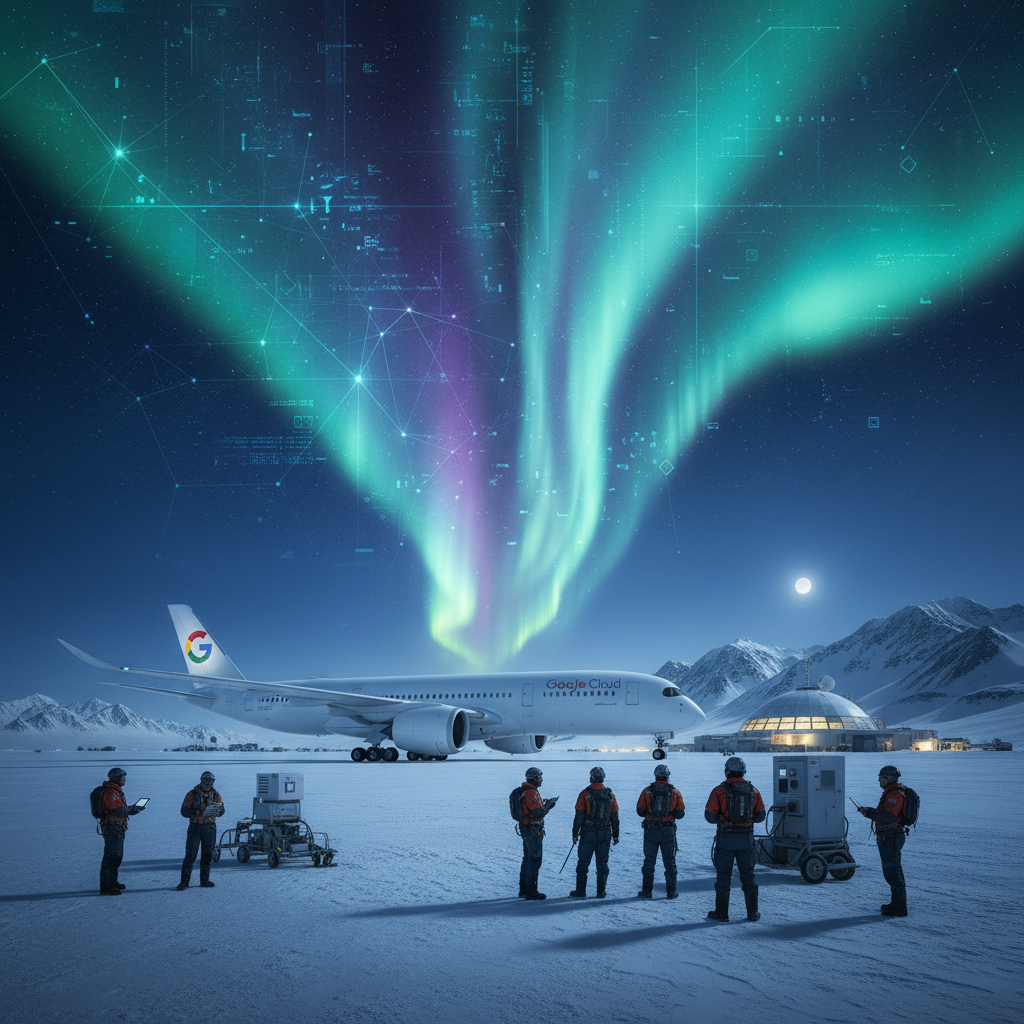
The wind howls outside our research station, a familiar symphony that has accompanied countless nights here on the ice. Last night, the aurora lit up our research station, painting the sky in greens and purples, a reminder of the raw, untamed beauty of this place. In the silence of Antarctica, you hear things differently, and lately, the whispers of artificial intelligence, amplified by the surging fortunes of giants like Microsoft, have become impossible to ignore.
Satya Nadella, Microsoft’s CEO, has steered the company into an AI-first future with a conviction that has not only revitalized the tech behemoth but also sent its market capitalization soaring past rivals. This isn't just a story about stock prices, though. It's a tale of how this strategic pivot is rippling outwards, reaching even the most isolated corners of the globe, transforming how we work, innovate, and even understand our planet. From the bustling tech corridors of Stockholm to the quiet, specialized labs nestled amidst the Antarctic ice, Nadella's vision is recalibrating expectations and workflows.
I’ve seen it firsthand. Just last month, I spoke with Dr. Elara Karlsson, a glaciologist at the Swedish Polar Research Secretariat, who spends her days analyzing satellite imagery for subtle changes in ice sheet dynamics. "Before, processing even a small fraction of the data from our remote sensors took weeks of manual labor and specialized coding," she explained, her breath misting slightly in the cool lab air. "Now, with Microsoft Azure AI services and tools like Copilot integrated into our data pipelines, we can identify anomalies in hours. It’s like having a team of junior researchers working tirelessly, without needing extra coffee breaks." This is what AI looks like at the end of the world: a force multiplier for critical, often solitary, work.
The data certainly backs up Dr. Karlsson's anecdotal experience. A recent report by Bloomberg Technology highlighted Microsoft's aggressive push into enterprise AI, with Copilot adoption rates reportedly exceeding 30% in large corporations within its first year of broad availability. While specific figures for Sweden or Antarctica are harder to isolate, the trend is clear. Companies like Volvo Group, a Swedish industrial giant, have publicly discussed their increased investment in AI solutions, often leveraging Microsoft's ecosystem for everything from supply chain optimization to predictive maintenance. Their CEO, Martin Lundstedt, noted in a recent earnings call, "AI is no longer a luxury, it is a fundamental pillar of our operational efficiency and competitive edge. Our partnership with Microsoft has been instrumental in accelerating our digital transformation." This isn't just about saving money, it's about reimagining entire business processes.
But who are the winners and losers in this rapid shift? Clearly, Microsoft and its early adopters are reaping rewards. The surge in Microsoft's market cap, driven by investor confidence in its AI leadership, reflects a broader belief that AI integration is paramount for future growth. For smaller Swedish tech firms, particularly those specializing in niche AI applications or consulting, this creates both opportunity and pressure. Many are finding success by becoming specialized implementers of Microsoft's AI stack, helping local businesses integrate Copilot or customize Azure AI services. However, those clinging to legacy systems or failing to adapt risk being left behind, much like a ship caught in fast-moving ice without an icebreaker.
On the human side, the picture is more nuanced. Workers in Sweden, known for their strong emphasis on collaboration and work-life balance, are approaching AI with a blend of curiosity and caution. A survey conducted by a leading Swedish labor union, Unionen, found that while 65% of their members felt AI could enhance productivity, nearly 40% expressed concerns about job displacement or the need for significant reskilling. "We are not afraid of new technology, far from it," stated Therese Svanström, President of Unionen, in a recent press conference. "But we must ensure that AI serves people, not the other way around. Training and social safety nets are crucial as these tools become more prevalent in every workplace."
Here in Antarctica, where specialized skills are paramount and human resources are always limited, AI is often seen as an enabler rather than a threat. For researchers like Dr. Karlsson, it means more time for complex analysis and less for repetitive tasks. For the small support teams keeping our stations running, AI powered predictive maintenance on critical infrastructure, often running on Azure, means fewer unexpected breakdowns in extreme conditions. It's about augmenting, not replacing, the invaluable human element.
Looking ahead, the trajectory set by Nadella's Microsoft seems irreversible. The integration of AI into everyday software, from productivity suites to specialized scientific tools, will only deepen. We are likely to see further consolidation in the AI infrastructure space, with Microsoft, Google, and Amazon vying for dominance, while smaller players innovate within their ecosystems. For Sweden, this means continued investment in digital literacy and specialized AI talent, ensuring its workforce can leverage these powerful tools. For us in Antarctica, it means an even greater capacity to understand and protect this fragile continent, using AI to decipher the planet's most complex climate signals.
The journey is just beginning. As the sun dips below the horizon, casting long shadows across the snow, I reflect on how these technological tides, born in distant boardrooms, reach even these silent, windswept shores. The future, it seems, will be written in code, but understood through the lens of human experience, whether in a bustling Swedish city or a remote research outpost. This intricate dance between human ingenuity and artificial intelligence is shaping our world, one data point, one insight, one aurora-lit night at a time. It is a story of progress, carefully balanced with the enduring human spirit. To understand how other regions are navigating the rise of AI, you might find insight in articles discussing Microsoft's Azure AI Grip [blocked] in Europe.