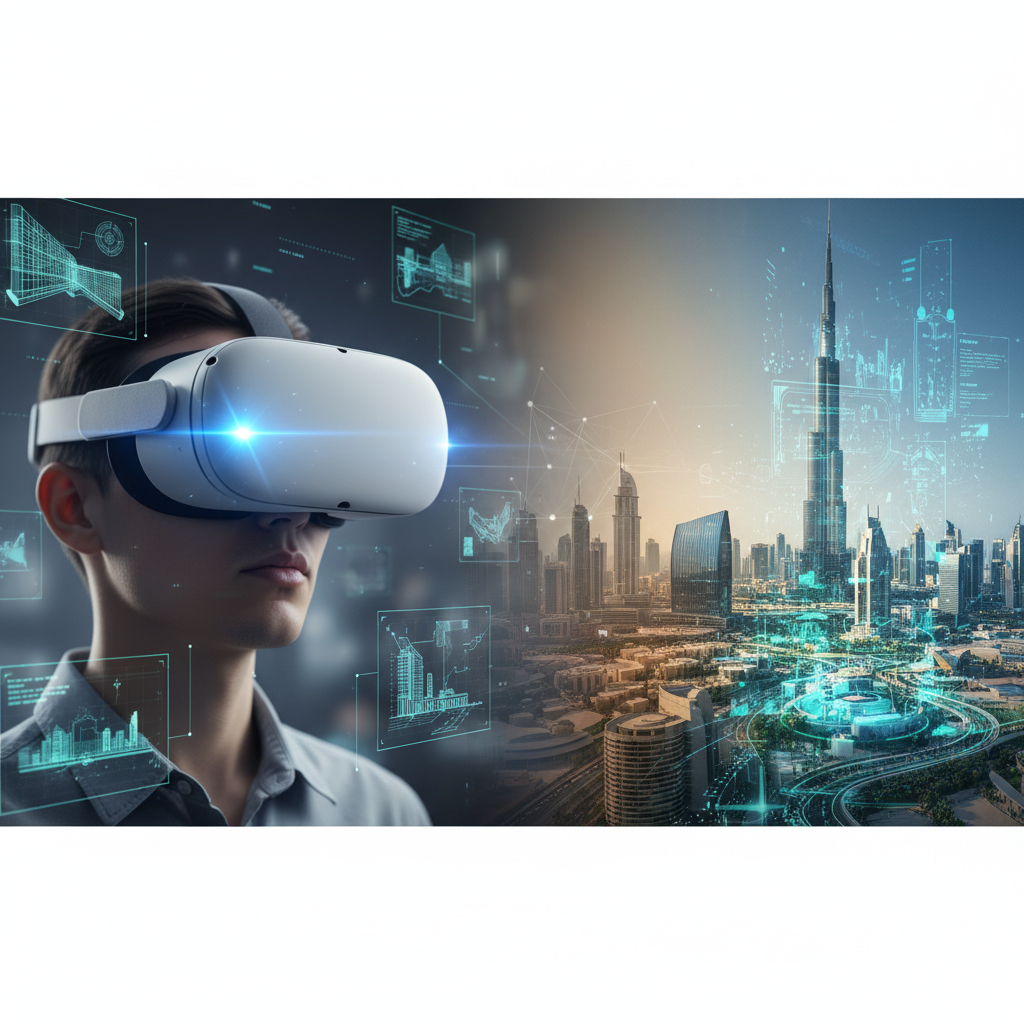

The unveiling of Apple's Vision Pro marked not merely an incremental step in consumer electronics, but a profound declaration of intent for the future of human computer interaction. While much of the global discourse has centered on its immersive displays and intuitive gestures, the true revolution lies deeper, embedded within its sophisticated AI architecture. This is not simply about watching movies in a virtual cinema or projecting spreadsheets onto a living room wall; it is about the intelligent interpretation of our physical world and the seamless augmentation of reality, a paradigm shift with particular resonance in regions like the UAE, where the future is not merely anticipated, but actively constructed.
For decades, the vision of a truly intelligent city, one that anticipates needs and optimizes resources autonomously, has been a cornerstone of the UAE's national strategy. From Masdar City's sustainable blueprint to Dubai's ambitious 2040 Urban Master Plan, the emphasis has always been on leveraging cutting edge technology to enhance livability and efficiency. The arrival of spatial computing, powered by advanced AI, offers a crucial new layer to this grand design. Imagine urban planners, architects, and engineers collaborating on a digital twin of a new district, not on a flat screen, but within a fully immersive, three dimensional environment, where AI agents can simulate traffic flows, energy consumption, and even pedestrian comfort in real time. This is not science fiction; this is the immediate horizon.
Dr. Aisha Al-Hajri, Director of Smart City Innovation at the Dubai Future Foundation, articulated this vision eloquently in a recent panel discussion. “Our goal has always been to create a city that breathes, learns, and evolves with its inhabitants. Apple Vision Pro, with its powerful spatial AI, provides a critical interface for interacting with our digital twins. We are moving beyond dashboards to truly experiential data visualization and manipulation. This is what ambition looks like, a direct pathway to more intuitive urban management and citizen engagement.” Her words underscore a profound truth: Dubai doesn't just adopt the future, it builds it, often by integrating disparate technological threads into a cohesive tapestry.
At the heart of Vision Pro's potential lies its ability to understand and map the physical environment with unprecedented accuracy. Its array of cameras and sensors, coupled with on-device machine learning, creates a real time, persistent understanding of space. This 'spatial intelligence' allows applications to anchor digital content to real world objects and surfaces, maintaining fidelity even as the user moves. Consider a facilities manager inspecting a complex building: instead of consulting blueprints, they could see real time sensor data, maintenance histories, and even projected structural analyses overlaid directly onto the physical infrastructure. This dramatically reduces errors and increases operational efficiency, a critical factor for the UAE's vast infrastructure projects.
The economic implications are substantial. A recent report by PwC projected the global market for augmented and virtual reality to reach over 1.5 trillion USD by 2030, with enterprise applications driving a significant portion of this growth. In the UAE, where digital transformation is a national imperative, investments in spatial computing are expected to surge. According to data from the UAE Ministry of Economy, venture capital funding for AI and immersive technologies within the Emirates grew by 45% in 2025, reaching approximately 1.8 billion AED. This robust investment ecosystem, coupled with a forward thinking regulatory framework, positions the UAE as a prime testing ground for these transformative technologies.
The integration of large language models and multimodal AI, such as those powering OpenAI's GPT series or Google's Gemini, within spatial computing environments will unlock even greater capabilities. Imagine conversing with an AI assistant that not only understands your spoken commands but also interprets your gaze, gestures, and the context of your physical surroundings. This AI could proactively offer information, suggest solutions, or even generate complex 3D models based on a brief verbal description and a scan of the room. This level of intelligent assistance moves beyond simple task execution; it represents a partnership between human and machine in problem solving and creativity.
Mohammed Al-Fahim, CEO of Emirates Digital Solutions, a leading regional systems integrator, highlighted the practical applications. “We are already exploring how Apple Vision Pro can enhance training simulations for critical industries, from aviation to healthcare. The ability to create hyper realistic, interactive environments, where AI coaches guide trainees through complex procedures, offers a level of immersion and effectiveness previously unattainable. Furthermore, for our burgeoning tourism sector, imagine personalized, AI guided tours that adapt in real time to a visitor's interests, overlaying historical context or future projections onto iconic landmarks. The UAE's AI strategy is decades ahead, and this technology fits perfectly into our long term vision.”
Beyond enterprise and government, the luxury sector, a cornerstone of the UAE economy, is also poised for disruption. High end retail could offer virtual try ons that accurately simulate fabric drape and fit, while real estate developers could provide virtual walkthroughs of properties that do not yet exist, allowing potential buyers to customize layouts and finishes in an immersive, interactive experience. The convergence of AI, spatial computing, and high fidelity graphics will redefine luxury experiences, making them more personalized and engaging than ever before.
However, the path forward is not without its challenges. Data privacy, ethical considerations surrounding pervasive spatial tracking, and the sheer computational demands of rendering complex virtual environments remain critical areas of focus. The UAE, with its proactive approach to digital governance and its commitment to responsible AI development, is well positioned to navigate these complexities. Initiatives like the UAE Council for Artificial Intelligence and Blockchain are actively formulating policies to ensure that these powerful technologies serve humanity responsibly.
As we look towards the next decade, the fusion of advanced AI and spatial computing, exemplified by devices like Apple Vision Pro, will fundamentally alter how we perceive and interact with the world. For nations like the UAE, already deeply invested in building smart, sustainable, and future proof cities, this technology is not merely an accessory, but a foundational pillar. It is a tool that empowers us to visualize, plan, and ultimately build the future with unprecedented clarity and intelligence. The digital and physical realms are converging, and the intelligent interpretation of this new hybrid reality will define the next era of innovation. For more insights into the evolving landscape of enterprise AI, one might consult resources like TechCrunch's AI category or MIT Technology Review. The journey has just begun, and its trajectory is nothing short of transformative.