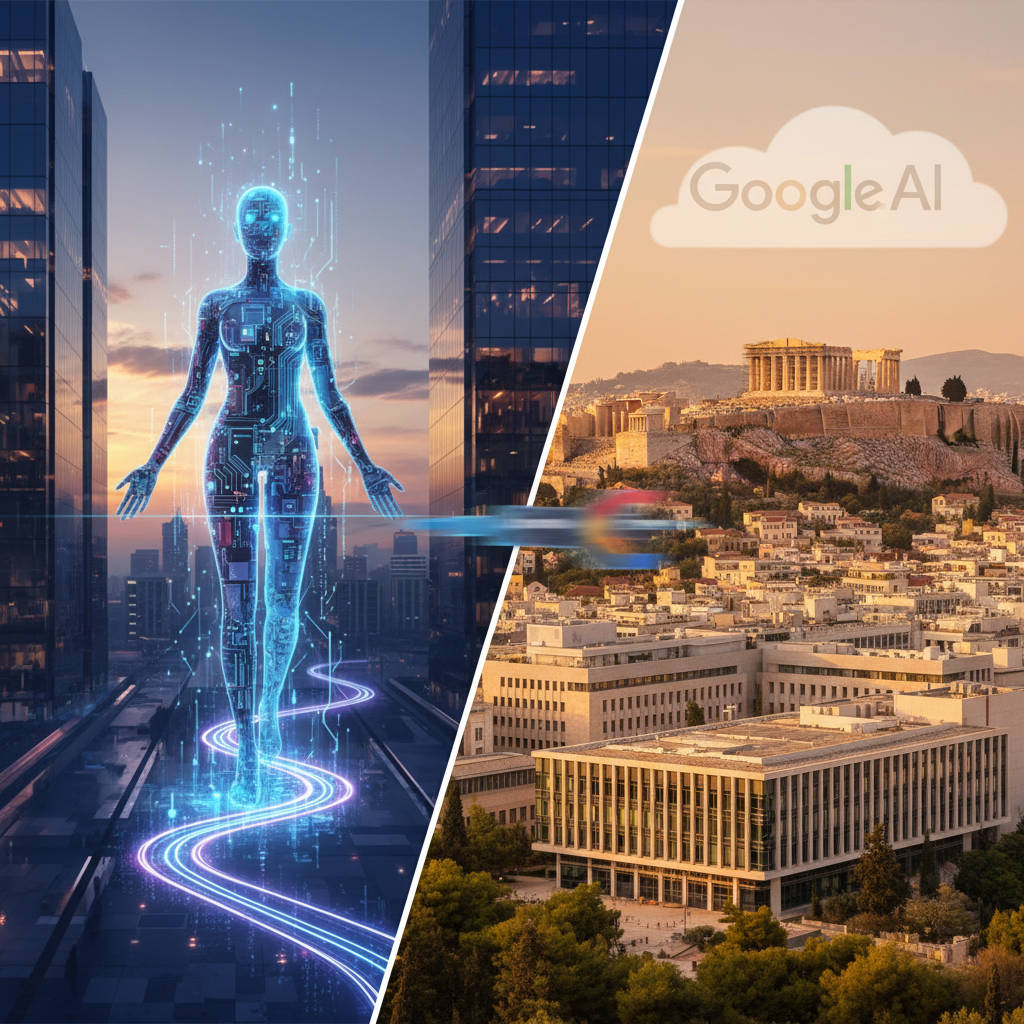
Ah, Character.AI. The name itself evokes a certain theatrical flair, does it not? Like a modern Greek drama playing out on the global stage, only instead of gods and heroes, we have algorithms and venture capitalists. For those of us watching from the sun-drenched shores of the Aegean, this company's recent odyssey from a billion-dollar valuation to a significant Google partnership, punctuated by a talent exodus, is more than just a Silicon Valley footnote. It is a parable, a cautionary tale, and perhaps, a blueprint for how Europe, and specifically Greece, might navigate the turbulent waters of artificial intelligence.
Let us rewind a little. Not decades, but a mere few years. Character.AI burst onto the scene with a promise that felt both profound and playful: AI companions, characters you could converse with, that remembered your interactions, that evolved. It was a vision that resonated deeply with our human desire for connection, for storytelling, for a digital echo of ourselves. The founders, Noam Shazeer and Daniel De Freitas, both veterans of Google's LaMDA team, brought with them an almost mythical pedigree. Their early work, particularly the transformer architecture, laid the very foundation for much of what we now call generative AI. This pedigree, coupled with the intoxicating allure of a truly novel product, quickly propelled Character.AI to a reported valuation exceeding one billion dollars, a unicorn in the digital stable.
But as any student of history knows, rapid ascent often precedes a period of intense trial. The initial euphoria, the viral spread of its platform, the sheer novelty of interacting with a digital persona of Socrates or a fictional character, began to face the inevitable friction of reality. Scaling a product that relies on such intricate, nuanced AI is no small feat. The company grappled with content moderation challenges, the perennial struggle of balancing open-ended creativity with safety, and the sheer computational demands of running such sophisticated models for millions of users. Then came the talent exodus.
Reports began to surface, quietly at first, then with increasing frequency, of key engineers and researchers departing. Some sought greener pastures, drawn by the gravitational pull of larger, more established tech giants like OpenAI, Anthropic, or even their former employer, Google. Others perhaps grew disillusioned with the pace, the strategic direction, or the sheer pressure cooker environment that defines hyper-growth startups. This is not uncommon, of course, in the cutthroat world of AI, where a handful of brilliant minds can command astronomical salaries and influence the trajectory of entire companies. But for Character.AI, it represented a significant challenge, a weakening of the very intellectual core that had propelled its initial success.
And this is where the plot thickens, where the drama finds its resolution, at least for now. The recent announcement of a deeper, more formal partnership with Google is, in my opinion, a masterstroke of strategic pragmatism. It is an acknowledgment that in the current landscape, competing head-on with the likes of Google, Microsoft, and Meta, with their seemingly infinite resources and vast data centers, is a titan's task. By aligning with Google, Character.AI gains access to unparalleled infrastructure, computational power, and perhaps most crucially, a stable platform to continue developing its cutting-edge conversational AI models. It is a symbiotic relationship: Google gets a proven, popular application for its foundational models, and Character.AI gets the oxygen it needs to survive and thrive.
What does this mean for us, here in Europe, and particularly in Greece? It is a potent reminder that while innovation can spring from anywhere, the resources required to scale and sustain that innovation in the AI era are immense. We often speak of the need for European AI champions, for startups that can rival Silicon Valley. But the story of Character.AI suggests that sometimes, the smartest move is not to fight the giants, but to dance with them, to find a niche, to specialize, and to leverage the existing ecosystems. TechCrunch has been tracking these strategic alliances, noting a growing trend of smaller AI firms partnering with larger cloud providers.
Greece, with its rich intellectual heritage and burgeoning tech scene, has a unique opportunity here. We may not have the venture capital rivers of California, nor the sheer scale of talent pools found in London or Berlin. But Greece has something Silicon Valley doesn't: a profound understanding of humanism, of philosophy, of the very essence of human interaction that AI seeks to emulate. Athens was the birthplace of democracy, now it's reimagining AI governance, not just in terms of regulation, but in terms of ethical design and societal integration. We are not merely consumers of technology; we are thinkers about its implications.
Consider the philosophical underpinnings of Character.AI: the creation of digital personalities, the exploration of identity in a synthetic realm. These are questions that echo through the works of Plato and Aristotle. Our approach to AI, therefore, must be fundamentally different. The Mediterranean approach to AI is fundamentally different. It is not just about speed and scale, but about purpose, about ethics, about how these technologies serve humanity, not just markets. "We need to foster an environment where our brightest minds can build groundbreaking AI applications, but also where they are deeply embedded in ethical frameworks," stated Professor Eleni Stavrou, head of the AI Ethics Lab at the National Technical University of Athens. "The Character.AI story shows us that even brilliant ideas need a robust support system, and that system can be found in collaboration, not just competition." Her words resonate deeply with the Greek spirit of community and shared endeavor.
This Google partnership for Character.AI is not an end, but a new beginning. It is a pivot, a strategic recalibration in a rapidly evolving landscape. For the engineers who left, perhaps they found new challenges, new opportunities to push the boundaries of AI. For those who remain, they now have the backing of one of the world's largest tech companies, allowing them to focus on what they do best: building compelling, interactive AI experiences. This kind of strategic alignment, where specialized AI companies leverage the foundational models and infrastructure of hyperscalers, is likely to become the dominant paradigm in the coming years. MIT Technology Review has extensively covered the consolidation of AI power and the increasing reliance of startups on major cloud providers.
What we, in Greece, must learn from this is the importance of adaptability and strategic foresight. We cannot simply try to replicate Silicon Valley. We must cultivate our own strengths: our creative spirit, our philosophical depth, our unique cultural perspective. We can become a hub for ethical AI development, for specialized applications in areas like cultural heritage, tourism, and maritime logistics, where our local knowledge provides an undeniable edge. We can focus on building the 'characters' of AI that truly understand and serve the diverse needs of humanity, rather than just chasing the next valuation milestone. The journey of Character.AI, with its highs and lows, its talent shifts and strategic alliances, offers a rich tapestry of lessons for anyone daring to build in this brave new world of artificial intelligence. The stage is set, the drama continues, and the lessons are there for those willing to listen. The future, as always, is not something that happens to us; it is something we build, brick by digital brick, with wisdom and foresight. As our ancestors taught us, even the most innovative ideas need a strong foundation to withstand the test of time, and sometimes, that foundation is best built in collaboration, not isolation.