
Ciao, amici! Mattèo Ferrarì here, and today we are looking up, far beyond the familiar rooftops of Rome, past the rolling hills of Tuscany, and into the vast, silent expanse of space. For many, space exploration feels like something out of a science fiction film, a grand endeavor led by distant governments and billionaire visionaries. But what if I told you that the very algorithms shaping our lives here on Earth, the ones behind your smartphone's suggestions or the logistics of your morning espresso delivery, are now quietly, profoundly, revolutionizing humanity's quest for the stars? This is not just about rockets and astronauts anymore, it is about the elegant dance between human ambition and artificial intelligence, a dance where Italy, as always, is finding its unique rhythm.
The Silent Revolution Above Our Heads
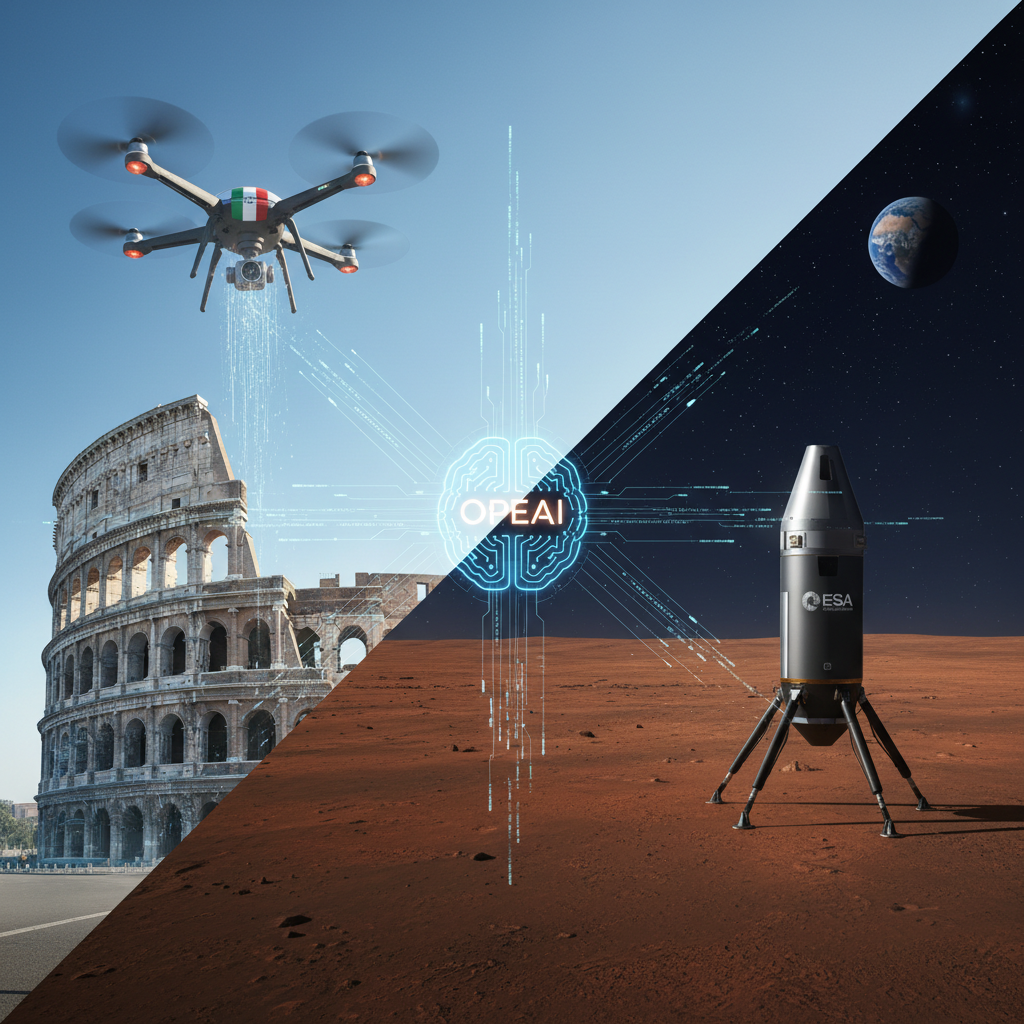
We hear a lot about AI these days, do not we? It is in our cars, our homes, our offices. But the quietest, perhaps most impactful, application is happening hundreds of kilometers above us, in the cold vacuum of space. AI is becoming the invisible co-pilot for Mars missions, the vigilant guardian of our planet's orbiting infrastructure, and the tireless listener in the cosmic search for extraterrestrial intelligence. The European Space Agency, with its strong Italian contingent, is at the forefront of this. Imagine a rover on Mars, thousands of kilometers away, making real-time decisions about its path, identifying geological features, and even prioritizing scientific targets, all thanks to onboard AI. This is not a distant dream, it is happening now. Similarly, the ever-growing constellation of satellites that power our GPS, weather forecasts, and internet are being managed, optimized, and protected by sophisticated AI systems. Without this intelligent orchestration, our digital world would simply grind to a halt. Yet, for most people, these cosmic developments remain an abstract concept, overshadowed by the more immediate, terrestrial concerns of daily life.
Why Most People Are Ignoring It
It is easy to let our eyes glaze over when we hear terms like 'satellite constellation management' or 'deep space autonomous navigation'. These concepts feel distant, complex, and perhaps a little too technical for the average person enjoying their evening aperitivo. We are more concerned with the AI that helps us choose a movie on Netflix or the one that writes our emails. The attention economy is fierce, and space AI, despite its profound implications, struggles to compete with the immediate gratification and tangible controversies of consumer-facing AI. There is a perception that space is for scientists and governments, not for the person on the street. Plus, the sheer scale of space exploration means that breakthroughs often take years, even decades, to materialize, making it less 'click-worthy' than the latest generative AI model from OpenAI or Google's Gemini. We are a species that loves instant results, and the universe, bless its heart, operates on a much grander, slower timescale.
How It Affects YOU
Now, let us bring this back down to Earth, to your life, my friend. Why should you care if a rover on Mars uses AI or if satellites are autonomously managed? Because the technologies developed for space have a remarkable habit of finding their way into our daily existence. Think about GPS, weather forecasting, even advanced medical imaging, all born from space programs. The AI algorithms learning to navigate treacherous Martian terrain could one day guide autonomous vehicles through our crowded city streets, making them safer and more efficient. The AI systems that process vast amounts of satellite data to monitor climate change, track deforestation, or predict natural disasters are directly impacting our planet's health and our ability to respond to crises. These are not just abstract scientific pursuits; they are practical tools that will enhance public safety, improve resource management, and provide critical data for environmental protection. Your next weather app update, your car's navigation system, or even the precision agriculture that grows your food could very well be beneficiaries of this cosmic AI push. It is a fascinating intersection of technology and everyday life.
The Bigger Picture: A New Renaissance for Humanity
This is not just about better gadgets or more efficient systems. The integration of AI into space exploration represents a fundamental shift in humanity's relationship with the cosmos. It is about extending our senses, our intellect, and our reach far beyond what human biology alone could ever achieve. Economically, this is creating entirely new industries, from specialized AI software for space applications to advanced sensor manufacturing and data analysis firms. Countries like Italy, with its rich heritage in aerospace engineering and a burgeoning AI sector, are positioning themselves to be key players. Socially, the search for extraterrestrial intelligence, now supercharged by AI that can sift through astronomical data at unprecedented speeds, challenges our very understanding of our place in the universe. If we ever do find definitive proof of life beyond Earth, it would be the most profound discovery in human history, and AI is making that possibility more tangible than ever before. This is a new renaissance, a rebirth of exploration, driven by silicon and algorithms rather than sails and sextants.
What Experts Are Saying
I spoke with several experts who are deeply immersed in this cosmic AI revolution. "The sheer volume of data we are collecting from space, from Mars orbiters to Earth observation satellites, is beyond human capacity to analyze," explained Dr. Elena Rossi, Head of AI Research at the Italian Space Agency (ASI). "AI is not just an assistant, it is a necessity. It allows us to extract insights, identify anomalies, and make discoveries that would otherwise remain hidden in petabytes of information." She added, "We are seeing a significant push towards autonomous systems, reducing the need for constant human intervention and allowing missions to react much faster to unexpected events. This is crucial for deep space exploration where communication delays are immense."
Professor Marco Bianchi, a specialist in machine learning for astrophysics at the University of Bologna, shared his perspective on the search for alien life. "For decades, Seti projects relied on human pattern recognition, which is inherently limited. Now, with advanced neural networks, we can detect subtle, complex signals that might indicate intelligent origins, signals that a human ear or eye would simply miss," he told me. "It is like upgrading from a simple magnifying glass to a powerful electron microscope in our search for cosmic neighbors." He emphasized that the progress in AI research is directly fueling these capabilities.
And from the private sector, Isabella Conti, CEO of 'Stellar AI Solutions', a Milan-based startup developing AI for satellite operations, highlighted the practical implications. "In a workshop in Milan, we are building the brains for tomorrow's satellite fleets. Our AI can predict potential collisions, optimize orbital paths to save fuel, and even diagnose hardware failures before they become critical," Conti said. "This translates directly to more reliable services for telecommunications, navigation, and environmental monitoring here on Earth. Italy does AI differently, with style, and our focus on robust, elegant solutions is gaining international attention."
What You Can Do About It
So, what is your role in this grand cosmic drama? First, stay informed. Read articles like this one, follow reputable space agencies and AI research institutions. Understand that the investments made in space AI today are investments in our collective future on Earth. Second, advocate for responsible development. As with all powerful technologies, ethical considerations are paramount. We need to ensure that the AI governing our space assets is transparent, secure, and aligned with human values. Support initiatives that promote international cooperation in space, as the challenges and opportunities of the cosmos are too vast for any single nation to tackle alone. Finally, encourage young people, especially here in Italy, to pursue Stem fields. The next generation of engineers, data scientists, and astrophysicists will be the ones pushing these boundaries even further. Perhaps one day, a bright young mind from Palermo or Venice will design the AI that discovers life on Europa or helps us establish a permanent lunar base.
The Bottom Line: Our Future Is Intertwined with the Stars
In five years, the impact of AI in space exploration will be undeniable and deeply integrated into our lives, even if we do not always see it directly. We will witness more sophisticated Mars missions, perhaps even the first human steps on the red planet, guided and supported by advanced AI. Our planet's climate will be monitored with unprecedented accuracy, thanks to AI-powered satellite networks. The search for extraterrestrial intelligence will have made significant strides, potentially bringing us closer to answering humanity's oldest question: Are we alone? La dolce vita meets machine learning, creating a future where our terrestrial existence is inextricably linked to the cosmic ballet above. The stars are calling, and AI is helping us answer. This is not just science fiction anymore; it is our unfolding reality. And for Italy, with its blend of ancient wisdom and modern innovation, it is a chance to leave another indelible mark on human history, reaching not just for the sky, but for the universe itself.