
G'day, fellow stargazers and tech enthusiasts. There's a hum in the air, a palpable excitement that feels like the dawn of a new era, and it's emanating not just from the usual suspects in Silicon Valley, but from right here, under our magnificent Southern Cross. We're talking about AI in space exploration, a topic that truly makes my Irish roots tingle with wonder and my Australian home swell with pride. We're not just dreaming of the stars anymore, we're coding our way to them, and the impact is going to be absolutely monumental.
For decades, space exploration has been the ultimate frontier, a testament to human ingenuity and our insatiable curiosity. But let's be honest, it's also been incredibly complex, dangerous, and resource-intensive. Enter artificial intelligence, the game-changer that's rewriting the rulebook for everything from Mars missions to the search for extraterrestrial intelligence. And guess what, Australia is right at the forefront, proving that you don't need to be a global superpower to make a cosmic impact.
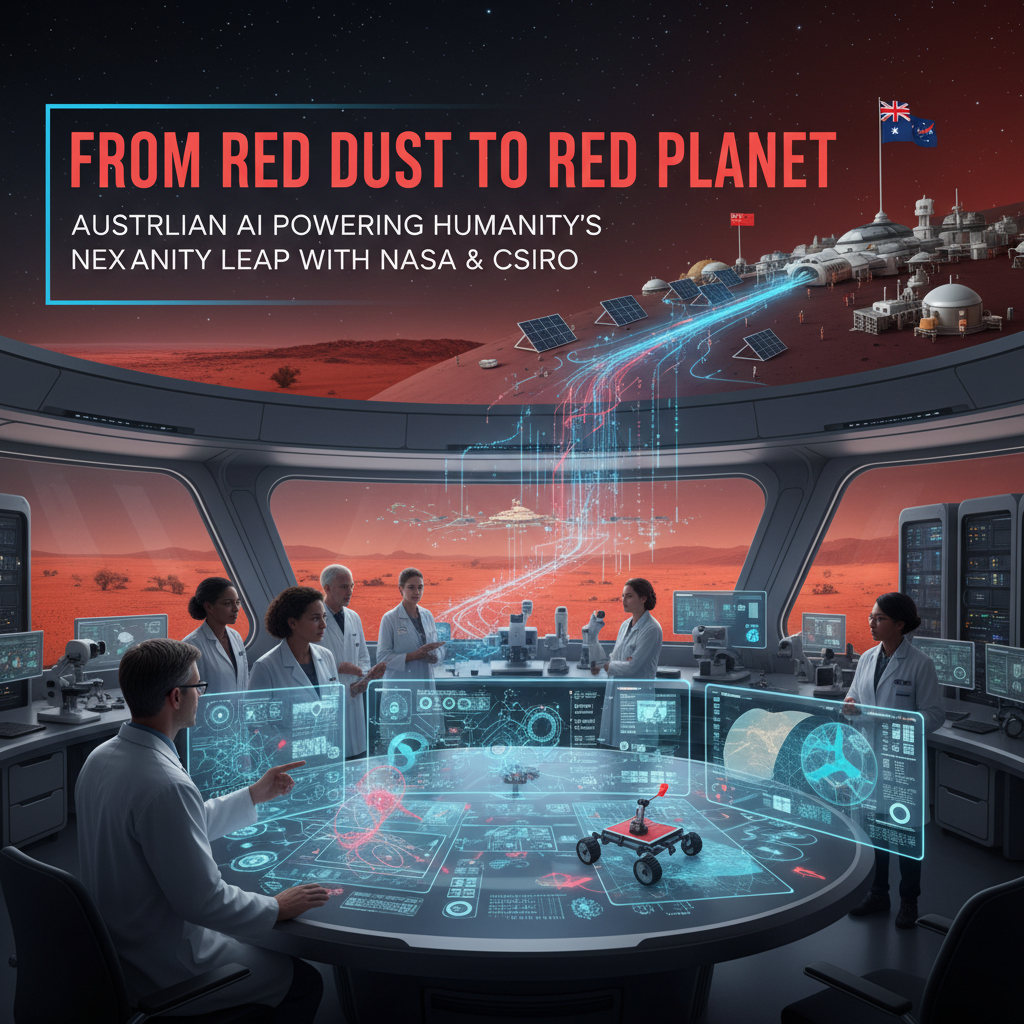
Think about it: sending a human to Mars is a logistical nightmare. The time delays for communication alone can be up to 20 minutes one way, making real-time decision-making impossible. This is where AI steps in, becoming the ultimate co-pilot, the autonomous brain that can react instantaneously, analyze vast amounts of data, and even make critical repairs without human intervention. NASA, a name synonymous with space itself, is heavily investing in this, and our local talent is right there with them.
One of the most thrilling developments is the application of AI to autonomous rovers and landers. Imagine a rover on Mars, not just following pre-programmed commands, but intelligently navigating treacherous terrain, identifying scientifically interesting rock formations, and even prioritizing research tasks based on real-time data analysis. This isn't science fiction anymore, it's happening. Companies like Perth-based Fleet Space Technologies, while primarily focused on Earth observation and IoT, are developing AI-powered satellite constellations that could easily adapt their edge computing capabilities for lunar or Martian surface operations. Their small, low-cost satellites are already demonstrating the kind of resilient, distributed intelligence that will be crucial for deep space missions.
Dr. Megan Clark AC, former head of the Australian Space Agency, has often spoken about Australia's unique position in space. She once noted, "Australia's vast, remote landscapes and expertise in remote operations make us a natural fit for developing technologies that will thrive in extraterrestrial environments." This insight is golden, folks. Our experience managing mining operations in the outback with minimal human presence is directly transferable to managing a Martian base or an asteroid mining operation. My Irish roots taught me to question, my Australian home taught me to build, and right now, we're building the future of space.
Then there's the monumental task of satellite AI. Our skies are getting crowded, and not just with birds. Thousands of satellites are orbiting Earth, collecting an unprecedented amount of data. This deluge of information, from climate monitoring to telecommunications, is simply too much for humans to process efficiently. AI algorithms are becoming indispensable for sifting through this data, identifying patterns, predicting events, and even optimizing satellite performance and collision avoidance. The Csiro, Australia's national science agency, is a powerhouse in this area, with researchers developing advanced machine learning models for Earth observation data analysis. Their work helps us understand everything from bushfire patterns to agricultural yields, and these same techniques are being scaled up for space-based applications.
But the true frontier, the one that ignites the imagination like nothing else, is the search for extraterrestrial intelligence, or Seti. For decades, we've been listening, patiently sifting through radio signals from the cosmos. It's like looking for a needle in a haystack the size of the universe. Traditional methods are slow and often miss subtle anomalies. Here, AI offers a quantum leap forward. Machine learning algorithms can be trained to identify patterns that human eyes or conventional signal processing might overlook, distinguishing potential alien signals from cosmic noise or terrestrial interference. Projects like Breakthrough Listen, which uses some of the world's most powerful telescopes, are increasingly incorporating AI to analyze their vast datasets. Imagine the day an AI flags a signal, a true message from beyond. What a moment that would be!
Professor Alan Duffy, an astrophysicist from Swinburne University of Technology, a beacon of research here in Melbourne, recently highlighted this shift. He stated, "AI isn't just making our telescopes smarter, it's fundamentally changing how we approach the question of whether we are alone. It allows us to explore a much wider range of possibilities and detect signals that might be hidden in plain sight." This isn't just about faster processing, it's about expanding our very perception of what an alien signal might look like. It's about letting AI help us think outside the box, or in this case, outside the planet.
And let's not forget the health and safety of our astronauts. Long-duration space missions, like a journey to Mars, expose humans to extreme conditions, radiation, and isolation. AI-powered health monitoring systems can continuously track an astronaut's vital signs, predict potential medical issues before they become critical, and even recommend personalized interventions. Imagine an AI doctor on board, a silent guardian ensuring the crew's well-being light-years away from Earth. This is not just about convenience, it's about survival. Companies globally, including those working on remote healthcare solutions here in Australia, are developing AI diagnostics that could be adapted for space environments.
This is more than just a technological race, it's a global collaboration, a shared human endeavor. Australia's contribution, often overlooked by those with a Silicon Valley tunnel vision, is becoming increasingly vital. There's something happening in the Southern Hemisphere that Silicon Valley hasn't noticed yet, a quiet revolution in space tech that leverages our unique geography, our innovative spirit, and our deep expertise in remote operations. We're not just building components, we're building entire intelligent systems that will enable humanity to truly become a multi-planetary species.
The sheer volume of data generated by space missions, from rover telemetry to astronomical observations, demands sophisticated AI for analysis and insight. NVIDIA's powerful GPUs, for instance, are becoming the backbone for processing these massive datasets, enabling researchers to run complex simulations and train advanced AI models. This hardware, combined with cutting-edge Australian software, is creating a formidable force in space exploration. The future is bright, folks, and it's filled with AI-powered spacecraft, autonomous Martian colonies, and perhaps, the answer to humanity's oldest question: are we alone? The journey is just beginning, and what a ride it's going to be. Keep your eyes on the stars, and on Australia, because we're just getting started. For more on how AI is transforming various sectors, you might want to check out DataGlobal Hub's AI news section. The universe is calling, and AI is helping us pick up the phone. What an exhilarating time to be alive, eh?