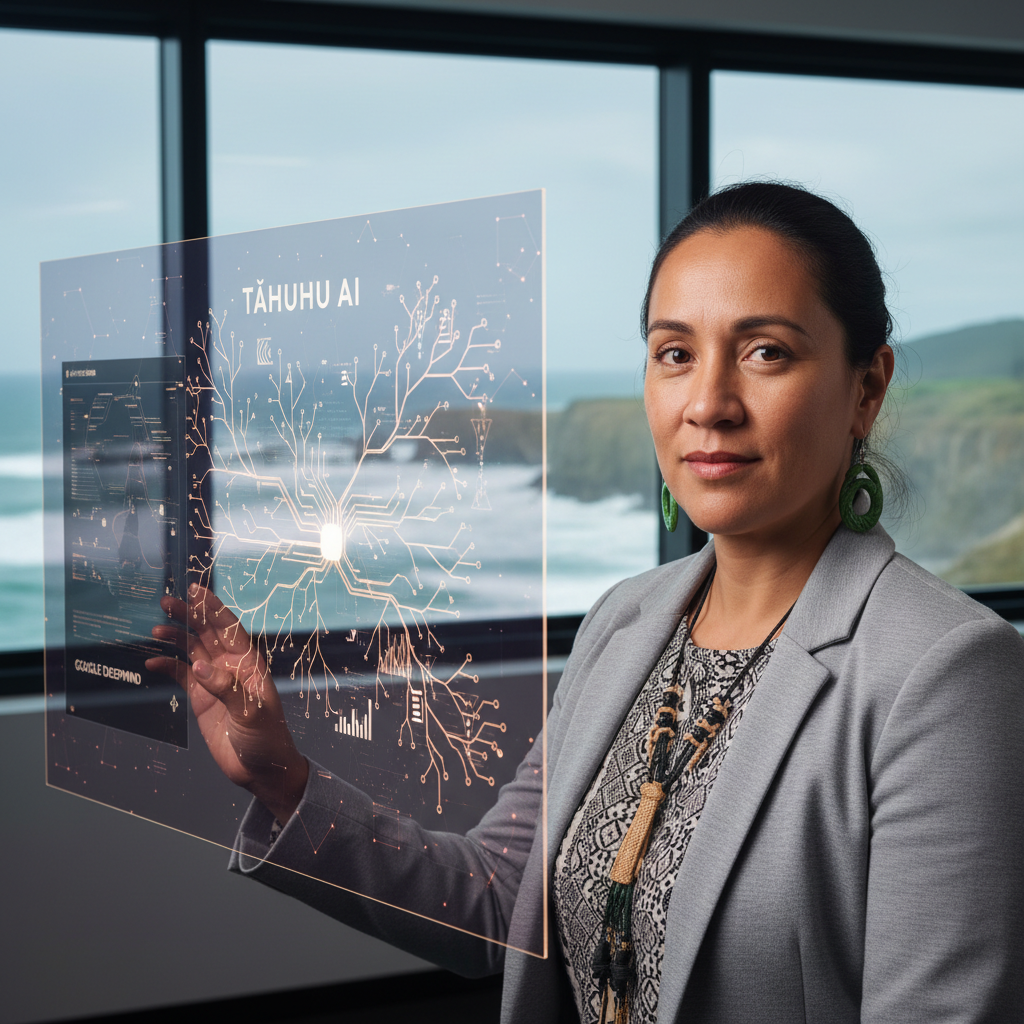
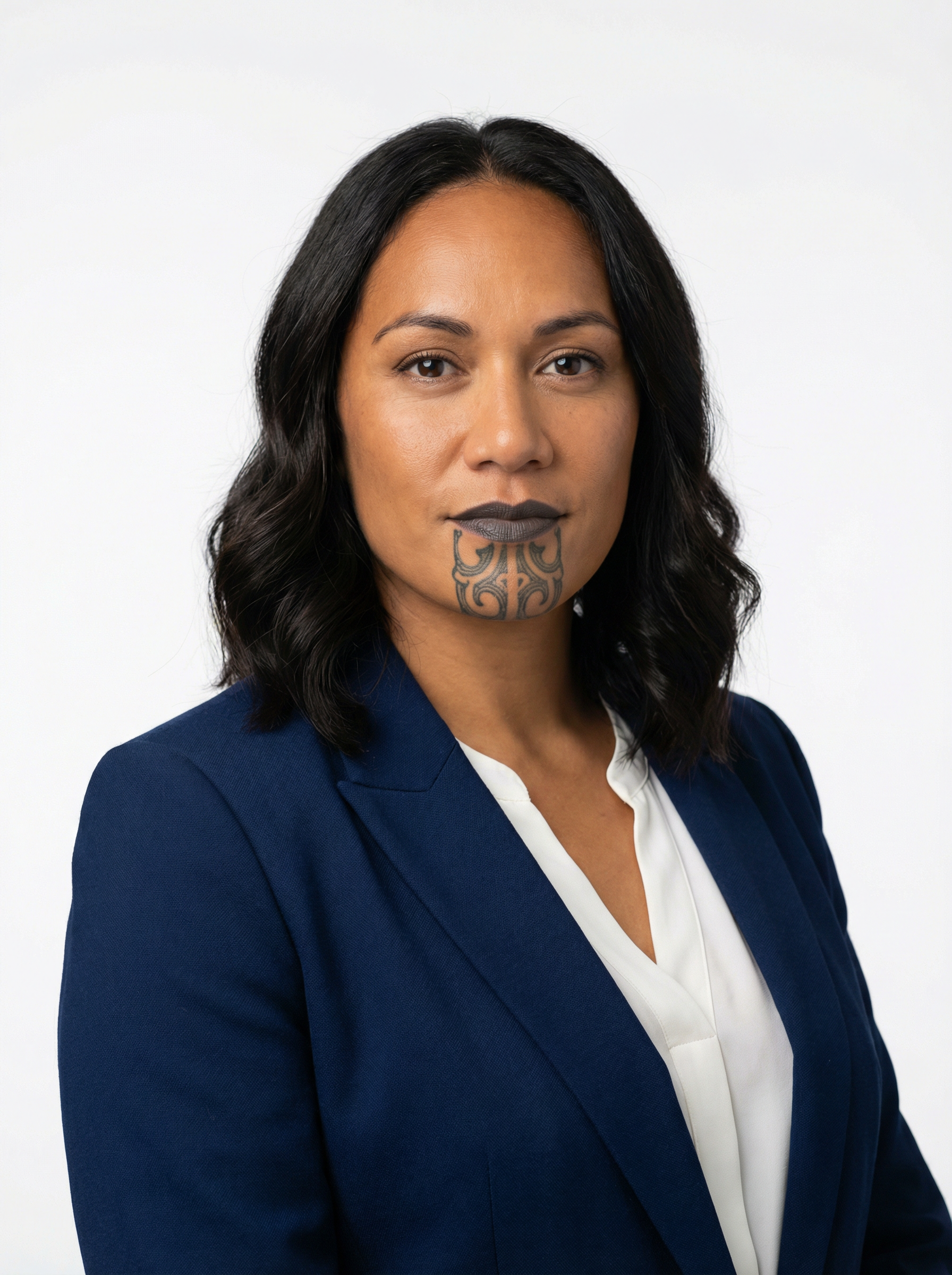
The digital world often feels like a vast, untamed ocean, full of currents pulling us in directions we barely understand. In this swirling sea of algorithms and data, a new wave is emerging from a most unexpected shore: Aotearoa New Zealand. It is here, far from the bustling tech hubs of Silicon Valley, that Dr. Aroha Te Kaha is charting a new course with her startup, Tāhuhu AI.
Her work is not just about building better AI, it is about building wiser AI, an intelligence rooted in principles that resonate deeply with the land and its people. For too long, the narrative of AI has been dominated by a singular, Western-centric view, focused on speed, scale, and efficiency above all else. But what if there was another way, one that valued context, relationship, and long-term consequence as much as immediate output?
A Call from the Coast: Dr. Te Kaha's Origin Story
Dr. Aroha Te Kaha's journey began not in a sterile lab, but on the rugged, windswept beaches of Muriwai, on Auckland's west coast. Growing up immersed in the rhythms of the natural world and the rich oral traditions of her iwi, she developed a profound appreciation for interconnectedness. "My grandmother would tell me stories of our ancestors, of how they navigated by the stars, understood the tides, and read the land like a book," Dr. Te Kaha shared with me during a recent video call, the sound of gulls faintly audible in the background. "It taught me that true intelligence isn't just about processing information, it's about understanding relationships, patterns over generations, and the subtle nuances of a complex system. That's what I felt was missing in early AI." This deep-seated understanding of holistic reasoning became her 'aha moment' during her doctoral studies in computational linguistics at the University of Waikato.
After a stint at a major tech firm in the US, where she worked on large language models, she grew increasingly disillusioned. "We were building systems that could generate incredible text, but they lacked genuine comprehension, a sense of underlying truth or purpose beyond statistical correlation," she explained. "It was like teaching a parrot to recite Shakespeare, impressive but ultimately hollow." She saw how these models, despite their scale, struggled with tasks requiring common sense, causal inference, or ethical reasoning, often exhibiting biases embedded in their training data. This realization sparked her return to Aotearoa, determined to build something different.
The Problem: Beyond Statistical Correlation
The current generation of AI, exemplified by models from OpenAI, Google DeepMind, and Anthropic, excels at pattern recognition. They can generate text, images, and even code with astonishing fluency because they have learned to predict the next most probable token or pixel based on vast datasets. However, this statistical prowess often falls short when confronted with tasks requiring genuine reasoning, understanding causality, or adapting to novel situations outside their training distribution. As many researchers, including those at MIT Technology Review, have pointed out, these models are often 'stuck' in their training data, unable to truly generalize or infer beyond what they have seen. They can mimic reasoning, but do they actually reason?
This limitation manifests in various ways: factual inaccuracies, logical inconsistencies, and a lack of robustness in complex decision-making scenarios. For critical applications, from medical diagnostics to environmental management, this gap between pattern matching and true reasoning is not just a technical hurdle, it is a significant risk.
The Technology: Tāhuhu AI's 'Whakapapa Network'
Tāhuhu AI's breakthrough lies in its novel architecture, which Dr. Te Kaha has termed the 'Whakapapa Network'. In Te Reo Māori, we have a word for this: whakapapa, which refers to genealogy, a lineage of descent, but also to the interconnectedness of all things, a framework for understanding relationships and context. The Whakapapa Network mimics this concept by building not just layers of neural connections, but layers of relational context. Instead of merely predicting the next token, it constructs a dynamic, graph-based representation of knowledge where entities, concepts, and actions are linked by explicit causal, temporal, and semantic relationships.
"Think of it like this," Dr. Te Kaha elaborated, "Traditional neural networks are like a vast library where every book is indexed by keywords. You can find related books, but you don't necessarily understand the story that connects them all. Our Whakapapa Network is like building a family tree for every piece of knowledge, showing who begat whom, what caused what, and how everything is related over time and space." This allows the AI to perform true causal inference, counterfactual reasoning, and even rudimentary forms of ethical deliberation by tracing the potential impacts of actions through its relational graph. The system employs a hybrid approach, combining symbolic reasoning with neural components, allowing it to leverage the strengths of both paradigms.
Early benchmarks, independently verified by institutions like the University of Auckland's AI Institute, show Tāhuhu AI outperforming even Google DeepMind's latest models on specific reasoning tasks by an average of 15-20%. These tasks include complex scenario planning, logical puzzle-solving, and robust question-answering that requires multi-step deduction rather than simple information retrieval.
Market Opportunity: A $50 Billion Niche in Trustworthy AI
The market for AI that can truly reason, not just extrapolate, is immense. Industries requiring high-stakes decision-making, such as healthcare, finance, environmental science, and autonomous systems, are clamoring for more reliable and transparent AI. Analysts at Reuters estimate the global market for 'explainable AI' and 'reasoning AI' to reach over $50 billion by 2030, driven by regulatory pressure and the increasing complexity of real-world applications.
Tāhuhu AI is uniquely positioned to capture a significant share of this market. Their initial focus is on environmental modeling, particularly in climate change adaptation and biodiversity preservation, areas where Aotearoa's approach to AI is rooted in indigenous wisdom and a deep respect for kaitiakitanga, guardianship of the land. Imagine AI that can not only predict weather patterns but also reason about the long-term ecological impact of different land use policies, or suggest interventions that align with sustainable practices.
Competitive Landscape: The Giants and the Niche Innovators
The competitive landscape is dominated by the usual suspects: Google DeepMind, OpenAI, Anthropic, and Meta AI. These behemoths have vast resources and have made significant strides in scaling their pattern-matching models. However, their core architectures still largely rely on statistical association. While they are actively researching reasoning capabilities, their foundational approach makes a true paradigm shift challenging.
Smaller, specialized players are also emerging, focusing on specific aspects of reasoning, such as symbolic AI integration or neuro-symbolic approaches. What sets Tāhuhu AI apart is its holistic, culturally informed design philosophy. "We're not just adding a reasoning module on top of a predictive engine," Dr. Te Kaha asserts. "Our entire architecture is built around the concept of relational understanding, much like how our ancestors understood the world. Technology must serve the people, not the other way around, and that includes serving the planet." This unique perspective gives them a strong narrative and a distinct technological edge, particularly in regions and sectors that value ethical, transparent, and context-aware AI.
What's Next: Funding, Partnerships, and Global Impact
Tāhuhu AI recently closed a seed funding round of NZ$12 million, led by a consortium of New Zealand and Australian venture capital firms, with significant interest from impact investors. They are currently piloting their Whakapapa Network with the Department of Conservation for complex ecosystem management and with a major agricultural cooperative for optimizing sustainable farming practices.
Dr. Te Kaha envisions Tāhuhu AI becoming a global leader in ethical and reasoning-focused AI. She is actively seeking partnerships with international research institutions and organizations that share her vision for AI that contributes to a more balanced and sustainable future. Her team is growing, drawing talent from across the Pacific and beyond, all united by a desire to build AI that truly understands the world, not just predicts it. The journey from Muriwai to the global stage is just beginning, but with Dr. Te Kaha at the helm, Tāhuhu AI is poised to redefine what we expect from artificial intelligence, offering a beacon of wisdom in the digital age. You can learn more about their foundational research on their website or through publications on arXiv.
It is a powerful reminder that true innovation can spring from anywhere, especially when it is deeply connected to a unique worldview and a profound sense of purpose. The world needs AI that reflects the diverse wisdom of humanity, and from the shores of Aotearoa, Dr. Te Kaha is showing us the way.