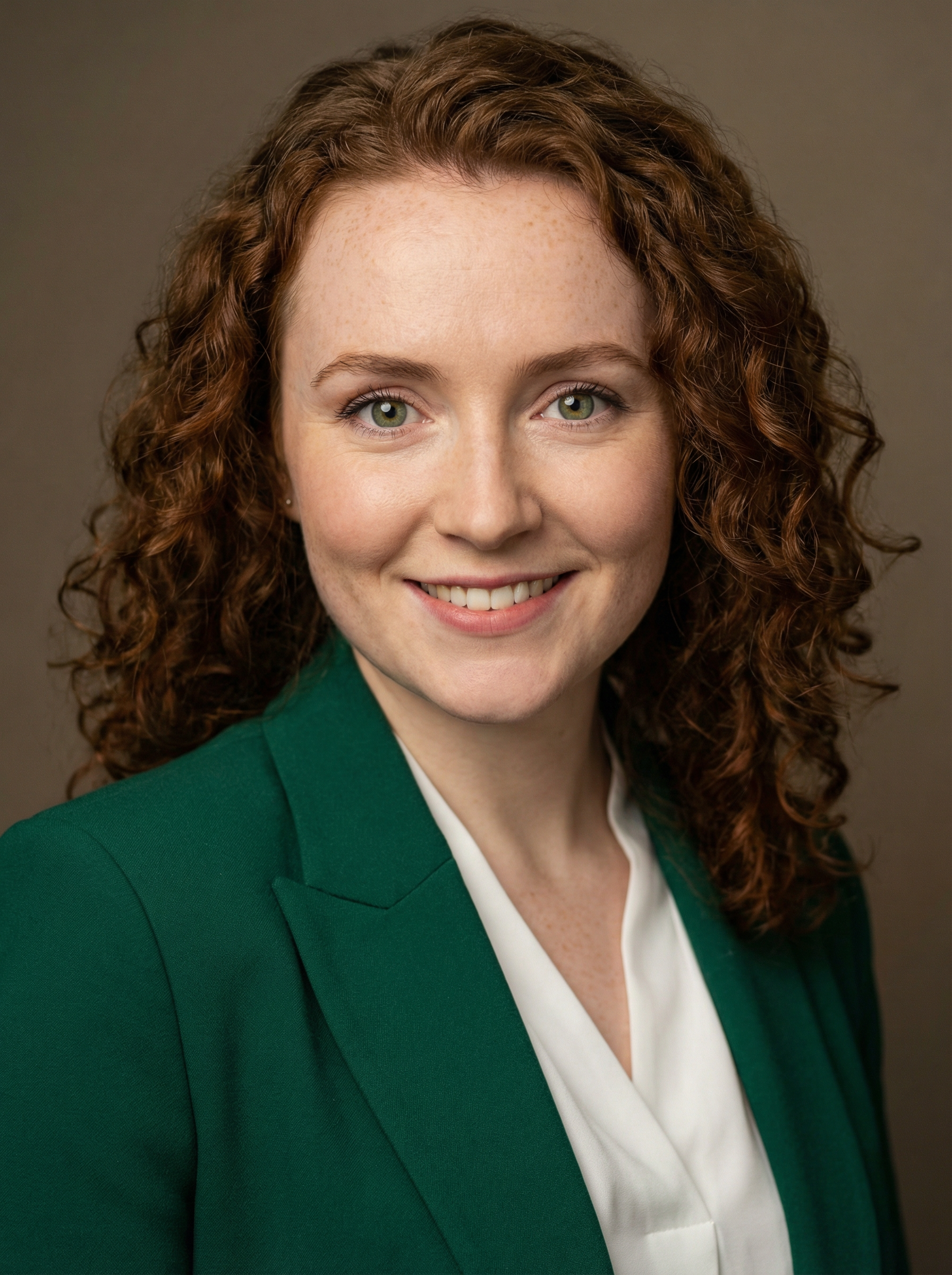
There’s a certain kind of person who sees a problem and thinks, 'Right, I’ll fix that myself.' Then there’s Aisling O'Connell, who saw the sprawling, inefficient chaos of global air travel and thought, 'I’ll build an AI to untangle that mess, and I’ll do it from Dublin.' It’s that blend of audacious ambition and grounded pragmatism, a distinctly Irish trait, that defines the 32-year-old CEO of Aerion AI.
I met Aisling in her company’s sleek, glass-fronted office overlooking the Liffey, a stone’s throw from the Google and Facebook behemoths that dominate Dublin’s Silicon Docks. She wasn’t in a power suit, mind you, but a sensible jumper and jeans, sipping tea from a chipped mug. No airs and graces here, just a laser focus that could probably optimize my morning commute if I gave her enough data. She was explaining how Aerion’s predictive maintenance algorithms had just saved a major European airline millions by flagging a potential engine fault weeks before it became critical. “It’s not magic, Aoifè,” she said, her Cork accent still thick despite years abroad, “it’s just a bloody good model and a mountain of data. The magic is convincing people to trust it.”
Aisling’s journey didn’t begin in the hallowed halls of Stanford or MIT, but on a dairy farm in County Cork. “My father would say, ‘If you can fix a tractor with a bit of baling twine and a prayer, you can do anything,’” she recounted, a wry smile playing on her lips. This early exposure to complex machinery and improvisation clearly stuck. She excelled in maths and physics, eventually earning a scholarship to the University College Dublin (UCD) where she studied aerospace engineering. “I loved the theory, the elegance of flight, but I also saw the clunky reality of it all. So much wasted fuel, so many delays, all because we were still operating on systems designed for a different century.”
After graduating, Aisling landed a coveted role at Airbus, working on flight control systems. It was a good job, stable, prestigious. But the slow pace of innovation, the bureaucratic layers, began to chafe. “I felt like I was tinkering with a grand old engine, when what it really needed was a complete digital overhaul,” she admitted. The 'aha!' moment, as these stories often go, wasn’t a sudden flash of genius but a slow burn of frustration. During a particularly brutal winter, she was stranded for days in Frankfurt due to cascading delays, watching ground staff manually re-route planes with paper charts and phone calls. “It was 2018, and it felt like 1988,” she said, shaking her head. “That’s when I thought, ‘There has to be a better way. AI could eat this problem for breakfast.’”
She started sketching out ideas in her spare time, fueled by late-night coffee and a growing conviction. Aisling knew she couldn’t do it alone. The technical challenge of building an AI capable of real-time flight optimization, predictive maintenance, and air traffic control was immense. She needed a co-founder with deep expertise in machine learning. That’s where Dr. Liam Gallagher, a brilliant but notoriously reclusive data scientist she’d met at a UCD alumni event, came in. Liam, then working for a secretive defense contractor, was initially skeptical. “He thought I was mad, honestly,” Aisling laughed. “A farmer’s daughter wanting to revolutionize aviation with algorithms. But I showed him my early models, the sheer scale of the data I’d managed to scrape, and the potential. He saw it then. He saw the inefficiency, the billions being lost.”
Their first attempt, a rudimentary flight path optimizer, was, in Aisling’s words, “a glorious failure.” It was too slow, too rigid, and didn’t account for the myriad real-world variables like sudden weather changes or unexpected runway closures. “We tried to force the data into our model, instead of letting the data teach the model,” Liam later told me over a video call from Aerion’s engineering hub in Cork. “It was a classic rookie mistake, but a necessary one.” They pivoted, focusing first on a more contained problem: predictive maintenance for aircraft engines. This allowed them to build a robust data pipeline and refine their machine learning models with a clear, measurable outcome.
They poured their life savings into it, working out of a cramped co-working space in Dublin. The early days were brutal, marked by 18-hour days, ramen noodles, and constant rejection from venture capitalists who couldn’t grasp the complexity or the scale of the problem. “One investor told us, ‘Aviation is too regulated, too slow. Stick to consumer apps,’” Aisling recalled, rolling her eyes. “Only in Ireland would you find this kind of skepticism mixed with a quiet belief that anything is possible if you just keep at it.”
Their breakthrough came when they secured a small seed round of €500,000 from Enterprise Ireland, the government agency supporting Irish businesses, and a crucial angel investment from a former Ryanair executive who understood the industry’s pain points. This allowed them to hire a small team of engineers and data scientists. Their predictive maintenance platform, which leveraged sensor data from aircraft components to forecast failures with 95% accuracy, quickly gained traction. “We showed airlines tangible savings, reduced downtime, and improved safety,” Aisling explained. “That’s a language everyone understands.”
In late 2023, after a grueling Y Combinator batch, Aerion AI closed a $30 million Series A round at a $300 million valuation, led by Founders Fund and with participation from Altos Ventures. “It was a whirlwind,” Aisling admitted. “Suddenly, everyone wanted a piece of the pie. The same VCs who’d laughed us out of the room were now emailing us daily.” The funding allowed them to expand rapidly, developing their flight optimization and air traffic control modules. Their flight optimization tool, now in beta with three major airlines, promises to reduce fuel consumption by up to 7% per flight, translating to billions in savings and a significant reduction in carbon emissions. “We’re not just saving money, we’re saving the planet, one flight at a time,” she said, a rare flicker of pride in her eyes.
Aerion AI’s revenue has soared, hitting an impressive $100 million Annual Recurring Revenue (ARR) last quarter. They’ve grown to over 200 employees, with offices in Dublin, Cork, and a small outpost in Seattle. “Building the company culture has been as challenging as building the tech,” Aisling mused. “We hire for grit, for curiosity, and for a bit of craic. You need people who aren’t afraid to fail, but who also know how to celebrate the small victories.”
What drives Aisling now, beyond the balance sheets and the valuations, is the profound impact Aerion AI can have. “Every day, thousands of planes are in the air, burning fuel, creating emissions, and often dealing with unnecessary delays,” she said, gesturing towards a large screen displaying real-time global air traffic data. “We have the technology, thanks to advances in large language models and NVIDIA’s powerful GPUs, to make that system smarter, safer, and more sustainable.” She believes that the next frontier isn’t just about optimizing existing systems, but about fundamentally reimagining air travel. “Imagine a world where air traffic controllers are augmented by AI, predicting congestion before it happens, rerouting planes in real-time, making every journey smoother. That’s the future we’re building.”
While Aerion AI is making waves globally, Aisling remains firmly rooted in Ireland. “Dublin’s Silicon Docks have a story to tell, and it’s not just about the big American companies,” she stated. “It’s about Irish ingenuity, about leveraging our talent and our unique position in Europe to build world-class tech.” She’s a vocal advocate for Stem education in Ireland, regularly speaking at schools and universities. “We need to show young people that you don’t have to leave Ireland to build something extraordinary. You can do it right here.”
The road ahead for Aerion AI is not without its turbulence. Regulatory hurdles, cybersecurity concerns, and the sheer inertia of a deeply entrenched industry are formidable challenges. But Aisling O'Connell, the farmer’s daughter who dared to dream of a smarter sky, seems more than ready for the flight. As she puts it, with a final, determined nod, “The craic is mighty in Irish AI, and we’re just getting started.”
For more on how AI is transforming industries, check out TechCrunch's AI section. You can also find in-depth analysis on the societal impact of AI at Wired. The latest advancements in AI research are often covered by MIT Technology Review.