
A few years ago, if you told someone in Bratislava that they'd soon see trucks driving themselves across borders, they might have offered you a shot of Slivovica and a skeptical smile. But oh, how quickly things change! Today, in April 2026, the future of logistics isn't just knocking on our door, it's already delivering packages, and it's powered by the most exhilarating advancements in artificial intelligence.
The global logistics industry, a colossal beast valued at over $800 billion, is undergoing a seismic shift. We are witnessing the dawn of autonomous trucking and delivery, a development that promises to solve some of the most persistent challenges in supply chain management, from driver shortages to fuel efficiency and safety. And believe me, from my vantage point here in Central Europe, the excitement is palpable.
Think about it: the journey of goods from a factory in Košice to a market in Berlin, or even further afield to Istanbul, is a complex ballet of human coordination, regulations, and sheer physical endurance. But what if the heavy lifting, quite literally, could be handled by intelligent machines? Companies like Waymo Via, Aurora, and TuSimple have been at the forefront of this race, clocking millions of miles in testing. Waymo Via, for instance, has been expanding its operations in the US, demonstrating the viability of Level 4 autonomous driving for long haul routes. This means the truck can handle almost all driving situations independently, with a human driver only needed for emergencies or specific complex scenarios. It's truly incredible.
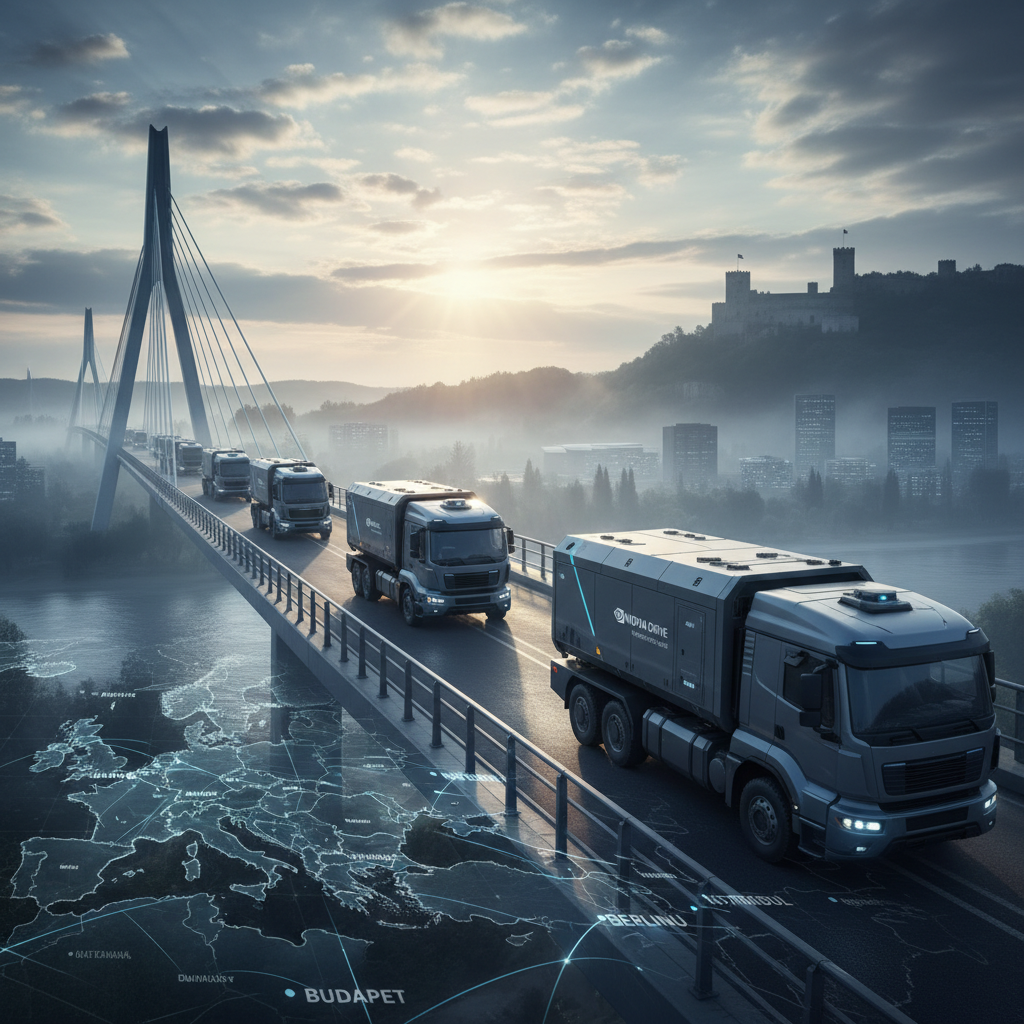
But let's bring it closer to home. Slovakia, with its strategic location and strong automotive industry, is perfectly positioned to become a vital hub in this autonomous logistics revolution. Our highways, connecting East and West, North and South, are the arteries of Europe. Imagine fleets of self-driving trucks, perhaps even powered by NVIDIA's cutting edge AI platforms, moving seamlessly across these routes, optimizing delivery times and reducing costs. This isn't just a dream, it's becoming our reality. NVIDIA, a name synonymous with AI innovation, is investing heavily in this space, providing the computational horsepower needed for these complex systems. Their Drive platform is designed to enable everything from advanced driver assistance systems to fully autonomous driving, and its application in trucking is a game changer.
"The sheer scale of data processing required for safe and efficient autonomous trucking is immense," explained Jensen Huang, CEO of NVIDIA, in a recent industry address. "Our platforms are not just about processing power, they are about creating a complete ecosystem that allows AI to perceive, predict, and plan in real time, making autonomous vehicles a reality for the logistics sector." This commitment from a global leader like NVIDIA underscores the seriousness of this technological wave.
The implications for our region are profound. Central Europe's quiet revolution in manufacturing and technology is about to get a lot louder. We have the engineering talent, the infrastructure, and the geographical advantage. The European Union, through initiatives like the Connecting Europe Facility, is already investing in smart infrastructure, which will be crucial for the widespread adoption of autonomous vehicles. The regulatory framework, while still evolving, is also being shaped to accommodate this future. The EU AI Act, for example, sets a global standard for AI regulation, ensuring that these powerful systems are developed and deployed responsibly. This is something we in Europe pride ourselves on, balancing innovation with safety and ethical considerations.
One of the most exciting aspects for me is how this technology addresses the pressing issue of driver shortages. Here in Slovakia, like in many parts of Europe, finding skilled truck drivers is a constant challenge. Autonomous trucks don't get tired, they don't need breaks, and they can operate around the clock, significantly increasing the capacity and efficiency of our transport networks. This doesn't mean the end of human jobs, but rather a shift. We will need skilled technicians to maintain these advanced vehicles, AI specialists to refine their algorithms, and logistics planners to optimize their routes. It's an evolution of the workforce, not an elimination.
Consider the impact on last-mile delivery too. While the image of a massive self-driving truck on the highway is compelling, the rise of autonomous delivery robots and drones for urban environments is equally transformative. Companies like Starship Technologies have already deployed their delivery robots in various cities globally, navigating sidewalks and delivering groceries or packages directly to customers' doors. While perhaps less visible on our streets here yet, the technology is proven and its expansion into our cities is inevitable. Imagine a world where your groceries arrive via a friendly robot, reducing traffic congestion and emissions in our beautiful historic city centers.
Of course, there are challenges. Cybersecurity is paramount. These vehicles will be connected, generating vast amounts of data, and protecting them from cyber threats is non-negotiable. Public acceptance is another hurdle; people need to trust these machines. Rigorous testing, transparent communication, and a robust regulatory framework will be key to building that trust. And let's not forget the weather! Our Central European winters can be quite demanding, and autonomous systems need to prove their reliability in all conditions, from heavy snow to thick fog. But I am an optimist, and I believe our brilliant engineers and scientists are up to the task.
I recently spoke with Dr. Elena Kováčová, a leading researcher in robotics at the Slovak University of Technology in Bratislava. She shared her perspective, saying, "The integration of AI into our physical infrastructure is not just about automation, it's about creating intelligent systems that can adapt and learn. Slovakia's hidden tech talent is already contributing to global advancements in perception systems and decision-making algorithms for autonomous vehicles. We are not just consumers of this technology, we are innovators." Her words fill me with such pride and excitement for what's to come.
This isn't just a story about technology, it's a story about progress, about making our supply chains more resilient, our roads safer, and our economies more dynamic. The journey of a package from a factory to your doorstep is about to become a marvel of artificial intelligence. And for us here in Slovakia, it means a thrilling new chapter in our industrial story. Bratislava is having its moment, and the future of logistics is driving right through it, full speed ahead. For more insights into the broader impact of AI on global logistics, you can explore articles on Reuters Technology. The world is watching, and I for one, cannot wait to see what innovations roll out next from our region. The road ahead is autonomous, and it's looking incredibly bright. The advancements in AI are truly making a difference, and you can always find more details on these developments at The Verge. We are living through an incredible time of transformation, and the logistics sector is just one exciting example of how AI is reshaping our world. For a deeper dive into the technical aspects and research, MIT Technology Review often publishes fascinating analyses on the topic.