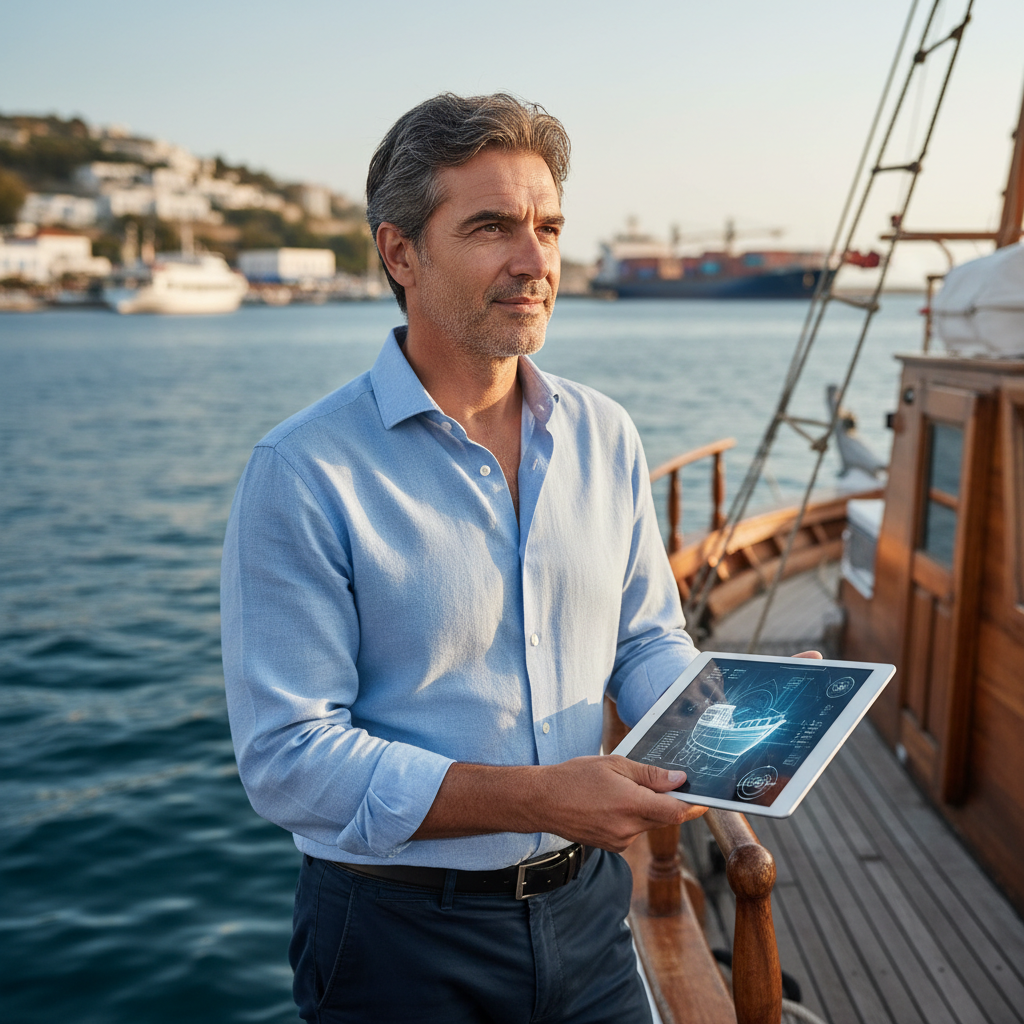
The salt spray on your face, the endless horizon, the rhythmic creak of a ship at sea, these are the ancient rhythms that have shaped my homeland, Greece, for millennia. We have always looked to the sea, not just for sustenance, but for connection, for commerce, for destiny. So, when I hear about a young Greek entrepreneur, Nikos Vasileiou, who is taking the age-old wisdom of the mariner and fusing it with the cutting edge of artificial intelligence, my ears perk up. His company, Nautica AI, a standout from the Y Combinator W2025 batch, is not just building software, it is reimagining the very arteries of global trade.
I met Nikos virtually, of course, a man whose calm demeanor belies the immense ambition of his project. He spoke with the quiet confidence of someone who understands both the profound complexity of the ocean and the intricate dance of algorithms. His defining moment, he explained, came not in a bustling tech hub, but on a small fishing boat off the coast of Crete, watching his grandfather navigate by instinct and generations of accumulated knowledge. "My grandfather could feel the weather changing before any instrument could register it," Nikos recounted. "He knew the currents, the fish, the mood of the sea. I realized then that while technology brings precision, it often lacks that holistic, intuitive understanding. AI, I believe, can bridge that gap, learning from the masters and then scaling that wisdom globally."
Nikos's origin story is, in many ways, a classic Greek tale of intellect meeting opportunity. Growing up in a coastal town near Patras, his childhood was a blend of ancient history lessons and tinkering with early computers. He excelled in mathematics and physics, a natural fit for the logical rigor required in both engineering and sailing. He left Greece, as many bright minds do, to pursue higher education abroad, earning his degree in computer science from a prestigious university in the UK. His early career saw him working on optimization problems for logistics companies in Northern Europe, where he first encountered the inefficiencies and vast potential of the global supply chain, particularly its maritime backbone.
It was during a sabbatical, back in Greece, that the idea for Nautica AI truly solidified. He was consulting for a small shipping firm in Piraeus, witnessing firsthand the manual processes, the reliance on outdated systems, and the sheer volume of data that was either ignored or underutilized. He saw captains making critical decisions based on fragmented information, often leading to suboptimal routes, increased fuel consumption, and higher emissions. This was not just an economic problem, it was an environmental one. The Mediterranean approach to AI, I believe, is fundamentally different, often rooted in practical needs and a deep respect for natural systems. Nikos embodied this.
He knew he needed a co-founder with complementary skills, someone who understood the deep mechanics of machine learning and could translate complex algorithms into tangible solutions. He found his partner, Dr. Elara Vance, at a European AI conference in Amsterdam. Elara, a brilliant data scientist with a background in predictive modeling for atmospheric sciences, shared his vision for applying AI to complex, dynamic environments. Their initial conversations were about weather patterns and ocean currents, but quickly evolved into a shared conviction that AI could revolutionize ship routing, predictive maintenance, and cargo optimization. "We realized," Elara told me, "that the same principles we use to predict a storm's path could be applied to predict a vessel's optimal journey, accounting for hundreds of variables in real time."
The breakthrough for Nautica AI came with their proprietary dynamic routing engine. Unlike existing systems that relied on static weather forecasts and historical data, Nautica AI integrated real time satellite imagery, oceanographic data, port congestion information, and even geopolitical factors. Their models learned from millions of past voyages, identifying patterns invisible to the human eye. The result was a system that could recommend routes that not only saved significant fuel, sometimes upwards of 10-15 percent per voyage, but also minimized exposure to adverse weather, reducing transit times and improving safety. This was not just an incremental improvement, it was a paradigm shift.
Building the company was, as always, a monumental task. They started small, working out of a co-working space in Athens, the birthplace of democracy, now it's reimagining AI governance and, in this case, maritime logistics. They focused on hiring a diverse team, blending seasoned maritime experts with young, ambitious AI engineers. Nikos emphasized a culture of continuous learning and a deep respect for the domain knowledge of their maritime colleagues. "You cannot innovate in an industry like shipping without understanding its soul," he often says. Challenges were plentiful, from securing initial pilot customers in a conservative industry to navigating complex international regulations. But their early successes, particularly a pilot project with a major Greek tanker company that demonstrated substantial cost savings, provided the momentum they needed.
Their acceptance into the Y Combinator W2025 batch was a significant turning point, providing not just capital but invaluable mentorship and exposure. The YC experience allowed them to refine their product, scale their team, and articulate their vision to a global audience. Following YC, Nautica AI quickly garnered attention from venture capitalists, closing a Series A round reportedly in the tens of millions of dollars, led by a prominent European deep tech fund and participation from several strategic maritime investors. This funding round, which occurred remarkably fast after their YC demo day, underscored the market's hunger for intelligent solutions in a sector ripe for disruption.
Today, Nautica AI is no longer a startup in a co-working space. They have offices in Athens and Rotterdam, key maritime hubs, and their platform is being adopted by a growing number of shipping companies across Europe and Asia. Their product suite has expanded to include predictive maintenance for vessel engines, optimizing schedules to minimize downtime, and even AI-powered cargo loading optimization, ensuring maximum efficiency and stability. Nikos and Elara are now focused on expanding their geographical reach and further enhancing their AI models to incorporate even more complex variables, such as real time emissions tracking and compliance with evolving environmental regulations.
What drives Nikos Vasileiou, beyond the obvious entrepreneurial ambition, is a profound sense of purpose. He sees the global shipping industry, responsible for over 80 percent of world trade, as a critical lever for economic prosperity and environmental sustainability. "We have a responsibility," he stated passionately, "to make this industry smarter, cleaner, and safer. AI is not just about efficiency, it's about stewardship of our planet and its resources." He often speaks of the ancient Greek concept of phronesis, practical wisdom, and how AI can help us achieve it on a grand scale.
The future for Nautica AI looks as vast as the ocean itself. They are exploring partnerships with port authorities for AI-driven traffic management and with insurance companies for dynamic risk assessment. The long term vision is to create an intelligent, interconnected maritime ecosystem, where every vessel, every port, and every cargo is optimized by AI, leading to unprecedented levels of efficiency and sustainability. Greece has something Silicon Valley doesn't, a millennia-long relationship with the sea, and Nikos Vasileiou is proving that this deep heritage can be a powerful catalyst for AI innovation. His journey reminds us that the most profound technological advancements often emerge from a deep understanding of our oldest challenges and a willingness to look beyond the immediate horizon, much like a seasoned captain navigating by the stars. For more insights into the evolving world of AI and its impact on various industries, you can follow the latest developments on TechCrunch's AI section or delve into deeper analysis at MIT Technology Review. The waves of change are upon us, and Nikos Vasileiou is riding them with a clear vision and a steady hand. For a broader perspective on how Europe is shaping AI policy, consider the discussions around the Brussels' AI Act [blocked], which directly impacts companies like Nautica AI operating within the EU.