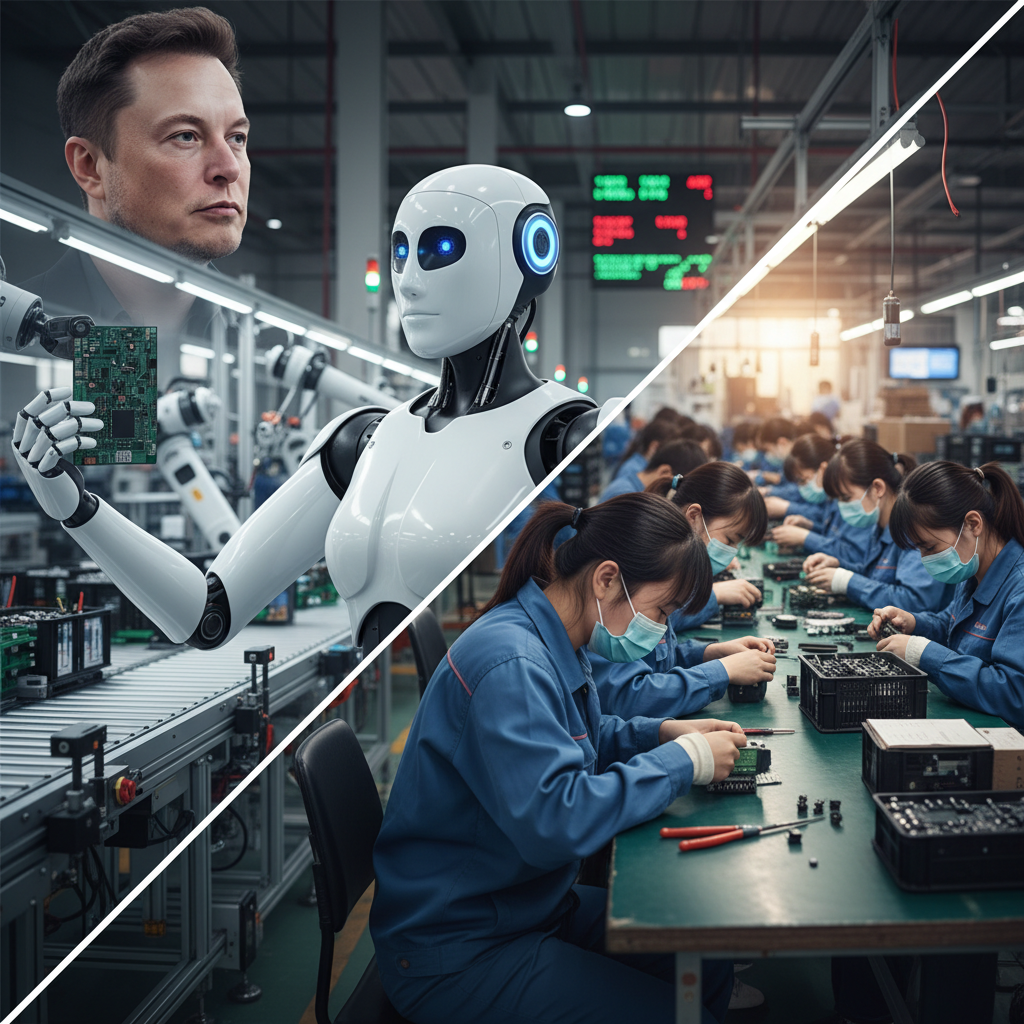

The image is compelling: sleek, bipedal robots moving with purpose, assembling cars, lifting heavy components, and performing tasks once reserved for human hands. This is the vision Elon Musk, CEO of Tesla, has painted for Optimus, his company's humanoid robot. He speaks of a future where these machines alleviate labor shortages, drive down costs, and fundamentally reshape manufacturing. But here in China, the world's industrial powerhouse, we look at such pronouncements with a healthy dose of skepticism and a keen eye for the underlying economics.
Musk has often stated that Optimus could eventually be more valuable than Tesla's car business or even its full self-driving technology. He envisions millions, perhaps tens of millions, of these robots working in factories, homes, and offices. In Tesla's own factories, Optimus prototypes are reportedly already performing rudimentary tasks, a testament to the company's commitment. However, the journey from a controlled test environment to the chaotic, high-volume demands of a Chinese manufacturing plant is a chasm that even the most advanced AI struggles to bridge.
The Real Story is in the Supply Chain
To understand Optimus's prospects in China, we must first look beyond the flashy demonstrations and into the intricate web of global supply chains and labor markets. China's manufacturing sector thrives on a delicate balance of cost efficiency, speed, and adaptability. Factories here can pivot production lines in days, not weeks, a flexibility often enabled by a vast, skilled, and relatively affordable human workforce. Introducing complex, expensive humanoid robots into this ecosystem presents significant hurdles.
Consider the cost. While Tesla has not yet announced a commercial price for Optimus, estimates from industry analysts suggest an initial unit cost potentially ranging from $20,000 to $50,000, perhaps even higher for early models. This is a substantial investment for a factory that might employ thousands of workers, each earning a fraction of that figure annually. Even with projected operational cost savings, the capital expenditure and the learning curve for integrating such advanced robotics are immense. "The initial investment in humanoid robots, even if they become more affordable, is a significant barrier for many Chinese manufacturers who operate on tight margins," explains Dr. Li Wei, a robotics expert at Shanghai Jiao Tong University. "They need proven return on investment, not just a promise of future efficiency." His assessment, shared during a recent industry forum, highlights the pragmatic approach prevalent here.
Furthermore, the sophistication required for Optimus to perform diverse, unstructured tasks on a factory floor is still years away. Current factory automation in China largely relies on specialized industrial robots, often robotic arms, designed for repetitive, precise movements. These machines excel at welding, painting, and assembly of specific components. Optimus, with its general-purpose design, aims for a broader capability, but this generality often comes at the expense of specialized speed and precision in highly optimized environments.
Beijing's Strategic Calculations and Local Contenders
Beijing isn't saying this publicly, but the government's stance on advanced robotics is a nuanced one. On one hand, there's a clear drive towards industrial upgrading and automation, articulated in initiatives like "Made in China 2025." The goal is to move away from low-end manufacturing towards high-tech, high-value production. Humanoid robots fit this vision perfectly as a symbol of technological prowess and future productivity. On the other hand, widespread robot adoption also raises questions about employment stability, a critical concern for a government that prioritizes social harmony.
Local companies are not sitting idle. Chinese robotics firms, often backed by significant state and private investment, are rapidly advancing their own humanoid robot projects. Companies like Unitree Robotics, known for its quadruped robots, and Agibot have showcased impressive prototypes. While perhaps not yet matching Tesla's brand recognition or Musk's audacious timelines, these domestic players benefit from proximity to the manufacturing heartland, understanding of local needs, and often, more direct access to the supply chains for components.
"The competition in humanoid robotics is heating up globally, and China is a key battleground," says Professor Wang Min, who leads a research group on intelligent manufacturing at Tsinghua University. "While Tesla has a strong vision, Chinese companies are iterating quickly, often with a focus on practical applications and cost-effectiveness tailored for our domestic market." This localized approach cannot be underestimated. The ability to quickly adapt, customize, and service robots within China's vast industrial landscape provides a significant advantage.
The Human Factor: Adaptability and Skill
One often overlooked aspect in the discussion of robot takeover is the unique adaptability of human labor. A factory worker in Shenzhen can be retrained to operate a new machine, learn a new assembly process, or troubleshoot an unexpected problem with remarkable speed. This human flexibility is a cornerstone of China's manufacturing agility. Can Optimus, or any humanoid robot, replicate this level of cognitive flexibility and problem-solving in dynamic, unpredictable factory environments in the near future? The answer, for now, is a resounding no.
Furthermore, the integration of robots requires a new set of human skills. Factories will need engineers, technicians, and programmers who can install, maintain, and supervise these advanced machines. This creates new job categories, but it also necessitates a massive retraining effort. The transition is not simply replacing a human with a robot, but fundamentally restructuring the entire production process and workforce.
Connecting the Dots: From Shenzhen to Silicon Valley
To truly understand the future of Optimus in Chinese manufacturing, we need to connect the dots between technological ambition, economic reality, and geopolitical currents. The US-China tech rivalry, particularly in semiconductors and advanced AI, casts a long shadow. The components that power Optimus, from its AI chips to its advanced sensors, are often subject to export controls and trade tensions. This makes a purely American-centric robot solution potentially vulnerable in the Chinese market.
Chinese manufacturers are increasingly prioritizing domestic supply chains and indigenous technology. While Tesla's Shanghai Gigafactory has been a monumental success, demonstrating a powerful collaboration, the landscape for advanced robotics, especially those with national security implications, might be different. The push for self-reliance in critical technologies means that local solutions, even if initially less advanced, might gain preference over foreign alternatives.
Ultimately, Optimus's success in China will not solely depend on its technical capabilities. It will be a complex interplay of cost, local competition, geopolitical considerations, and the robot's ability to seamlessly integrate into the unique, highly dynamic, and human-centric manufacturing ecosystem that has defined China's industrial might for decades. Musk's vision is grand, but the path through China's factory gates is paved with practicalities and fierce competition. The future of manufacturing here will likely involve more robots, yes, but perhaps not always the ones we expect, and certainly not without a significant human element guiding their every move. For more insights into global AI trends, you can explore reports from MIT Technology Review or follow the latest developments on Reuters Technology. The narrative of robots replacing humans is compelling, but the reality is always more intricate, especially in the world's factory floor.