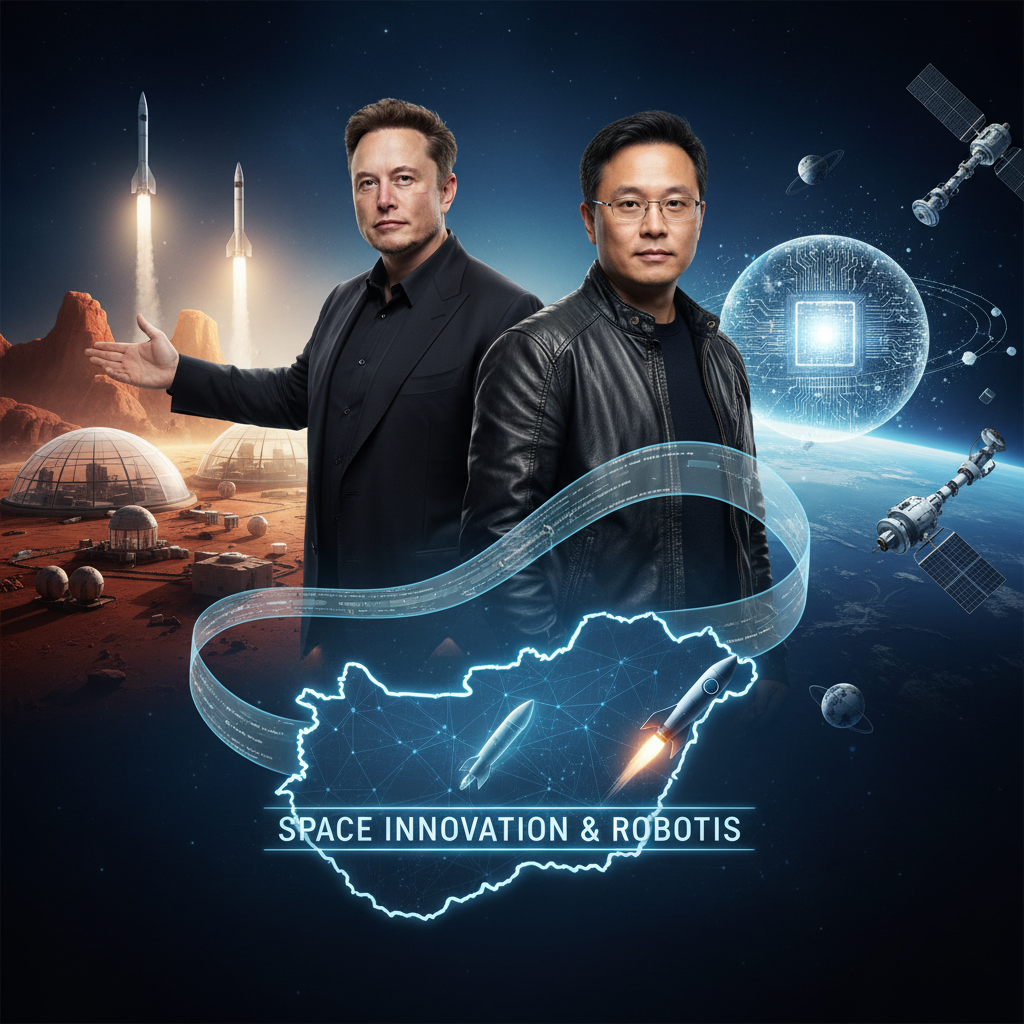

Let us be frank. When you hear about AI in space, your eyes probably glaze over. Mars missions, satellite AI, the search for extraterrestrial intelligence. It sounds like science fiction, a playground for Silicon Valley billionaires like Elon Musk and the endless coffers of NASA. You are busy worrying about inflation, your job, or whether your kids will ever afford a flat in Budapest. Why should you care about algorithms guiding rovers on another planet or sifting through cosmic static for alien whispers? Because, my friends, what happens light-years away has a way of landing right on your doorstep, often with a thud.
Most people are ignoring this for a simple reason: it feels distant, both literally and figuratively. The European Union, bless its bureaucratic heart, is consumed with regulating AI on terra firma, crafting the EU AI Act with painstaking detail. Meanwhile, the real frontier, the one where the rules are still being written in starlight and silicon, is accelerating at a pace that leaves committees in Brussels gasping for breath. We are talking about NVIDIA's specialized AI processing units powering orbital data centers, Google DeepMind's algorithms optimizing satellite constellations, and even the audacious plans of SpaceX to use AI for autonomous navigation on Mars. This is not some abstract academic exercise; it is a tangible shift in global power and technological dominance, one that Central Europe, and Hungary specifically, risks being left behind on.
How does this affect you? Directly, profoundly, and in ways you might not yet grasp. Think about your smartphone. Its GPS, weather forecasts, and even your internet connection often rely on a vast network of satellites. Now imagine those satellites, powered by advanced AI, not just relaying data but actively managing themselves, optimizing their performance, and even repairing minor faults autonomously. This means more reliable communication, more precise navigation, and potentially, a whole new layer of infrastructure that dictates everything from global trade routes to agricultural yields. For Hungary, a nation heavily reliant on logistics and agricultural exports, the efficiency gains, or losses if we are not at the table, are monumental. Your job in transportation, in farming, in telecommunications, will be touched by this. Beyond the practical, there is the existential. What if AI, sifting through petabytes of radio telescope data, finally detects a verifiable signal from another civilization? The philosophical, religious, and societal implications are staggering. Will we be ready for that conversation, or will we be too busy debating the ethical guidelines for chatbots?
The bigger picture is one of digital sovereignty and geopolitical leverage. The nation or bloc that dominates space AI will hold an unprecedented advantage. It is about more than just pretty pictures of nebulae. It is about surveillance, resource management, defense, and the control of information. Imagine a future where AI-powered satellite swarms can monitor Earth with unparalleled detail, predict environmental shifts, or even manage global supply chains with minimal human intervention. The economic implications are staggering. A report from the European Space Agency suggested that the global space economy could reach 1 trillion euros by 2040, with AI as a primary driver. Where does Hungary fit into that? Are we merely consumers of this technology, or can we carve out a niche, perhaps in specialized AI applications for small satellite constellations, an area where our engineering talent could truly shine? The Hungarian perspective nobody wants to hear is that while we are busy arguing about domestic politics, the future is being decided in the vacuum of space, and we need to stake our claim.
Experts are already sounding the alarm, or at least, trying to get people to pay attention. Dr. Eszter Kovács, a leading aerospace engineer at the Budapest University of Technology and Economics, recently stated, "Our students are brilliant, but the opportunities for cutting-edge space AI research are still largely concentrated in the US and China. We need more investment, more collaboration, and a clear national strategy to prevent a brain drain of our brightest minds to Silicon Valley or Beijing." She is right. We cannot afford to lose this generation of talent. Dr. Chen Li, a senior researcher at Google's DeepMind division, highlighted the sheer scale of the challenge and opportunity. "The data coming from telescopes and orbital sensors is immense, far too much for humans to process efficiently. AI is not just an enhancement; it is a fundamental requirement for the next generation of space discovery and operation. We are seeing AI models like Gemini and Claude being adapted for anomaly detection in satellite telemetry and for optimizing deep space communication protocols." Meanwhile, a senior official from the European Space Agency, who preferred to remain anonymous due to the sensitivity of ongoing policy discussions, confided, "The EU AI Act is a good start for terrestrial applications, but space is a different beast. The regulatory framework needs to be agile, forward-looking, and internationally coordinated. We cannot have 27 different sets of rules for something that transcends borders and planets." Finally, Professor Ákos Szabó, an astrophysicist at Eötvös Loránd University, put it simply, "The search for extraterrestrial intelligence, Seti, has been revolutionized. AI can now distinguish genuine signals from cosmic noise with an accuracy and speed that was unimaginable even a decade ago. It is no longer a question of if we find something, but when."
What can you do about it? First, demand that your elected officials, both in Budapest and Brussels, recognize the strategic importance of space AI. Push for dedicated funding for Hungarian startups and research institutions in this field. Support educational programs that encourage young Hungarians to pursue careers in AI, robotics, and aerospace engineering. We have a proud history of innovation, from the Rubik's Cube to the ballpoint pen; it is time to apply that inventive spirit to the cosmos. Second, stay informed. Do not let the complexity deter you. Follow the developments from companies like SpaceX, Blue Origin, and the European Space Agency. Understand the implications. Read articles from sources like MIT Technology Review and Wired to grasp the cutting-edge. This is not just about rockets and robots; it is about our collective future. Contrarian? Maybe. Wrong? Prove it.
The bottom line is this: in five years, the impact of AI in space will be undeniable. We will see more autonomous satellite systems, more efficient space travel, and perhaps even the first credible evidence of life beyond Earth. The nations that invested early and strategically in this domain will reap immense economic, scientific, and geopolitical rewards. Those that did not will find themselves playing catch-up, reliant on the technologies and data controlled by others. Budapest has a message for Brussels and indeed, for the world: ignoring the stars means ignoring a significant part of our future. We need to look up, not just inward, and prepare for a future where AI is not just on our phones, but orbiting our planet and exploring others. The stakes are too high for us to simply watch from the sidelines. The cosmos is calling, and AI is its new interpreter. We must be part of that conversation.